Digital vs Mechanical Coffee Scales: Which Is More Accurate?
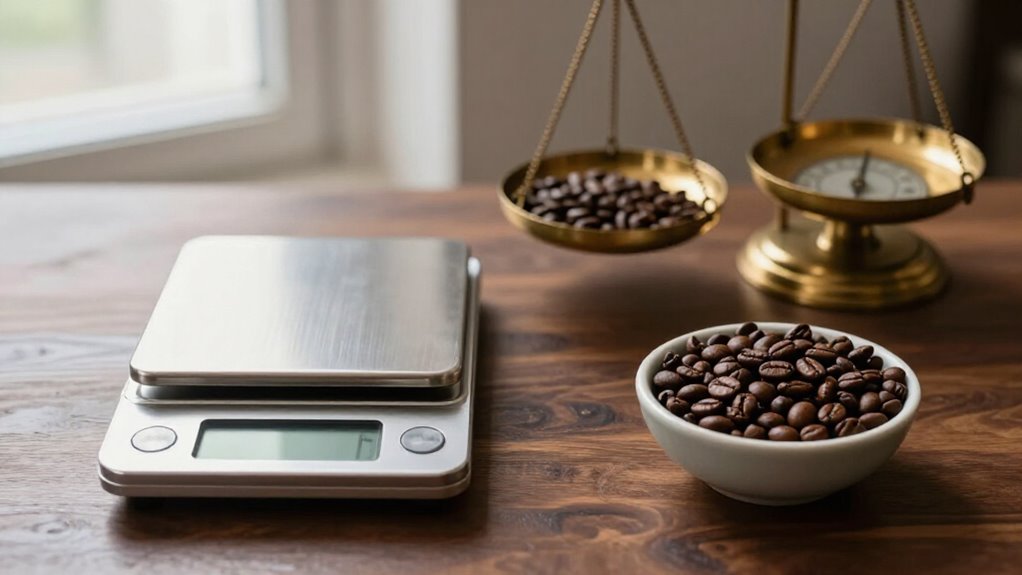
Digital coffee scales are generally more accurate and repeatable than mechanical models, especially when you’re controlling espresso dose or brew yield.
Digital load cells provide finer resolution, faster response, tare, and often an integrated timer, while spring-and-lever mechanisms can suffer from friction, hysteresis, and parallax.
However, resolution isn’t accuracy: prioritize stable zero, linearity, calibration, temperature stability, and vibration resistance.
Check capacity, spill protection, and auto-off behavior for your workflow.
Continue for guidance on verifying scales.
Accuracy, Resolution, and Display
Digital coffee scales generally deliver higher practical accuracy because load-cell sensors, electronic calibration, and numeric displays reduce measurement and parallax errors. You’ll typically see 0.1 g resolution, while specialty espresso models may show 0.01 g.
Mechanical scales commonly offer 1–5 g increments, so a 1 g error can materially alter a 20 g dose. Resolution isn’t accuracy: calibration, linearity, and stable zero determine whether displayed changes reflect actual mass. Backlit numeric displays also help you read results directly, unlike analog dials, where viewing angle can introduce parallax.
| Feature | Digital | Mechanical |
|---|---|---|
| Typical increment | 0.1 g | 1–5 g |
| Small-dose control | Fine | Coarse |
| Readout | Numeric | Analog |
| Practical effect | Consistent | Variable |
For ratio control, you’ll make finer adjustments and detect small dose changes more reliably than coarse readings.
Load Cells vs. Springs
The readout’s resolution depends on the mechanism beneath it: a digital coffee scale uses a load cell with strain gauges that convert applied force into an electrical signal, while a mechanical model uses springs and levers to move a needle across a dial. In a load-cell design, you place the brewing vessel on a platform that transfers force to the sensor. The resulting resistance change is amplified and interpreted as mass, giving you typical readability near 0.1 g.
Spring mechanisms instead translate compression through mechanical geometry. Friction, hysteresis, spring tolerances, and needle alignment can limit repeatability, so you’ll usually see coarser increments and greater variation. Heat can also disturb load-cell performance; use the scale’s heat-proof silicone pad to shield sensing components during brewing.
Battery Life and Auto-Off
Because coffee digital scales depend on batteries or rechargeable cells, you’ll need to replace or charge them periodically; mechanical scales use spring-and-lever mechanisms and operate without power. Battery life accordingly becomes an operational variable: low charge can interrupt a measurement, while mechanical models remain immediately available.
When you choose a digital model, assess its rated runtime and charging method. USB-C charging, as used by some Timemore Black Mirror models, eliminates battery swapping but doesn’t remove power-management demands.
Auto-off behavior conserves energy by shutting down after inactivity, yet it can disrupt your workflow if you pause between adding coffee and placing the cup.
- Check the stated runtime before purchase.
- Prefer adjustable auto-off intervals for longer pauses.
- Keep charging access convenient during service and travel.
Tare and Timer Controls
When you place a cup, carafe, or portafilter on the platform, the tare control resets the reading to zero so you measure only the coffee or water. You can then add ingredients without calculating the container’s mass, reducing arithmetic and cumulative operator error.
Digital models typically preserve a stable zero while displaying changes in 0.1-gram increments, which helps you monitor dosing and flow.
An integrated timer lets you track bloom and brew time without a separate device. It supports dialing-in because you can compare dose, yield, and elapsed time. Some scales provide espresso or pour-over modes, aligning timing with workflow.
Mechanical scales lack timers and may offer limited or no tare, so you’ll rely on timing. Digital controls improve consistency, provided calibration remains reliable.
Cup Clearance and Footprint
After tare and timer controls, physical form determines whether a scale works on your espresso machine. Measure the drip tray, portafilter clearance, and cup height before comparing designs. Digital coffee scales usually have slimmer bodies and smaller footprints, so you can position them on crowded platforms more easily than bulky spring models. Capacity isn’t enough: platform width and height determine whether your cup or catch tray clears the sensors and housing.
- Check tray dimensions, not just stated capacity.
- Confirm the cup clears the scale and portafilter.
- Treat silicone pads as useful protection that adds thickness.
A compact digital, such as the Hario Polaris, may fit beneath a portafilter, while a mechanical scale may not. You’ll ensure a fit by measuring the cup, scale, and machine.
Calibration Drift and Replacement Parts
Calibration drift affects both digital and mechanical coffee scales, but each type develops errors differently. Digital load cells can shift with sensor wear and temperature, while mechanical springs and levers may loosen, creep, or deform after heavy use. Check scale readings with 100 g, 50 g, 20 g, and 10 g certified calibration weights. If readings vary across points, for example, an error at 10 g but not 100 g, suspect a calibration fault rather than user technique.
You can use digital model’s calibration routine; mechanical scales require adjustment or recalibration. Persistent error warrants service, not compensation in the recipe. Ask whether replacement load cells, springs, levers, or components exist, and compare cost with replacement.
Replace the scale when parts, support, or traceability aren’t practical.
Waterproofing and Spill Damage
Because digital coffee scales rely on sensitive load cells and electronics, spilled water can alter sensor readings or cause permanent damage. You should treat models as splash-resistant at most, never soak or place them in a dishwasher.
A silicone heat-proof pad can shield the load-cell area from drips, but it doesn’t make electronics waterproof. Check the IP rating before rinsing; an IP67 model can tolerate immersion, whereas typical scales require wiping.
- Choose sealed construction if you brew frequently.
- Dry platform and seams after spills.
- Avoid wet cleanup around timer controls.
Mechanical scales avoid electronic load cells, so water poses less immediate risk; however, moisture can cause corrosion or misalignment. For accuracy, keep either design dry, inspect all seals carefully, and follow manufacturer cleaning instructions.
Capacity and Overload Risk
When you compare scales, check that the maximum weight comfortably exceeds your heaviest setup, including the vessel, portafilter, and grounds.
Digital models often offer capacities of 2,000–2,500 g and may include overload protection, while mechanical designs vary by construction. Don’t exceed the stated limit or apply sudden impact, because either can produce inaccurate readings or damage the sensing mechanism.
Maximum Weight Limits
Capacity sets the safe operating range for any coffee scale. Digital coffee models commonly support 2,000, 2,500 g, with accuracy specified in 0.1-g increments. You should include the container, grounds, and any tools when estimating total load; keep that sum comfortably below the rating.
- Digital limit: Exceeding capacity can push load cells beyond their rated range, reducing accuracy or causing permanent sensor damage.
- Mechanical limit: Spring and balance scales also have rated loads; exceeding the dial’s effective range can create unreliable readings.
- Practical margin: Staying below maximum capacity preserves sensitivity for espresso dosing and small measurement changes.
Although a scale may display a value near full capacity, that reading isn’t necessarily dependable. Match capacity to your brewing workflow rather than choosing maximum size alone. Choose limits carefully.
Overload Protection Differences
A scale’s stated maximum weight defines more than its usable range—it also indicates how much overload risk its measuring system can tolerate. Digital coffee scales commonly support up to 2,000–2,500 grams, but load cells can produce inaccurate readings or suffer damage when overloaded. Many higher-end models add overload protection, sealed construction, or heat-proof silicone pads that limit damage from spills and overfill; these features don’t make overloading safe.
Mechanical scales also have rated limits, but their springs tolerate some bumps better. However, they may not preserve precision after overload, and recovery can require recalibration. You’ll reduce risk by staying below the maximum, distributing weight centrally, and confirming fit on your machine or drip tray. That margin prevents errors during rapid pouring or espresso dosing.
Espresso vs. Pour-Over
For espresso, you’ll benefit from a digital scale with 0.1 g resolution, fast response, and a compact design for weighing doses and shot output. For pour-over, you’ll need stable real-time weight readings and an integrated timer to control brew ratio and extraction time.
A digital scale generally suits both methods best, while a mechanical model may suffice when you don’t need subgram precision or timing features.
Espresso Scale Precision
When you’re dialing in espresso, a scale with 0.1 g resolution lets you control dose and output closely enough to detect meaningful extraction changes. In espresso, those small shifts can alter brew ratio and flavor, making 0.1 g a practical performance threshold, not a luxury.
Digital load-cell scales generally outperform mechanical spring models because they deliver faster, clearer readings and better repeatability during rapid shot measurement. Resolution alone doesn’t prove accuracy: you should also consider linearity, calibration, stable zero, and resistance to vibration. A compact espresso model should remain stable beneath the portafilter and respond quickly as liquid accumulates.
- Dose control: Measure coffee in tenths of a gram before brewing.
- Output control: Stop the shot at a repeatable beverage mass.
- Model selection: Prioritize updates, stable readings, and calibration support.
Pour-Over Weighing Needs
Because pour-over recipes use larger water volumes and doses than espresso, a scale with 0.1 g resolution is typically sufficient for tracking coffee-to-water ratios such as 1:15. For pour-over, you’ll weigh both the coffee dose and accumulated brew water, so digital 0.1 g increments let you monitor the target ratio throughout a V60 workflow. A mechanical scale may handle the total mass, but its coarser graduations make small additions harder to identify and can reduce repeatability.
Digital tare functions also limit cumulative error when you add water in stages.
Espresso requires tighter control because you weigh a small dose and beverage output, often a double shot. For either method, a timer helps you correlate weight with extraction time; mechanical designs generally require separate timing.
Best Scale For Each
Once you’ve matched resolution to your brewing method, the best scale depends on workflow, clearance, and timing needs. For espresso, choose the tested Acaia Lunar: its 0.1 g increments and integrated timer support repeatable dosing and yield measurements. If counter space is tight, the under-$100 Hario Polaris offers a slim under-machine fit.
For pour-over, the tested Acaia Pearl best matches a Hario V60 workflow, where brew-time and ratio control matter.
- Best value: The $65 OXO Brew/Precision Scale with Timer gives you practical timing and sufficient precision for either style.
- Versatile alternative: The $200 Fellow Tally Pro combines Weight, Timer, and Brew Assist modes for espresso or pour-over ratios.
- Choose based on fit, timing, and calibration support, not resolution alone; verify capacity and water resistance.
Prioritize NIST-Traceable Calibration
Prioritize coffee scales with NIST-traceable calibration, which links their measurements to documented reference standards and a defined uncertainty chain. When you compare models, look for calibration certificates, stated uncertainty—not merely “accurate” marketing. Traceability doesn’t guarantee perfect performance, but it gives you a reference for evaluating error and drift.
Verify performance across the operating range with laboratory-grade weights, such as 100 g, 50 g, 20 g, and 10 g. Multiple points reveal linearity errors that a single check can miss. This matters when you rely on 0.1 g readings: identical displayed resolution doesn’t mean identical true accuracy.
Whether you’re comparing budget digital, premium digital, or mechanical scales, documented traceability plus multi-point testing provides the most objective basis for choosing the more accurate instrument.
Conclusion
Ultimately, you’ll get more consistent coffee by matching the scale to your workflow, not by assuming digital or mechanical is inherently superior. Digital models generally provide finer resolution, tare, timers, and easier repeatability, while mechanical scales avoid batteries but can limit precision.
Evaluate load-cell stability, capacity, clearance, spill resistance, and auto-off behavior. For critical measurements, verify performance against NIST-traceable calibration weights. Choose the scale that preserves accuracy under your actual brewing conditions and daily habits.