
Espresso Accessories Workflow Order
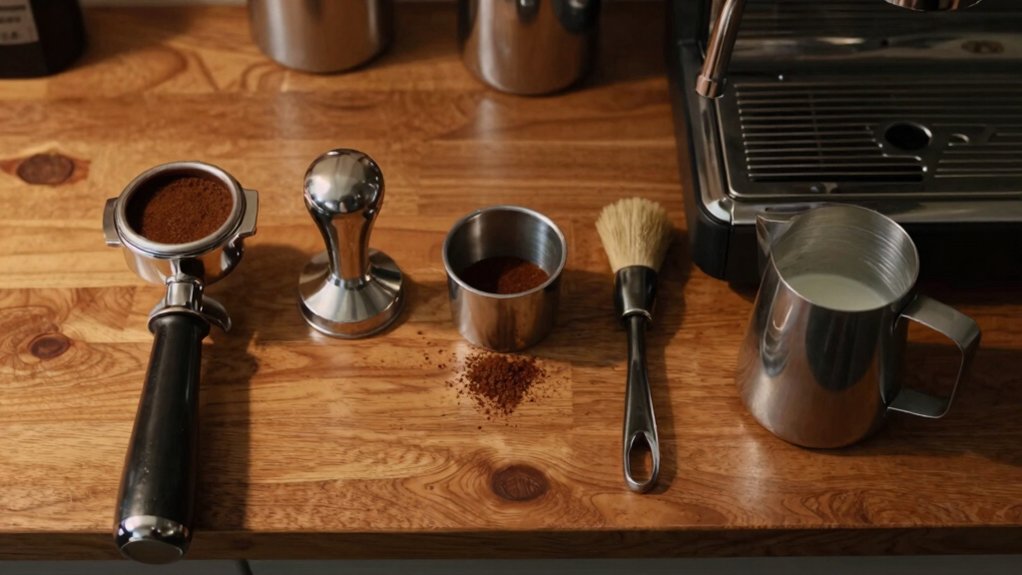
Order your espresso accessories to control tamp pressure, basket volume, grind tolerance, and environmental tweaks. Start with a tamper sized to your basket and target ~20–30 lbs as a baseline. Then match dose to basket capacity, leaving headspace for bloom.
Set grinder tolerances tight; verify particle distribution and CV across doses. Monitor humidity for small incremental grind shifts. This sequence keeps extraction consistent and lets you fine-tune based on puck resistance and shot timing for better results.
Quick Overview
- Start by matching portafilter basket capacity to your target dose, leaving headspace for bloom and puck expansion.
- Establish a baseline tamp pressure around 20–30 lbs; then adjust for grind, dose, and machine brew pressure.
- Set and document grind-size tolerance ranges. Adjust incrementally while monitoring shot time and puck resistance.
- Validate consistency across doses with particle-size checks, dosing CV, and visual bottomless shot/puck inspections.
- Monitor environment (humidity/temperature) and tweak grind settings every 25–50 µm to maintain extraction stability.
Tamper Pressure & Diameter
Why does tamping force and diameter matter? You’ll control extraction by setting tamper pressure around 20–30 lbs, targeting consistency over exact numbers. Adjust based on grind, dose, and machine pressure. Finer grinds need less force; coarser ones require more.
Diameter variation changes PSI at the puck: smaller baskets concentrate force, while larger ones dilute it. Verify fit and compensate for diameter variation when dialing in.
| Parameter | Typical Value | Impact |
|---|---|---|
| Tamper pressure | 20–30 lbs | Repeatability, extraction control |
| Standard diameter | 58 mm | Industry baseline, even PSI |
| Diameter variation | 49–58 mm | Alters PSI; affects channeling risk |
Establish a baseline (≈30 lbs); then tweak upward or downward per extraction results.
Portafilter Basket Capacities
Tamping pressure and tamper diameter set the puck’s initial density, but the basket’s capacity determines how that mass interacts with water and pressure. You must match dose to basket volume to avoid under- or over-extraction. You’ll check portafilter compatibility first; basket dimensions and rim fit change usable volume and flow resistance. Evaluate capacity against your target dose, noting headspace for bloom and puck expansion.
- Small single baskets: low volume, high resistance, sensitive to tamp variation.
- Double/triple baskets: larger volume, stable yield, require higher dose control.
- Precision baskets: uniform holes, predictable extraction, aid reproducibility.
- Ridgeless vs ridged: affects distribution, tamp alignment, and seating.
Use a scale and visual checks to validate basket capacity choices.
Grind Size Tolerance
You need to control grind size tolerance to achieve an optimal particle distribution that promotes even extraction. Specify tolerance range specs and confirm consistency across doses. Small shifts change flow rate and flavour balance.
You’ll also evaluate environmental effects (humidity, burr wear) and adjust settings to maintain repeatable results.
Optimal Particle Distribution
Particle-size uniformity determines how consistently water extracts soluble compounds. So aim for a tight grind tolerance that minimizes fines and boulders. You’ll target an optimal particle distribution that balances surface area and permeability: too many fines speed extraction and amplify bitterness; too many large particles under-extract and taste sour.
Use a quality burr grinder and validate distribution uniformity with simple sieving or macro visual checks (bottomless shots, tamped puck inspection). Adjust settings incrementally and evaluate shot yield, time, and taste. Small changes can shift the distribution curve. Favor reproducible settings over chasing theoretical perfection.
When distribution skews, address dosing technique, grinder maintenance, and grind setting rather than compensating with extreme tamping or machine modifications.
Tolerance Range Specs
Fine control over grind-size tolerance defines how consistently your grinder produces the target distribution and directly affects extraction predictability. You should evaluate tolerance spec sheets for allowable particle-size deviation (D90–D10 ranges) and how they translate to real-world grind uniformity.
Tight tolerances reduce shot-to-shot variance; letting you rely on tampers and dosing routines rather than frequent adjustments. Also consider mechanical sources of drift: burr wear, motor torque, and feed consistency all widen tolerances over time.
Assess tamper stability requirements relative to the grinder’s output. If your grinder exhibits broader tolerance, you’ll need stricter tamping control to avoid channeling. Choose grinders with documented tolerance metrics and serviceability so you can maintain narrow distributions and predictable extractions without constant recalibration.
Consistency Across Doses
How consistently does your grinder reproduce the target distribution from shot to shot? You should assess grind size tolerance using objective consistency metrics: particle-size histograms, span, and percent fines. Compare repeated samples at a fixed setting.
Evaluate dose uniformity by weighing multiple doses; check standard deviation and coefficient of variation. Variation beyond 0.5–1.0% indicates dosing or retention issues. Inspect for drift over sequential shots to reveal heat or burr wear effects.
Use quick tests: tamp identical doses into precision baskets and photograph puck surfaces or measure extraction time variance. Prioritize grinders and dosing systems that minimize distribution shifts and dose-to-dose variability. Tighter tolerance reduces routine adjustments and speeds reliable workflow.
Impact On Extraction
Why does grind size tolerance matter for extraction consistency? You rely on tight tolerances to control flow rate, soluble yield, and shot balance. Small particle-size shifts change contact time and require recalibration of dose or tamp.
Evaluate your grinder’s repeatability under the workflow demands: A burr grinder with precise stepped or stepless settings reduces variables, while poor tolerance forces compensatory changes in espresso technique that mask equipment limitations.
Consider ergonomics too; settings that require awkward adjustments impede rapid dialing and increase human error. Measure with brew scale and timed shots, inspect puck behavior with a bottomless portafilter, and judge performance across consecutive doses.
Prioritize grinders and workflow placement that deliver consistent particle distribution and intuitive controls to protect extraction fidelity.
Adjusting For Environment
Changes in humidity and temperature force you to rethink grind size tolerances because they alter bean hardness, hygroscopic behavior, and extraction kinetics. You’ll monitor environmental humidity and ambient temperature; then adjust grind settings incrementally to maintain target flow and yield.
Evaluate puck resistance, shot time, and sensory cues after each 25–50 µm change. Small adjustments yield measurable extraction shifts. Use a calibrated burr grinder and a brew scale to isolate variables, and document conditions for reproducibility.
In higher humidity, tighten tolerances toward coarser settings to prevent over-extraction. In drier conditions, finer tolerances compensate for reduced water uptake. Treat tolerance bands as operational ranges, not absolutes. Prioritize repeatable metrics (dose, yield, time) over subjective impressions.
Frequently Asked Questions
Where Should I Place a Knockbox for Best Workflow Efficiency?
Place the knockbox immediately adjacent to your portafilter station for optimal knockbox placement and workflow efficiency. You’ll minimize movement between grinder, precision baskets, and tamping mat cleaning. Keep it near the milk thermometer and steam wand to support steaming consistency without crossing paths. This placement preserves grinder longevity by reducing accidental hits.
Choose material choices that resist impact, ensure portafilter compatibility, and confirm essential features like a silicone ring and stable base.
Do I Need a Milk Thermometer for Consistent Steaming?
Do I need a milk thermometer? Yes, a milk thermometer ensures consistent steaming and repeatable temperatures. You’ll confirm target ranges (around 55–65°C/130–149°F); prevent scalding; and protect texture for microfoam.
If you’re experienced and use tactile cues, you might skip it. However, for dialing-in recipes and training, it’s invaluable. Choose a stainless-steel probe with fast response and clear markings to integrate into your routine efficiently.
Which Grinder Features Matter Most for Longevity?
You want grinder longevity: prioritize burr material durability, robust motor cooling, and solid build quality. Ceramic or hardened steel burrs resist wear; steel handles impact better for consistent particle size over time.
Look for sealed bearings, serviceable parts, and easy burr replacement to extend life. Consistent grind settings, a sturdy grind chamber, and good heat dissipation prevent wear and flavor degradation.
Regular cleaning and calibrated dosing preserve long-term performance.
Are Precision Baskets Compatible Across Different Portafilters?
Yes, precision baskets compatible across different portafilters depend on portafilter compatibility. You’ll evaluate diameter, depth, and rim design: IMS and VST follow tight tolerances; however, OEM portafilters vary. Measure inner basket diameter and seat type, then match specifications. Adapters or aftermarket portafilters can improve fit.
If dimensions don’t align, extraction suffers from channeling or leakage. Therefore, verify measurements before buying to ensure consistent performance.
What Tamping Mat Material Is Easiest to Clean?
Silicone mats are easiest to clean: you’ll wipe, rinse, or toss them in the dishwasher with minimal residue. They resist staining, won’t absorb hard water effects, and maintain thermal stability so extraction temperature near the group stays constant.
Compared with rubber or neoprene, silicone yields quicker sanitization and less odor retention. You’ll favor silicone for durability, nonporous surface, and consistent tactile feedback during tamping operations.
Conclusion
You’ve controlled key variables: tamper pressure and diameter, basket capacity, grind tolerance and particle distribution—to keep doses consistent and extraction predictable. Monitor specs and environmental shifts; then tweak grind, dose, or tamp to stay within tolerance ranges.
Evaluate flow rate and puck integrity after each change. Prioritize consistent dosing over one-off corrections. With disciplined measurement and small, systematic adjustments, you’ll maintain repeatable shots and spot deviations before they harm cup quality.