Storing Roasted Coffee Beans After Roasting
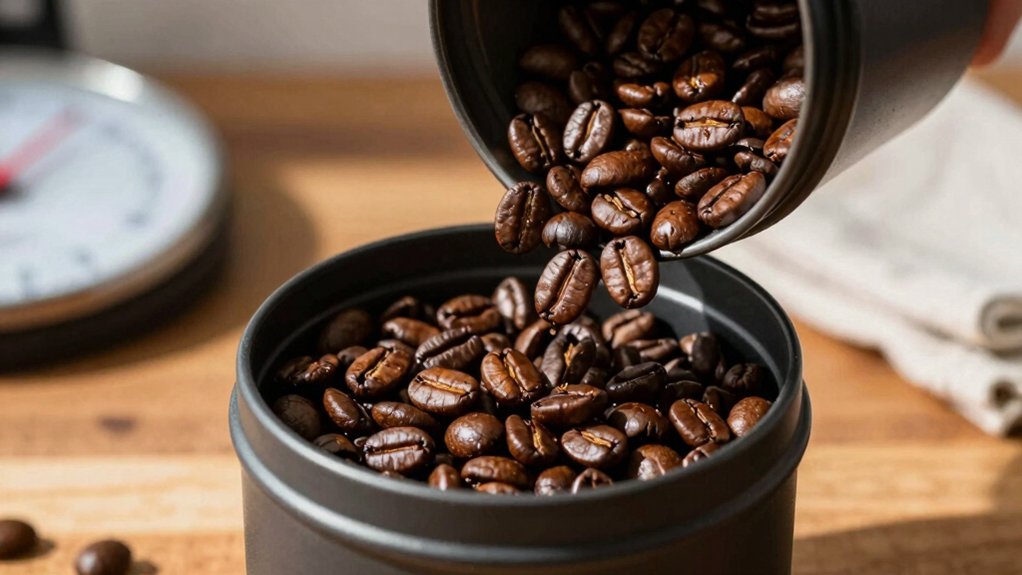
You should let freshly roasted beans degas before sealing.
Light roasts need about 7–14 days; medium 5–10; dark 2–7, with most profiles venting actively in 12–72 hours.
Use a one‑way valve placed near the bean mass centerline to avoid bloating and ensure steady CO2 release.
Then transfer to airtight, appropriately sized containers with minimal headspace to limit oxygen.
Track valve start time and pressure.
Follow best practices below to preserve aroma.
Quick Overview
- Let beans rest in a vented bag for the initial degassing window: light 7–14 days, medium 5–10, dark 2–7 days.
- Use a good one-way valve to vent CO2 within hours after roast to prevent bag swelling and uneven pressure.
- After active degassing subsides, transfer beans to airtight, opaque containers with minimal headspace for storage.
- Match container size to batch usage: split large roasts into daily-use jars to reduce oxygen exposure each opening.
- Record roast date, valve start time, and ambient conditions to refine future degassing and storage timing.
Roast-Level vs. Degassing Times
How long should you wait before brewing? You assess roast level to set timing: light roasts need 7–14 days, medium 5–10, dark 2–7. This reflects differing degassing rate and effects on flavor. Use an airtight container after the initial window. Monitor gas levels to decide transfer timing.
When the valve starts releasing visible gas, note optimal degassing window. Consider valve placement to avoid backflow. A one way degassing valve helps maintain headspace without oxygen ingress. However, check long term valve performance and capacity limits of your storage.
Track when the valve starts and record degassing rate; this practical monitoring guides brew readiness and minimizes overexposure to oxygen.
| Roast | Days | Rate |
|---|---|---|
| Light | 7–14 | Slow |
| Dark | 2–7 | Fast |
Airtight Container Capacity Limits
Why does container size matter? You’ll control oxidation and headspace by matching airtight capacity to the batch size. Too much empty volume raises oxygen proportion; too-tight packing risks crushing beans and trapping moisture.
Calculate container sizing to leave minimal headspace after degassing settles. Use smaller airtight capacity vessels for daily-use quantities (1–2 weeks). For larger batches, split into multiple sealed containers to reduce repeated air exposure.
Avoid overfilling glass or plastic: allow bean movement without compaction to prevent abrasion. Label containers with roast date and remaining volume to guide usage and rotation.
Select containers based on batch consumption rate, thermal stability, and ability to maintain seal integrity. Precise sizing prolongs peak flavor.
One-Way Degassing Valve Timing
When you fit a one-way degassing valve, note that it should start venting within the first few hours after roast to prevent bag bloating. Aim to capture the optimal degassing window: typically 12–72 hours for most profiles.
While considering valve placement and sealing quality, these factors alter flow rates and internal pressure. Monitor CO2 release with quick pressure checks or a simple squeeze test. Choose valves rated for long-term performance to avoid clogging or backflow.
When Valve Starts
Curious about the exact moment to seal a bag with a one-way degassing valve? You’ll time closure based on roasting duration and measured gas diffusion rates rather than guesswork. Shorter roasts emit CO2 rapidly but taper sooner; longer roasts release lower peak volumes over extended periods.
Monitor headspace pressure or use empirical degassing curves from your roast profiles to determine when valve outflow drops to near-ambient pressure differentials. Seal when valve throughput falls below the valve’s minimum backpressure threshold; this ensures CO2 can still escape without allowing oxygen ingress.
After sealing, place the bag in stable, cool storage to limit oxidation. Avoid sealing immediately post-roast; let predictable gas diffusion reduce internal pressure to the valve’s operating range.
Optimal Degassing Window
How long should you wait to seal a bag with a one-way valve? You should wait until active CO2 release subsides enough that valve throughput prevents backpressure but still allows venting; typically 12 to 48 hours. Assess degassing feasibility by monitoring visible gas flow and avoiding tight seals during the initial 12 to 24-hour peak.
For practical workflows, cool beans to ambient temperature. Place them in valve-equipped bags with a loose closure for the first half-day. Then fully seal once outgassing rate declines. This balances container oxygen exclusion with continued CO2 release, optimizing aroma retention while reducing oxidation risk.
If you must seal earlier for logistics, use a larger-capacity valve or schedule a short controlled venting period to prevent bloating.
Valve Placement Effects
Having sealed bags once outgassing slows, you should still consider where to place the one-way valve on the package: valve position affects gas flow paths, internal pressure gradients, and the risk of localized backpressure that can push air in through imperfect seals. Place the valve near the bean mass centerline rather than at an edge or seam to promote uniform CO2 evacuation and reduce pressure differentials that drive ingress.
Match valve placement to degassing timing: earlier valves should sit higher to clear rapidly evolving CO2; for later sealing, a central low-profile valve minimizes trapped pockets. Test placement with small batches, inspect seams under slight vacuum, and prioritize a position that directs flow away from closure lines to limit oxygen exposure and maintain roast integrity.
Monitoring Gas Levels
When should you switch a bag’s one-way valve from open-air degassing to sealed storage? You monitor CO2 release by checking bag pressure and listening for hissing during handling.
Use monitoring gas techniques: feel for slight inflation and measure flow with a simple hand-held flowmeter or a pressure gauge if available. Degassing timing typically peaks 12 to 72 hours post-roast; most beans stabilize between 24 and 48 hours.
Switch to sealed storage once pressure decline is steady and valve output drops below a minimal, consistent rate. This avoids trapping excessive CO2 that can deform packaging or insufficient venting that allows oxygen ingress.
Record times and ambient conditions to refine degassing timing for specific origins and roast levels. Then transfer to airtight, opaque containers.
Long-Term Valve Performance
Why does valve timing matter for long-term storage? You must match one-way valve performance to roast level and expected degassing times to prevent package rupture or oxygen ingress. Darker roasts degas faster and with higher CO2 flux; lighter roasts release gas more slowly.
Select valves rated for peak flow corresponding to measured degassing times (initial 12–72 hours for most profiles) and ensure sustained low-permeation characteristics thereafter. For multi-week or frozen storage, verify valve longevity under temperature cycles and humidity exposure. Degraded seals increase oxygen diffusion.
In practice, test a sample batch: monitor pressure, replace bags if valves show reduced throughput or leakage, and store in airtight, opaque containers once degassing subsides to preserve aroma and limit oxidation.
Frequently Asked Questions
Can I Freeze Beans Immediately After Roasting?
You shouldn’t freeze beans immediately after roasting. Freezing after roast is acceptable only if you can’t consume them within a week. However, immediate freezing ethics require degassing first. Beans need 12–24 hours to release CO2 and 5–7 days to rest for optimal flavor.
Cool fully, allow initial degassing, then package in airtight vacuum or freezer bags and freeze. Avoid repeated freeze-thaw cycles. Always thaw once before storing at room temperature.
How Long Can I Keep Brewed Coffee at Room Temperature?
You should keep brewed coffee at room temperature no longer than 2–4 hours. After brewing, freshness decay accelerates as volatile aromatics dissipate and aroma leakage increases. This degradation affects flavor and perceived strength.
Store brewed coffee in an insulated carafe to slow cooling and oxidation if you’ll drink within a few hours. For longer storage, refrigerate promptly in an airtight container and consume within 24–48 hours to avoid further quality loss.
Do Flavored or Infused Beans Need Different Storage?
Yes, flavored or infused beans need slightly different care. You’ll prioritize shorter storage duration because added oils and flavor compounds reduce flavor stability. Keep them cool, dry, airtight, and dark. Use within a week or two for best taste.
Don’t freeze flavored beans repeatedly; condensation harms infused oils. Grind only before brewing, reseal bags promptly, and rotate stock so flavored batches are consumed first to preserve their intended profile.
Will Whole Beans Absorb Odors From Nearby Foods?
Yes, whole beans will absorb nearby odors if exposed. To protect roasted bean odor and ensure freshness preservation, keep beans in airtight, opaque containers away from aromatic foods, moisture, and heat.
Let freshly roasted beans degas for 12 to 24 hours with lids loose; then seal. Avoid storing in cabinets with strong-smelling items. Use dedicated storage or vacuum or zipper bags for longer holds.
Freeze only when necessary and avoid thaw-refreeze cycles.
Can I Store Beans in a Clear Glass Jar Long-Term?
No, you shouldn’t use a clear glass jar for long-term storage. You’ll need airtight storing containers with good glass jar quality only for short-term use. Clear glass exposes beans to light, accelerating flavor loss.
Use opaque, airtight containers designed to let CO2 escape during initial degassing. Alternatively, keep high-quality glass jars opaque or stored in a dark cabinet. For long-term storage, prefer vacuum or freezer-grade bags and avoid repeated thaw cycles.
Conclusion
You’ve learned that roast level dictates degassing speed, so plan storage and valve timing accordingly. Use an airtight container sized to limit headspace gas buildup and install a reliable one-way degassing valve so pressure is released without oxygen ingress.
Start monitoring as soon as the roast cools: lighter roasts peak sooner; darker roasts later. Position the valve at the container’s highest point and routinely check valve integrity. Faulty valves undermine long-term aroma and freshness control.