Ideal Water Temperature for Pour Over Coffee
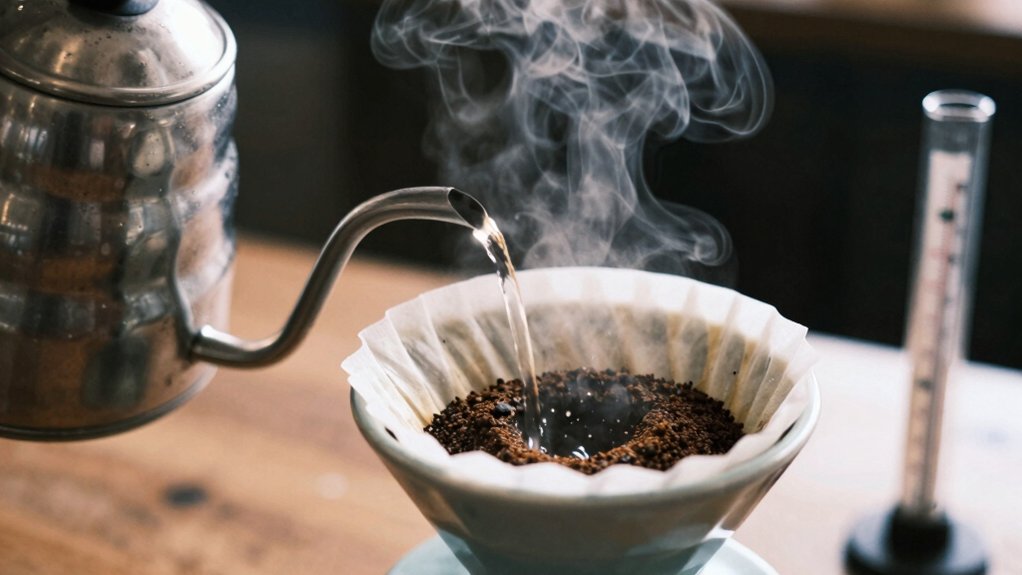
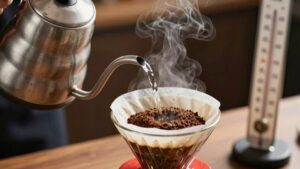
You should brew pour-over coffee with water between about 90–96°C (195–205°F) to get balanced extraction: brighter, acidic notes toward the higher end and smoother, chocolatey flavors nearer the lower end.
Preheat your kettle and dripper.
Use a thermometer while you dial in grind and brew time, and keep pours steady to avoid large temperature drops.
Aim for consistency each brew; if you keep going, you’ll find practical tweaks for kettles, pours, and retention that improve repeatability.
Quick Overview
- Aim for 91–96°C (195–205°F) for pour-over to extract balanced flavors without excessive bitterness or sourness.
- Light roasts benefit from the higher end (94–96°C) to emphasize brightness and aromatic complexity. Medium roasts typically pull best around 91–94°C for a balanced, chocolatey profile.
- Dark roasts prefer slightly lower temps (88–92°C) to reduce bitterness and emphasize smoothness. Preheat equipment, use a thermometer or carafe, and adjust grind or time if brew tastes sour or bitter.
Brew Temperature Comparison Chart
How should you choose the right brew temperature for your method and roast? You’ll match temperature to roast and method: Light roasts need hotter water (94–96°C) to unlock flavor aroma, while dark roasts use cooler ranges (88–92°C) to curb bitterness.
Adjust with grind size: Finer grinds extract faster; therefore, lower temperature or shorter brew time helps. Use the table below to compare broad categories quickly.
| Method Group | Temp °C | Key note |
|---|---|---|
| Light roast / Pour-over | 94–96 | bright, aromatic |
| Medium roast / Chemex | 91–94 | balanced, chocolatey |
| Dark roast / French press | 88–92 | smooth, reduced bitterness |
Fine-tune with consistent pours, bloom, and 3–4 minute total brew time.
Water Temperature Tolerance Table
A simple tolerance table helps you see how small temperature changes affect extraction so you can pick practical targets for your brew. You’ll map target ranges, acceptable drift, sensory risks, and corrective actions. Keep entries tight: target (°C/°F), tolerance ±, likely flavor outcome, and quick fix. Track water temp drift between kettle and pour; log ambient conditions. Use thermometer use initially to validate your routine. Then rely on calibrated timing once you understand your setup.
- 93–96°C (199–205°F): ±1°C — full extraction; risk bitter if high — reduce pour temp.
- 90–92°C (194–198°F): ±1°C — balanced, bright; slightly increase temp.
- 86–89°C (187–192°F): ±1°C — under-extracted, sour; increase temp and grind finer.
- : ±2°C — weak, flat; reheat and retest with thermometer.
Kettle Heat Retention Tips
Choose an insulated kettle and preheat it so your boil stays close to the target 195–205°F while you prepare the grounds.
Practice boil management: stop at a full rolling boil; let it rest 30–60 seconds if needed; and use a thermal carafe or covered kettle to retain heat during pour.
Small habits like keeping the lid on between pours and using a gooseneck that seals well will minimize temperature loss and improve extraction consistency.
Insulated Kettle Choice
Why pick an insulated kettle for pour-over when heat retention directly affects extraction? You want consistent water temperature from boil to pour. Insulated kettles minimize drop, so your water stays within the 92–96°C window longer. Choose double-walled stainless models with tight lids and narrow spouts to reduce convective and evaporative losses while preserving pour control.
Consider capacity versus thermal mass: larger volumes hold heat but take longer to recover if you reheat. Look for kettles with durable insulation rated for minimal temperature decline over 5–10 minutes. Also, ensure they fit for a gooseneck attachment if precise flow matters.
You’ll balance insulation, weight, and pourability so the kettle supports repeatable extraction rather than forcing temperature compensations during brewing.
Preheat Your Kettle
Want your water to stay in the 92–96°C window from boil to pour? Preheat kettle before you heat the final batch: rinse it with hot tap water, pour boiling water in, swish 10–20 seconds, then discard. That small step reduces thermal loss when you add boiled water. This improvement enhances temperature stability and shortens cooldown time.
If your kettle is insulated, warm both body and lid. If it’s thin metal, a quick metal-to-metal preheat helps. Use the same routine every brew to make temperature behavior predictable. Combine preheat kettle steps with minimal time between boil and pour to preserve target range. These simple, repeatable actions give you tighter control over extraction without complex gear.
Boil Management Techniques
How can you keep your kettle near the 92–96°C sweet spot from boil to pour? Focus on boil management: bring water to a full boil, then remove heat and let it rest 30–60 seconds to reach target. Use a lid and insulated or stainless steel kettle to slow cooling; that temperature buffering reduces heat loss between boil and pour.
Preheat the kettle and server to minimize initial drop when you transfer water. If you use an electric kettle with temperature settings, program a slightly higher setpoint to compensate for transfer losses. Monitor with a quick-read thermometer until you learn timing by feel.
These steps let you consistently hit the 92–96°C window without complex equipment. This improves extraction control and repeatability.
Retain Heat During Pour
Curious about keeping your kettle in the 92–96°C sweet spot while you pour? Focus on retention strategies that minimize temperature drop between boil and contact with grounds. Start by heating only the water you need: lower volume cools less during transfer. Use a kettle with good thermal insulation or add a lightweight cozy to the base and spout to slow conductive and convective loss.
Pour from a short distance and in controlled streams; long, thin streams expose water to air and cool faster. Preheat your pour vessel briefly to avoid stealing heat on first contact. Monitor temperature initially with a thermometer to calibrate timing for your setup. Then rely on consistent routine rather than repeated checks.
Use Thermal Carafe
Keeping a kettle hot while you pour is helpful. However, using a thermal carafe takes heat retention further by holding heated water at a stable temperature until you’re ready to brew. You’ll preserve target range heat (195–205°F / 90–96°C) by transferring just-boiled water into a well-insulated thermal carafe. This avoids repeated reboiling and temperature swings that alter extraction.
Choose a double-walled stainless steel carafe with a tight lid; its low conductivity and minimal headspace slow conductive and convective losses. Measure initial temperature, then wait only as long as the carafe maintains the desired drop, which is typically a few degrees over 5–10 minutes.
For precision, decant measured volumes into your gooseneck kettle from the carafe to pour. This maintains consistent heat retention and extraction.
Frequently Asked Questions
How Does Altitude Affect My Optimal Pour-Over Temperature?
Yes, altitude impact matters: As elevation rises, boiling point falls. You’ll need slightly higher brewing temperature to compensate for reduced extraction. Aim to increase your brewing temperature by a few degrees when water boils below ~100°C, monitoring taste for balance.
Use a thermometer to adjust brewing temperature precisely. Taste-test: Raise temp if sour or under-extracted; lower it if bitter or over-extracted to dial in optimal extraction.
Can Water Mineral Content Change Flavor Extraction?
Yes, water’s mineral balance directly alters flavor extraction. You’ll find calcium and magnesium promote extraction of acids and aromatics; this improves clarity and body. However, excessive bicarbonates can mute acidity and create flatness. Soft or distilled water under-extracts, yielding weak, dull coffee.
Adjusting mineral content or using specialty bottled blends helps you dial extraction toward brightness or roundness. So, test and tweak levels for the profile you want.
Should I Adjust Temperature for Espresso-Roast Beans?
Yes, you should lower the temperature for espresso-roast beans to avoid over-extraction and bitterness. Espresso roast vs extraction favors cooler water because darker beans extract faster; drop a few degrees and taste.
Also, consider mineral adjustments: softer, balanced water tames harshness while moderate minerals preserve sweetness and crema. Use a thermometer, adjust in 1–2°C steps, and calibrate with your grind and yield until extraction tastes clean and complete.
Does Water Temperature Impact Crema or Body?
Yes, water temperature affects crema formation and body perception. You’ll get richer crema with hotter extraction; higher temperature releases more oils and CO2. However, too-hot water can push bitter solubles that mask nuance. Cooler water yields thinner crema and lighter body, emphasizing acidity and clarity.
Adjust temperature by roast: use slightly cooler water for darker roasts to preserve pleasant body and prevent harsh, overly dense crema.
Can Pre-Infusing With Cooler Water Improve Delicate Flavors?
Yes, you can improve delicate flavors by using a slightly lower preinfusion temperature. It helps flavor preservation by gently releasing aromatic compounds without extracting harsh bitter notes.
Start bloom with water a few degrees cooler than your main pour, and hold for 25–45 seconds. Then raise the temperature for the rest of the brew. You’ll extract more nuanced acidity and aroma while avoiding early over-extraction that mutes subtle cup characteristics.
Conclusion
You’ll get the best pour-over when you control temperature deliberately: aim for 195–205°F (90–96°C) but adapt for roast and grind. Use cooler temperatures for light roasts and hotter for dark.
Use an insulated kettle, preheat it and your dripper, and manage boil so you’re not losing heat during the pour. Retain temperature with short pours, a thermal carafe, or preheated server. By measuring and minimizing heat loss, you’ll extract consistently balanced, flavorful coffee.