Coffee Grind Size Guide: Match Every Grind to Your Brew Method
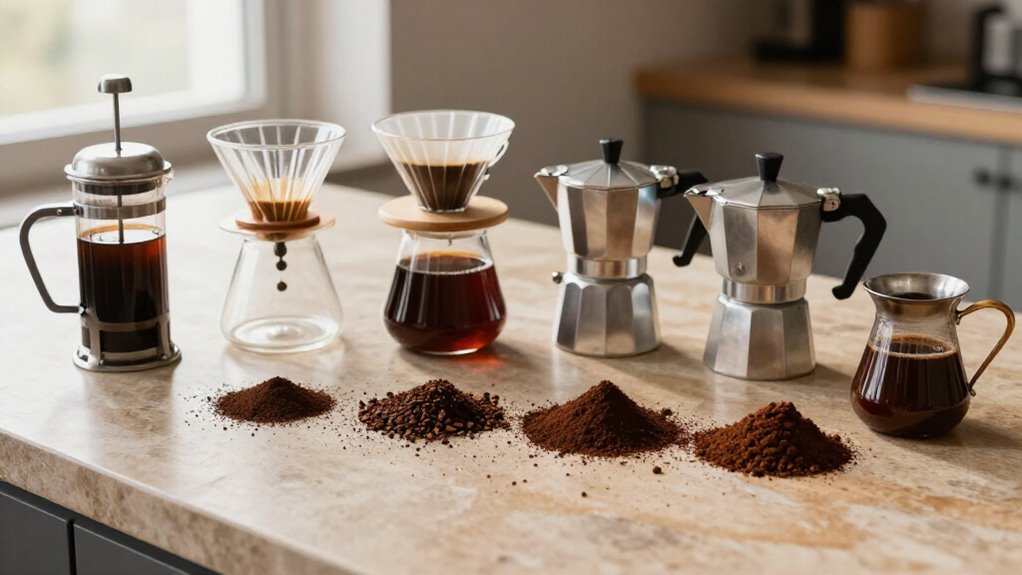
Match your grind to contact time: use powder-fine grounds for Turkish coffee, very fine for espresso, medium-fine to medium for pour-over, and coarse particles for French press or cold brew.
Think roughly 100–300 microns for Turkish, 400–800 for espresso, 400–900 for pour-over, and 900–1,500 for cold brew.
Treat microns as guidance, not rules. Taste and timing decide: go finer for sour, fast brews and coarser for bitter, slow ones.
More guidance follows on coffee extraction.
Begin With Micron Range
Because grind settings vary by grinder, use microns as a rough starting map rather than a strict target: Turkish extra-fine is about 100–300 μm, espresso roughly 400–800 μm, and cold brew around 1,000–1,500 μm.
Microns help you compare methods, but they’re not universal dial marks. Grinder design, burr alignment, and particle distribution change the result. Treat each range as a launch point, then judge the brew.
Match grind fineness to contact time: shorter brewing needs finer particles, while longer steeping needs coarser particles to limit bitterness. Use texture as a check, from powdered sugar toward coarse salt. If your cup tastes sour or finishes too quickly, go finer. If tastes bitter, dry, or extracts slowly, go coarser.
Burr grinders make results easier to repeat.
Espresso-to-Cold-Brew Grind Matrix
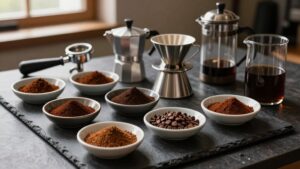
With microns as a rough reference, not a universal grinder setting, this matrix maps the spectrum from powdery espresso-fine grounds to cracked-peppercorn-sized cold-brew grounds. Use this continuum to match grind size with contact time: espresso brews quickly under pressure, so you need a very fine, powdered-sugar-like grind around 200–400 µm. Moka pot sits between espresso and drip; choose fine-medium grounds and don’t compact them.
| Brew method | Grind | Approx. size |
|---|---|---|
| Espresso | Extra-fine | 200–400 µm |
| Cold brew | Extra-coarse | 900–1400 µm |
For pour-over, start medium-fine to medium, roughly 400–900 µm, then adjust one notch at a time. French press and cold brew need coarser particles because immersion lasts longer. If espresso tastes sour, grind finer; bitterness calls for a coarser setting instead. Keep coarse grounds consistent to reduce muddiness.
TDS and EY Explained
TDS and EY give you two different ways to understand a brew: TDS measures how concentrated the coffee is, while EY measures how much of the bean’s soluble material made it into the water. TDS reports dissolved coffee solids as a percentage; higher readings indicate a stronger cup, but don’t guarantee better flavor. EY shows the percentage of solubles extracted from grounds.
You can have high TDS with low EY by using more coffee relative to water, or low TDS with high EY in a dilute, extracted brew.
When dialing in grind size, read numbers alongside brew time and taste. A finer grind increases surface area and may raise EY, pushing bitterness. A coarser grind can lower EY, producing sour, under-extracted flavors. Change one grind step at a time.
Water Temperature by Method
You’ll typically brew espresso at 90–96°C (194–205°F) and pour-over at 92–96°C (198–205°F).
Use about 90–94°C (194–201°F) for drip coffee and 93–96°C (200–205°F) for French press.
For cold brew, choose room-temperature or cool water around 10–22°C (50–72°F), since the long steep extracts coffee gradually.
Espresso Temperature Range
Although grind size controls how quickly espresso extracts, water temperature strongly shapes its balance. At about 90–96°C (194–205°F), you can develop sweetness without flattening acidity or pushing bitterness. For espresso, pair this range with a very fine grind and aim for 25–35 seconds of pressure-driven extraction at roughly 9 bars.
If your shot tastes sharp and thin, raise temperature slightly or tighten the grind, changing only one variable at a time. If it tastes harsh, dry, or bitter, lower the temperature slightly or open the grind. Darker roasts often respond better to the cooler end, while lighter roasts may benefit from more heat.
Let your machine stabilize before brewing, and record temperature, grind, dose, and shot time so you can repeat the result.
Pour-Over Water Temperature
For pour-over coffee, aim for 92–96°C (198–205°F): hotter water extracts flavors more readily, while cooler water can leave the cup under-extracted. For a V60, taste your cup before changing your grind. If it tastes sour, sharp, or hollow, raise the temperature by 1–2°C to add extraction energy. If it tastes bitter, dry, or astringent, lower the temperature by 1–2°C instead.
Keep the temperature steady by preheating your dripper and carafe; otherwise, heat loss can slow flavor extraction and make results inconsistent. Pair this range with a medium-fine grind and target a 2:30–3:30 total brew time for most cone and flat-bottom recipes. Change one variable at a time, and record your temperature, grind, brew time, and tasting notes so you can repeat your best cup.
Drip Coffee Temperature
Most automatic drip brewers perform best in this range during typical 4:30–6:30 brew times. For flat-bottom baskets, use about 94–96°C for fuller extraction through steady flow.
Cone filters, including V60 or Chemex-style designs, often respond better to slightly lower temperatures around 92–94°C, which helps prevent over-extraction. If your coffee tastes sharp or hollow, raise the temperature a few degrees within the recommended range before making a major grind change. If it tastes dry, bitter, or harsh, lower the temperature slightly, such as from 96°C to 93–94°C, and check that the brew isn’t running too long. Change one variable at a time.
French Press Temperature
Use water just off the boil—about 90–96°C (195–205°F)—for French press coffee. Your typical 3–4 minute steep needs enough heat to extract balanced flavor. If the cup tastes sour or thin, raise the temperature slightly, while staying below boiling. This adjustment speeds extraction without changing your recipe.
If your coffee tastes bitter, dry, or harsh, lower the water temperature a few degrees; aim closer to 90–93°C (195–200°F). Keep the temperature consistent from brew to brew because fixed contact time makes heat a major control. Use a thermometer, or wait briefly after boiling for repeatable results.
Once you press, decant immediately, ideally within 10–20 seconds. Coffee left in the press keeps extracting, so prompt pouring protects sweetness and prevents bitterness in your finished cup.
Cold Brew Water Temperature
Because cold brew steeps for 12–18 hours or longer, brew it with cool or room-temperature water—about 10–21°C (50–70°F)—to keep extraction smooth and limit harshness.
Use a coarse, often extra-coarse grind, because the long steep extracts slowly without heat. Keep the water temperature steady throughout the 12–18-hour brew so you can adjust flavor mainly through grind and steep time. Warmer water above 21°C (70°F) speeds extraction and can create a heavier, more bitter cup, even when you keep everything else unchanged.
After steeping, strain the coffee promptly. Don’t reheat the concentrate, since additional extraction can dull brightness and increase astringency. If your brew tastes harsh, shorten the steep or coarsen the grind before changing temperature. For repeatable results, measure the water and record your recipe.
Adjust After First Brew
After your first brew, taste the coffee before changing your recipe: sour, sharp, or hollow flavors suggest under-extraction, so go 1–2 micro-steps finer, while bitter, dry, or astringent flavors call for a coarser grind. Make one change at a time, then brew again with the same dose, water, and technique.
For espresso, use shot time: under 20 seconds or a fast, weak stream calls for 1–2 clicks finer; over 35 seconds calls for one click coarser. With a V60, a drawdown under 2:00 suggests finer, while over 4:00 suggests coarser. For drip, target 4:30–6:30.
If French press tastes muddy or silty, grind coarser and decant immediately after pressing. Record each setting and tasting note so you can repeat your best result next time, too.
Avoid Grinder Static Buildup
Static can pull fines onto the hopper, chute, and grounds bin, changing your effective dose and leaving your grinder inconsistent.
Keep static low by avoiding overly dry air, and grind soon after opening the bag, before beans gain extra charge. For very dry beans, apply only a light coat of water or the tiniest smear of food-safe oil to the burrs or hopper, following your grinder’s instructions.
Tap the dosing chute or grounds bin between grinds to release clinging fines. Wipe plastic surfaces with a slightly damp microfiber cloth, then dry them; residual oils and dry plastic encourage attraction. If static persists, try an ionizing accessory or grounded baffle. These steps help each dose reach your basket consistently, reducing waste and improving repeatability.
Turkish Coffee: Powder-Fine
For Turkish coffee, grind the beans to an extra-fine powder that feels like talc, with no noticeable grit. This powder-fine texture gives water enormous surface area, helping you extract a balanced cup during the brief, one- to two-minute brew.
Use a burr grinder if possible, and grind fresh; you’ll get clean flavor. Treat fineness as your dialing-in tool because Turkish brewing leaves little extraction time.
If your cup tastes sour or hollow, move one setting finer and brew again. If it tastes bitter or dry, step slightly coarser to slow extraction. Change only the grind first, so you can isolate its effect. Avoid sandy texture: visible grit can extract unevenly and make the flavor sharp. Your goal is a dense powder that settles naturally in the cup.
Preventing Clumped Espresso Grounds
Clumped espresso grounds usually signal a grind that’s too fine, static, or moisture from older coffee. If the puck resembles damp sand and flow stalls, move your grinder one click coarser. Aim for roughly 25–35 seconds, then change only one setting at a time.
Keep your routine tidy:
- Grind fresh, immediately before brewing, and use fresh beans.
- Tap the portafilter gently or use WDT to loosen clumps.
- Level the bed carefully before tamping; don’t over-agitate it.
- If flow stays slow beyond 35 seconds, go one click coarser.
If your shot runs under 25 seconds despite clumps, reassess your dose and grind rather than tamping harder. Static can increase retention and dosing errors, so tap the grinder or use its anti-static setting for better repeatability.
Particle Distribution by Sieve
A sieve distribution shows how many coffee particles fall within each mesh-size range, from fine dust to coarse boulders. That spread shapes extraction: fines dissolve quickly, while larger chunks extract slowly. A narrow distribution from a burr grinder gives balanced flavor; blade grinders create extremes. If you taste bitterness and sour sharpness together, fines may over-extract while boulders under-extract.
- Espresso: Look for mostly fine particles.
- Pour-over: Aim for a consistent medium range.
- French press: Keep particles coarse.
- Cold brew: Use extra-coarse grounds for long steeping.
Roast and humidity shift your distribution; light roasts and humid beans typically produce finer particles. Compare grounds with table-salt or sea-salt references, or spread them on white paper. If the pattern changes, adjust your grinder before changing your recipe.
Conclusion
Use your grind size as a starting point, not a rule. Match it to your brew method, then refine it after tasting the result.
If your coffee tastes sour, grind finer or raise the water temperature; if it tastes bitter, grind coarser or lower the temperature. Keep your grinder clean, manage static and clumps, and note each adjustment.
With consistent particles, balanced water, and careful dialing in, you’ll brew sweeter, clearer cups every time.