
How Is Decaf Coffee Made? The Process Explained Simply
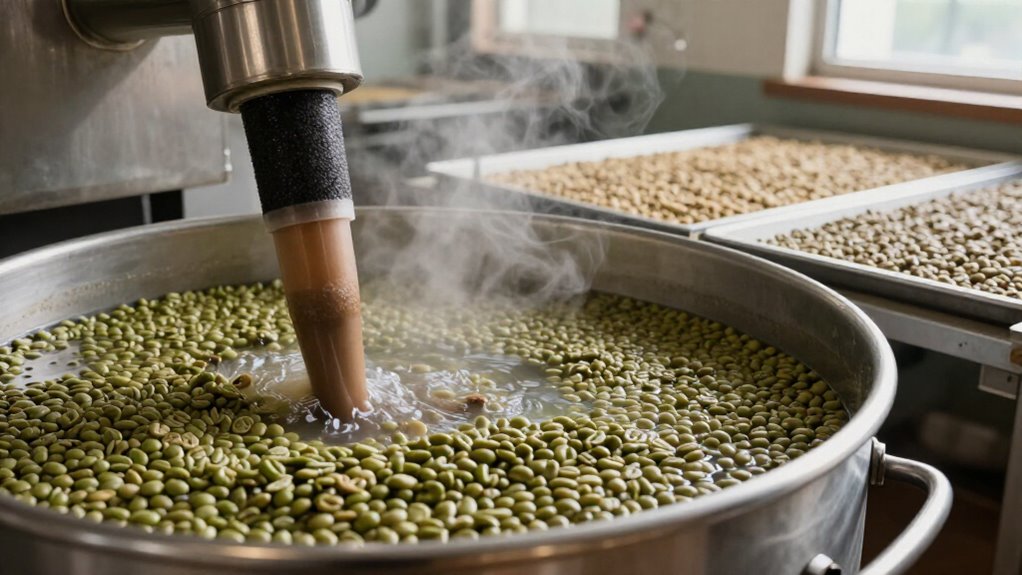
To make decaf, processors first hydrate green, unroasted coffee beans with water or steam, swelling their pores. They then remove caffeine using water filtration, solvents such as ethyl acetate, or supercritical carbon dioxide under high pressure. Swiss Water processing uses activated charcoal to trap caffeine while preserving flavor compounds.
After extraction, processors dry and roast the beans normally. Decaf isn’t caffeine-free: an eight-ounce cup typically contains 2–15 milligrams. Below, you’ll learn how each method works.
Decaffeination Happens Before Roasting
Before roasting, coffee beans undergo decaffeination while they’re still green and unroasted. After harvest, processors hydrate the beans through soaking or steaming, allowing caffeine to dissolve and move out of their structure. They then apply a selected extraction method, such as water filtration or supercritical carbon dioxide, while the beans remain green.
Working at this stage helps protect flavor precursors, the compounds that later develop during roasting, rather than exposing finished roasted coffee to additional treatment.
You can think of green-bean decaffeination as preparation for roasting, not a separate treatment of brewed coffee. Once processors complete extraction, they dry the beans and send them through the normal roasting process. Because you’re ultimately roasting these prepared beans, your cup can retain much of the coffee’s character.
Decaf Still Contains Caffeine
Despite its name, decaf coffee isn’t caffeine-free: decaffeination removes most, but not all, of the caffeine from green beans.
You can still consume about 2-15 milligrams in an eight-ounce cup, compared with roughly 70-140 milligrams in regular coffee. The exact amount depends on the bean, serving size, brew strength, and process. Caffeine dissolves into an extracting medium, but equilibrium, limited contact, and binding within the bean matrix prevent complete removal. In water-based processing, reconditioning may also reintroduce trace caffeine.
Manufacturers commonly report about 97% removal, although some products claim 99.9% on a dry basis. As a result, if you’re highly sensitive, pregnant, or limiting stimulants, check serving amounts and product labels carefully. Choosing smaller servings can help you reduce your total daily caffeine intake more effectively.
Carbon Dioxide Under Pressure
When producers use the carbon dioxide method, they place green coffee beans in a high-pressure chamber and pump in liquid CO₂ at roughly 300 atmospheres and 65°C. Under this extreme pressure, CO₂ penetrates the beans and dissolves caffeine selectively. You can think of the fluid as a targeted carrier: many flavor compounds remain largely insoluble, so aroma precursors stay in the bean.
After the extraction period, producers release pressure. CO₂ expands and leaves the chamber, carrying dissolved caffeine with it. Your beans then contain far less caffeine, although no process removes every trace. Producers send treated green beans to roasting.
Careful control of pressure and temperature determines extraction performance. That selectivity matters. You retain much of the bean’s potential flavor and aroma while caffeine declines.
Solvent Versus Water Processes
You’ll see solvent-based decaffeination use methylene chloride or ethyl acetate, either directly on green beans or through treated soaking water. In the Swiss Water Process, activated charcoal removes caffeine from green coffee extract while retaining many flavor compounds.
Comparing these methods helps you evaluate differences in flavor preservation, solvent exposure, processing controls, and cost.
Solvent-Based Decaffeination
Solvent-based decaffeination treats green, unroasted coffee beans with methylene chloride or ethyl acetate, chemicals that dissolve caffeine while retaining many flavor compounds. You’ll encounter two routes:
| Route | Key steps |
|---|---|
| Direct | Steam beans, rinse them with solvent 8–12 times, then steam again to remove residues. |
| Indirect | Soak beans in hot water, treat the caffeine-bearing extract with solvent, and return caffeine-free water for flavor reabsorption. |
| Performance | The process typically removes about 96–97% of caffeine, not every milligram. |
Manufacturers control solvent exposure and verify residue limits before roasting. You may still find roughly 8.6–13.9 milligrams of caffeine in a 16-ounce cup, depending on the product. Solvent processing often costs less, but chemical handling and removal steps shape consumer preferences. You can choose it for lower cost.
Water-Based Decaffeination
Water-based decaffeination starts with green coffee beans and uses water to draw out caffeine before roasting. In the Swiss Water Process, you soak the beans, creating a liquid containing caffeine and soluble flavor compounds. You pass this extract through activated-charcoal filters. The charcoal traps caffeine while allowing the flavor compounds to remain in the filtered liquid, called green coffee extract (GCE).
You then reuse that decaffeinated GCE for another batch. Fresh beans release caffeine into the GCE, and filtration removes it again, repeating the cycle. Unlike direct solvent processing, which uses methylene chloride or ethyl acetate to bind caffeine, this approach removes caffeine from water. Water-based systems can also use water to extract caffeine before a separate removal step. Decaf retains small caffeine amounts.
Comparing Flavor And Safety
When you compare decaffeination methods, solvent and water processes differ mainly in how they balance flavor retention, processing residues, and cost. Solvent methods use methylene chloride or ethyl acetate to remove caffeine efficiently, often achieving at least 97% reduction. Direct processing repeatedly rinses steamed beans, while indirect processing treats the separated soaking water and returns flavor-rich water to the beans.
Proper steaming and washing keep solvent residues within regulatory limits, but some consumers still prefer to avoid them.
The Swiss Water Process uses activated charcoal to trap caffeine from an extract without organic solvents. It generally preserves flavor precursors well, although both methods can slightly reduce aroma. Water processing usually costs more.
Neither option produces caffeine-free coffee: a 16-ounce decaf may contain 8.6–13.9 milligrams. If you’re highly sensitive, check labels and serving sizes.
Ethyl Acetate From Sugarcane
You’ll find that sugarcane-derived ethyl acetate removes caffeine from warmed green coffee beans. The solvent pulls out caffeine while leaving most flavor compounds intact, helping preserve the bean’s character.
Producers repeat spraying, rinsing, and evaporation until they remove about 97% of the caffeine, leaving only minute EA residue considered safe.
Sugarcane-Based Ethyl Acetate
Sugarcane-based ethyl acetate (EA) is an organic compound used to extract caffeine from green coffee beans. Manufacturers derive this “natural” EA from sugarcane, distinguishing its source from alternatives.
To produce EA-processed decaf, you’ll see green beans warmed before processors spray them with the compound. The caffeine bonds with EA, and workers rinse the beans while the EA evaporates, carrying away much caffeine. They repeat this treatment, rinse, and evaporation cycle until the beans reach decaffeinated levels.
The coffee still contains a small amount of caffeine because decaffeination isn’t complete. According to the description, only a minute amount of EA remains after processing, and that residue is reported as completely safe. If you’re comparing labels, “sugarcane EA” identifies the solvent’s origin, not sweetener or added sugar.
How The Solvent Works
The sugarcane source identifies where the ethyl acetate (EA) comes from; it doesn’t mean the coffee contains added sugar. To decaffeinate coffee, you warm green, unroasted beans, then spray or rinse them with EA. The solvent selectively binds to caffeine, creating a caffeine, EA mixture that you remove during rinsing.
You repeat the soaking and rinsing stages several times because decaf must meet caffeine standards, often reaching at least 97% caffeine reduction. Afterward, you let EA evaporate, carrying caffeine away. Steaming helps drive off liquid, and roasting completes the bean’s transformation for brewing.
This solvent action targets caffeine rather than requiring prolonged exposure of the beans to a solvent bath. As a result, the process can retain more flavor compounds than extensive direct solvent contact.
Flavor And Safety Considerations
Although ethyl acetate is derived from sugarcane, it doesn’t add sugar to the coffee or remain as a significant ingredient in the finished cup.
During processing, producers warm green beans, spray them with EA to bind caffeine, then rinse and rest them while the volatile compound evaporates. Repeating these steps reduces caffeine by typically 97% or more, although you may still find a small amount remaining.
Roasting further drives off EA, and producers generally consider the minute residue safe when it meets regulatory limits. However, you can notice flavor differences because processing may affect some taste compounds and aroma precursors.
Choose EA-processed coffee if you want a sugarcane-derived method, but compare origins and roast levels to find the profile you prefer most at home.
Swiss Water Process
How does the Swiss Water Process remove caffeine without organic solvents?
You begin with green beans, soaking them in hot water. This dissolves caffeine and water-soluble flavor compounds, producing an extract. You then send the liquid through activated charcoal. Charcoal adsorbs caffeine while allowing molecules to remain, creating green coffee extract (GCE).
Next, you soak a batch of green beans in GCE. Because the extract contains flavor compounds, the beans can reabsorb flavor precursors while caffeine continues moving out. You’ll circulate the liquid through charcoal, maintaining selective caffeine removal and helping preserve the beans’ sensory character.
The process originated in Switzerland in 1933, became commercialized by Coffex S.A. in 1980, and reached Canada in 1988. Your finished beans retain most flavor with reduced caffeine.
Solvent Residues Are Tightly Regulated
Solvent-based decaffeination uses methylene chloride or ethyl acetate to extract caffeine from green beans, followed by steaming, washing, and evaporation to remove residual solvent. These steps drive the chemicals off before roasting, while producers monitor residue levels against strict legal limits. Regulators set very low maximum concentrations because exposure to excessive solvent can harm your health.
Manufacturers must validate removal, test batches, and document compliance, so you can expect only trace amounts in properly processed coffee. Roasting provides another opportunity for volatile residues to dissipate, but it doesn’t replace controlled processing or testing. Early methods sometimes used benzene, yet producers abandoned it because evidence linked the chemical to cancer risk. Today, regulation covers solvent choice, handling, removal, and finished-bean testing. That helps protect you.
Green Beans Swell First
Before caffeine can be extracted, processors soak or steam green coffee beans to soften them and expand their pores. You can think of this as controlled pre-conditioning: water enters the bean’s structure, causing it to swell and become more permeable. That change helps caffeine dissolve and move into the water or processing liquid during the next extraction stage. It also prepares the beans for efficient transfer while keeping more flavor components closer to their original form.
- First: Green beans remain unroasted, so their cellular structure responds readily to moisture.
- Second: Swelling opens pathways that let caffeine migrate outward.
- Third: Softened beans support more consistent extraction throughout each batch.
- Finally: This preparation improves caffeine removal without needlessly disrupting flavor compounds.
This step sets the process.
Look for Swiss Water Certification
Once the beans have been hydrated and their pores opened, check the package for “Swiss Water Process” certification. This label tells you that the decaffeination uses water and activated carbon, rather than direct organic solvents on the beans. Swiss Water operators soak green coffee to create Green Coffee Extract, or GCE.
They filter that liquid through activated charcoal, which traps caffeine while preserving flavor compounds. The caffeine migrates into water along concentration gradients, so the process removes at least 97% of the original caffeine under commonly associated standards. The caffeine-free GCE gets reused for later batches, helping maintain consistent flavor.
Although the name suggests Switzerland, the facility operates in British Columbia, Canada. If you’d like to avoid solvent-based extraction, this certification offers evidence.
Conclusion
You now know how decaf coffee reaches your cup. Producers remove caffeine from green beans before roasting using water, solvents, or pressurized carbon dioxide. Each method extracts caffeine while preserving as much flavor as possible, and regulations limit solvent residues.
Decaf isn’t completely caffeine-free, so check labels if you’re especially sensitive. If you prefer a solvent-free approach, look for Swiss Water certification, which identifies beans processed without added solvents. Use that label to compare confidently.