
How to Dial in Espresso Grind Size
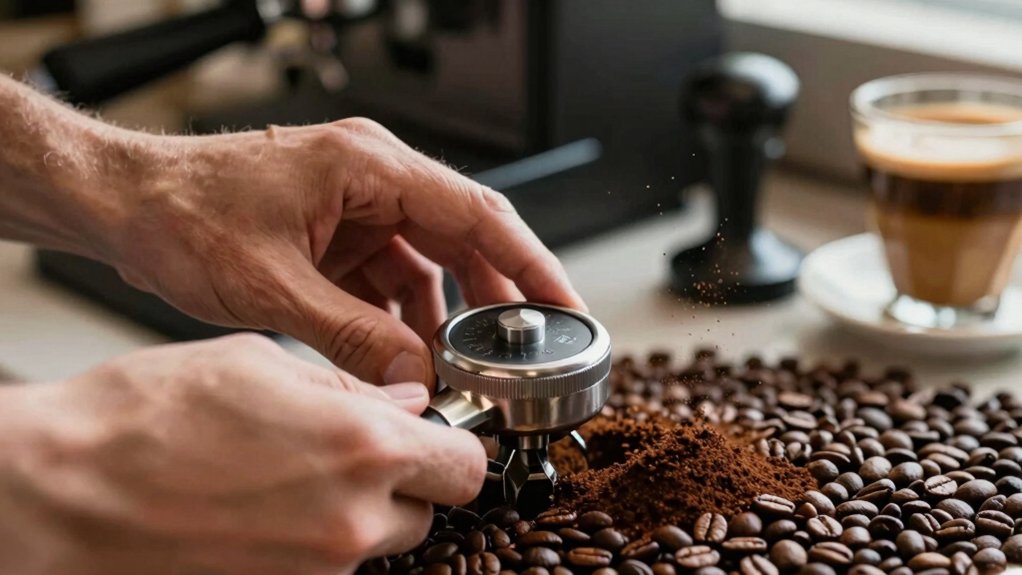
You’ll dial grind by changing only grind, keeping dose and yield fixed (start 1:2). Then make small, measured adjustments and track time, puck resistance, and yield. Finer slows flow and raises extraction; coarser speeds flow and lowers extraction.
Log burr clicks/rotations and retention after each change. Purge and weigh to detect trapped grounds. Clean and replace worn burrs when particle spread shifts or times drift. Follow the protocol below to refine extraction further.
Quick Overview
- Start with a 1:2 dose-to-yield baseline (e.g., 20 g in → 40 g out) to isolate grind as the primary variable.
- Adjust grind finer if extraction is fast (30–35 s) or tastes bitter.
- Make small, consistent adjustments (1–3 clicks or 1/8–1/4 turn) and pull a fresh shot after each change.
- Track time, yield, taste, and dose. Record burr clicks/steps and any changes in puck resistance.
- Minimize grind retention and monitor burr wear with regular cleaning and scheduled burr inspections/replacement.
Grind Size vs Yield Chart
How do grind settings translate to puck yield and extraction behavior across grinders? You’ll map grind size to output with a concise yield chart that shows expected dose to yield shifts as you change clicks, rotations, or numbered steps. Use the table to compare common adjustment ranges and expected puck behavior. Record retention and burr wear notes. Cleaning to reduce retention should be routine; replacement and alignment are required when burr wear skews consistency.
| Adjustment Type | Typical Range | Expected Effect |
|---|---|---|
| Clicks/rotations | 24–36 clicks / 0.9–1.5 rot | Finer = slower yield, coarser = faster yield |
| Numbered/steps | 6–8 / 1–24 dial | Small moves change dose to yield significantly |
Dose-to-Yield Ratios
Why choose a 1:2 dose-to-yield ratio as your starting point? You get a reproducible baseline: a 20 g dose to 40 g yield delivers predictable extraction time and concentration, letting you isolate grind adjustments without topic drift into unrelated concept changes like brew ratio extremes.
Use the 1:2 to control variables, then adjust.
- Standardization: keeps TDS and flow consistent so grind is the primary variable.
- Diagnostics: deviations in time or taste signal grind issues, not dose errors.
- Scaling: proportional changes (e.g., 18→36 g) preserve extraction dynamics so you can fine-tune particle size precisely.
Stick to the ratio, measure precisely, and change only one variable per test.
Grind Retention and Burr Wear
You’ll need to control grind retention because trapped grounds change dose and particle distribution between shots. Measure retained coffee by weighing the hopper and grind chamber before and after a purge. Watch for burr wear via uneven particle size or increased fines. Inspect burrs visually for rounded edges or nicks.
Clean and realign components to reduce retention. Schedule burr replacement or professional alignment when wear or misalignment measurably alters extraction.
Grind Retention Causes
Ever wondered what’s holding back your grinder’s consistency? You’ll find two primary causes: retained grounds and worn burrs. Grind retention occurs when particles lodge in the chute, dosing chamber, or burr housings; this alters dose weight and distribution between shots. Static, grind profile, and chute geometry all influence how much material sticks.
Burr durability determines long-term consistency: dulled or chipped burrs produce broader particle distributions and increase retention by creating irregular fragments that wedge in clearances. You should inspect and clean the feed path regularly. Use anti-static techniques and replace burrs per manufacturer wear guidelines.
Track extraction changes rather than time alone; degradation of burr durability manifests as faster shifts in shot flow and flavor even with unchanged settings.
Measuring Retained Grounds
Now that you’ve identified retention sources and burr wear as drivers of inconsistency, measure retained grounds quantitatively to separate their effects and guide corrective action.
Begin by blanking the grinder. Then run a timed purge and collect retained material in a pre-weighed container. Use a precision scale to record measured retention (grams) after multiple identical purges.
Perform a grind comparison: set two identical settings before and after disassembly or burr replacement to isolate retention changes from particle distribution shifts. Log retention alongside shot times and yield to correlate mass with extraction variance.
Repeat across several settings to map retention versus particle size. Use the dataset to decide targeted maintenance, dosing adjustments, or parts replacement rather than guessing from taste alone.
Burr Wear Indicators
How can you tell when burrs are wearing beyond acceptable limits? Inspect particle output: If grind consistency shifts toward broad tails or a rising fraction of fines and boulders despite unchanged settings, wear is likely. Measure retention and compare dose-to-dose particle spread; increasing variability signals degraded cutting edges.
Check burr alignment visually and mechanically. Play, wobble, or uneven contact surfaces produce asymmetric particle distributions. Monitor required setting changes: Frequent coarsening or sudden jumps to maintain extraction time indicate edge dulling. Also, watch shot performance; Persistent channeling or erratic flow after distribution suggests burr-caused inconsistency.
Replace or rotate burrs when quantitative tests show degraded uniformity or when alignment can’t be restored within manufacturer tolerances.
Cleaning To Reduce Retention
Retention in the grinder traps stale grounds, skews dose consistency, and accelerates burr wear. You should adopt a targeted cleaning routine that removes build-up without disturbing burr alignment. You’ll schedule cleaning routines based on throughput and roast oiliness: high-volume or oily beans need weekly intervention; lighter use can be monthly.
Use a brush and calibrated vacuum to extract lodged particles from the hopper, chute, and feed throat. Remove and blow out the dosing chamber. Avoid liquid cleaners on burrs; use approved grinder pellets sparingly to dislodge fines. Then purge with fresh beans.
Log retention impact by measuring dose variance and shot time before and after cleaning. Consistent, measured cleaning minimizes retention, preserves extraction repeatability, and extends burr life.
Replacement And Alignment
Why replace or realign burrs once you notice performance drift? Because worn or misaligned burrs change particle distribution, increasing fines or large shards that shift your grind size outside the optimal 180–380 micron range. You must schedule replacement alignment when extraction time, puck resistance, or shot consistency degrades despite normal dosing and tamping.
Inspect burrs for chipping, rounded edges, and uneven wear; measure retention and compare throughput against baseline. Replace both burrs as a matched set to restore concentricity. Realign mounting tolerances to eliminate eccentric grinding.
After service, recalibrate grinder settings and perform incremental grind size tests, tracking 25–30 second extraction targets and weight ratios. Regular maintenance prevents clogging, stabilizes extraction, and preserves predictable shot behavior.
Frequently Asked Questions
How Often Should I Clean My Grinder for Consistent Espresso Grind?
You should clean your grinder weekly for routine grind maintenance. Additionally, do a deep clean monthly to preserve flavor stability. Wipe burrs and chute after each use, and brush out fines daily if you’re high-volume. Fully disassemble monthly to remove oils and buildup.
Replace or sharpen burrs per manufacturer hours. Staying disciplined with this schedule keeps particle uniformity consistent, limits extraction variability, and prevents bitter or weak shots.
Can Water Temperature Affect the Ideal Grind Setting?
Yes, water temperature changes how you’ll set the grinder. You’ll account for water temperature when evaluating grind setting interactions because hotter water extracts faster; you may go coarser. Cooler water extracts slower, so you’ll grind finer.
Also factor humidity effects and bean origin adjustments: humid days swell beans, needing coarser grinds. Denser origins or darker roasts demand specific tweaks. Make small incremental trials to lock settings precisely.
Is Tamping Pressure Changing Grind Recommendations?
Yes, tamping pressure slightly shifts grind recommendations. You’ll use marginally coarser grinds if you tamp harder; more compression increases resistance. You will use slightly finer grinds if you tamp lighter to maintain extraction time.
Keep tamping consistent; treat pressure as a fixed variable when dialing. Make only small grind adjustments, monitor extraction time and yield, and iterate until 25 to 30 seconds and desired flavor balance are met.
Should I Adjust Grind for Different Bean Origins?
Yes, you should adjust grind for different bean origins. Bean origin affects density, roast absorption and solubility; so you’ll test grind size compatibility to reach target extraction. Denser, lightly roasted origins usually need finer settings. Softer, darker roasts tolerate slightly coarser grinds.
Make small, systematic adjustments, monitor extraction time and taste, and document settings per origin to ensure repeatable, optimal shots across beans and machines.
How Do Humidity Changes Alter Grind Behavior?
Humidity effects cause beans to absorb or lose moisture, changing flow and extraction. You’ll need grinder calibration more often.
You’ll tighten settings when humidity rises because wetter beans pack and extract slower. Loosen settings when air is dry since beans grind lighter and extract faster.
Monitor extraction time and puck behavior. Make small incremental adjustments, and log settings by humidity to keep your dial consistent and repeatable.
Conclusion
You now have the tools to dial in grind size precisely: use the grind size vs yield chart and dose-to-yield ratios to target extraction, monitor grind retention and burr wear, and measure retained grounds to avoid dosage drift.
Look for burr wear indicators and clean to reduce retention regularly. When alignment or wear exceeds tolerances, replace components promptly.
Stay methodical, measure outcomes, and iterate until extraction and consistency meet your spec.