How to Calibrate a Coffee Scale for Reliable Brew Ratios
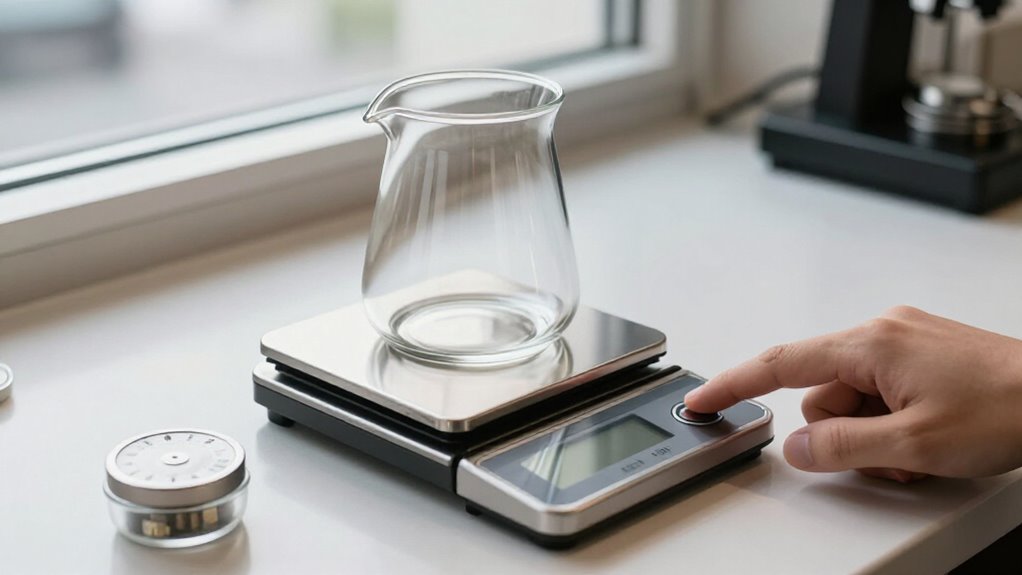
To calibrate your scale, place it on a vibration-free surface, warm it and tare to 0.0 g.
Enter CAL mode, then center a certified 100 g weight without touching it and wait for stability before confirming.
Repeat three identical 100 g checks, watching for flicker or drift.
In humid conditions, dry it, use silica gel, and recalibrate seasonally.
Log date and results, then verify 15–20 g and 200–300 g doses for 1:16 brewing.
Further safeguards follow.
Lock In 1:16 Ratios
To keep your pour-over baseline consistent, lock in a 1:16 ratio—for example, 20 g of coffee to 320 g of water—with a calibrated scale. Before brewing, place the scale on a flat, vibration-free surface and tare it to 0.0 g with nothing on the platform. Calibrate monthly, or whenever readings drift, using a certified 100 g weight. Center the weight and wait for DONE/PASS indication; this protects the ratio from dose errors that can push extraction toward sour or bitter flavors.
After calibration, verify the reading with a check: ten coins totaling 37.6 g. If it’s off by more than 0.5 g, recalibrate it first. Measure coffee and water in grams, not milliliters, and recheck when cup-to-cup flavor consistency breaks despite grind and ratio.
Gather a 0.1-Gram Weight
Start with a certified 0.1 g calibration weight, preferably Class F1 or E2, to verify a scale’s fine-dose accuracy. Buy from a metrology supplier or reputable scientific vendor, and keep the traceable certificate. The nominal mass is 0.100 g; avoid Class M1.
- Store it in a sealed, dust-free, anti-static capsule.
- Handle it with nonmagnetic tweezers.
- Wear gloves to prevent oil transfer.
- Inspect it with a loupe; reject corrosion or residue.
- Keep it away from steam, humidity, magnets, and vibration.
Use the reference during verification sessions, particularly after transport, impact, or unexplained brew-ratio drift. Don’t substitute coins or household objects: their mass and cleanliness are uncontrolled.
A certified 0.1 g weight gives you a defensible fine-dose check for reliable recipe measurements across your brewing workflow.
Check Zero After Warm-Up
After the scale has warmed up for a couple of minutes, place it on a flat, vibration-free surface and leave the platform empty. Wait for the display to settle at 0.0 g before you begin calibration or tare. A stable zero prevents an offset from distorting your coffee dose, water mass, and brew ratio.
If the reading doesn’t reach 0.0 g, inspect the platform and surrounding area for coffee grounds, moisture, or debris. Clean and dry the surface, then re-zero according to your scale’s controls. Don’t proceed while the number fluctuates or remains offset; movement, drafts, and vibration can interfere with the load cell. Confirm zero once more immediately before entering calibration mode.
| Check | Required result |
|---|---|
| Empty platform | 0.0 g |
| Surface | Clean, dry, stable |
Center Weight Before Confirmation
Place the verified calibration weight centrally on a level, vibration-free platform to load the sensor evenly. Wait until the displayed reading stabilizes, then verify the value before confirming the calibration prompt.
If the reading is off, don’t proceed; recenter the weight and repeat the check.
Position Weight Centrally
Center the calibration weight on the platform, away from all edges, so its load reaches the sensor evenly. When the display prompts you, place a certified 100 g weight precisely in the middle. If you’re using stacked reference pieces, align them neatly and keep the combined load centered; don’t let any piece overhang.
Wait until the digits settle completely before you confirm “DONE” or “PASS.” Vibration, movement, or a fluctuating display can produce a false result, even with correct placement.
For quick verification, put ten post-2019 one-rupee coins at the center. Their combined mass should read 37.6 g, within approximately ±0.2 g. If the result misses tolerance, repeat calibration with the weight centered.
Don’t conclude the scale is faulty after one poorly positioned reading.
Keep Surface Level
Before calibration, set the MANTABREW or other coffee scale on a clean, flat, vibration-free surface so the load cell remains stable. Confirm the platform is level and free of grounds, moisture, or debris; an uneven base can introduce tilt and distort the reference reading.
When prompted, place the certified 100 g weight at the platform’s exact center, never near an edge. Keep your hand clear, and don’t nudge the weight during registration; slight shifts can change readings by tenths of a gram.
After DONE or PASS appears, re-center the same weight and verify 100.0 g. If the value is incorrect, inspect the surface and placement before repeating calibration. Use this centered check to protect measurement accuracy and dependable brew-ratio calculations across every recipe consistently.
Wait For Stability
Once the calibration weight is on the platform, center it precisely and wait until the display stops drifting before confirming “DONE” or “PASS.” Keep the scale on its vibration-free surface while the load settles. Don’t touch the platform, table, or controls during this interval; even minor movement can create fluctuations.
Airflow from a fan, vent, or hand can also delay stabilization, so shield the scale from drafts. Watch for a steady, repeatable display rather than accepting the number that appears. Most scales settle within a few seconds, but allow longer if the environment is noisy or the platform was disturbed.
Confirm only when the reading remains unchanged. Premature confirmation can produce an inaccurate calibration, and a 1–2 g error may noticeably alter brew strength.
Verify Displayed Reading
Wait until the number stops drifting, then inspect the displayed value. It should read approximately 100.0 g; on a scale with 0.1 g resolution, accept a result within about ±0.2 g of the reference.
If the reading fluctuates, don’t interpret it yet: eliminate vibration, airflow, and contact with the platform. Keep your eyes on the settled value, and handle the weight carefully so you don’t alter its mass or position during weighing.
Confirm Calibration Prompt
When the scale prompts you to place 100 g, center the certified calibration weight precisely on the platform and keep the scale on a flat, stable surface. Wait until both settle before confirmation; edge loading, vibration, or wobble can distort the sensor response. Use the same certified 100 g reference each time, not coins or estimated objects.
After calibration displays “DONE” or “PASS,” remove the weight and tare. Return it to center and verify stable 100.0 g. If reading is wrong or inconsistent, repeat with the weight centered and scale undisturbed.
Don’t brew until verification succeeds; this check protects dose accuracy and repeatable ratios. It confirms the calibration process produced a usable reference before you measure coffee and water for brewing with confidence and consistency.
Adjust for High Humidity
Control ambient moisture by storing your scale in a closed, dry cupboard with silica gel packets to limit sensor drift. Recalibrate after humid exposure or at the start and end of monsoon season, especially if readings shift by 0.3–1.0 g. Verify the adjustment with a reference weight before changing your brew recipe.
Control Ambient Moisture
During high-humidity periods, such as India’s 80–90% monsoon conditions, moisture can affect the load cell and shift readings by roughly 0.1–0.3 g. Store your scale in a closed cupboard, away from windows, sinks, and stoves, and place silica gel packets inside the storage area; you’ll limit damp-air exposure.
After storage or relocation, let it sit on a level, vibration-free surface before calibrating or brewing; wet or warm air can temporarily destabilize readings.
During the monsoon, check accuracy after calibration: weigh ten one-rupee coins, which should total 37.6 g, and accept approximately ±0.2 g on a typical 0.1-g scale. If the error reaches roughly 0.3–1.0 g, recalibrate at monsoon start (June) and end (October), or whenever readings exceed your brewing tolerance consistently.
Prevent Sensor Drift
High humidity, especially India’s 80–90% monsoon conditions, can make a load cell drift by roughly 0.1–0.3 g, so you’ll need to check the scale more often.
Store your scale in a closed, dry cupboard between brews, and add silica-gel packets to limit moisture exposure. Keep the platform clean and dry; even condensation or residue can affect load-cell response. Before brewing, let the scale stabilize, then tare it on a level, vibration-free surface.
Verify performance with ten post-2019 1-rupee coins, which should read about 37.6 g. A result more than 0.5 g away indicates humidity-related drift. Record the reading and compare it with your tolerance, especially when targeting a 1:16–1:17 ratio. If drift reaches 0.3–1.0 g, inspect storage conditions before blaming coffee, water, or extraction variables.
Recalibrate After Humidity
When monsoon humidity reaches 80 to 90%, recalibrate your coffee scale because moisture can shift load-cell readings by roughly 0.1 to 0.3 g. Recalibrate at monsoon start, around June, and near October when drift appears. Warm the scale on a level, vibration-free surface, then tare it. Follow the manufacturer’s calibration sequence with a certified 100 g weight centered on the platform.
Confirm zero afterward and test doses, such as 15 to 20 g and 200 to 300 g.
If readings drift by 0.3 to 1.0 g and calibration corrects them, don’t assume your brew ratio changed. Verify with ten post-2019 one-rupee coins; they should weigh about 37.6 g. An error above 0.5 g warrants recalibration. Between checks, store the scale in a cupboard with silica gel, away from windows, sinks, and the stove. Log results.
Three Identical 100-Gram Readings
Place your MANTABREW coffee scale on a flat, vibration-free surface, tare it to 0.0 g, and enter calibration mode (CAL). Use a certified 100g calibration weight; center it on the platform and wait for the reading to settle before confirming.
After calibration completes, remove the weight, re-tare to 0.0 g, then place the same weight back on the platform. Repeat the check two more times, giving you three 100g readings.
Ensure each result matches closely; differences should stay within ±0.2g on a 0.1g-resolution scale. If any reading doesn’t match, differing by more than approximately 0.5g, run the calibration sequence again, then complete all three checks. Keep the weight centered during every test, and avoid touching the platform or scale while it settles. Log readings and date.
Watch for Display Flicker
If the display flickers during calibration, pause and move the MANTABREW scale to a flat, vibration-free surface. Inspect the platform for moisture, coffee grounds, or oily film, which can disturb load-cell sensing. Dry it completely and wipe away residue before continuing.
With the platform empty, confirm a stable 0.0g reading. If the value keeps jumping, don’t start the calibration sequence.
After calibration, run the coin test: ten post-2019 ₹1 coins should read 37.6g. If flicker returns or the result differs by more than about 0.5g, recalibrate and investigate the cause. If flickering persists after drying, repositioning, and recalibration, treat the sensor as unstable.
Stop using the scale for brew ratios until you resolve the fault or obtain service and verify accurate operation first.
Prevent Countertop Vibration Errors
Set your coffee scale on a rigid, level surface away from countertop edges, grinders, kettles, and other vibration sources. Let the display settle at 0.0g with an empty platform. Pause the grinder, avoid touching the counter, and keep moving equipment still during the calibration wait. Place the 100g reference weight centrally without shifting it, then wait for “DONE/PASS” confirmation.
Use these controls:
- Keep the scale centered on the stand.
- Remove debris and confirm the platform sits flat.
- Stop table movement before pressing calibration controls.
- If equipment must run nearby, isolate the scale on a stable stand.
- Recheck using ten one-rupee coins; expect 37.6g.
If that reading differs by more than 0.5g, remove vibration sources and repeat calibration. Small impacts can create errors of 0.1g.
Record Date and Drift
Once vibration is controlled, log the calibration date and measure drift with a consistent reference. Record the date for every calibration—monthly for routine use, or at monsoon start and end in June and October.
After calibration, recheck ten post-2019 one-rupee coins, which should total 37.6 g, and write the displayed value in your log. Calculate drift as the difference from 37.6 g.
A reading within about 0.2 g is generally normal on a 0.1-g scale; if the error exceeds 0.5 g, recalibrate. Compare readings before and after adjustment: correcting 0.3–1.0 g suggests the scale remains serviceable.
During 80–90% humidity, log fluctuations of 0.1–0.3 g as probable moisture-related drift and schedule an earlier check. Persistent error beyond tolerance warrants battery inspection, cleaning, or manufacturer service.
Conclusion
Once you’ve calibrated your coffee scale, verify it before important brews: warm it up, zero the platform, and confirm a centered 100-gram weight. If readings drift, flicker, or vary, eliminate vibration, humidity, and unstable surfaces before adjusting again.
Record the date and observed error so you can track performance over time. With a stable, repeatable scale, you’ll measure coffee and water accurately, protect your 1:16 recipe, and brew consistently from one cup to the next.