Descaling Solution vs Vinegar for Espresso Machines: What’s Safer?
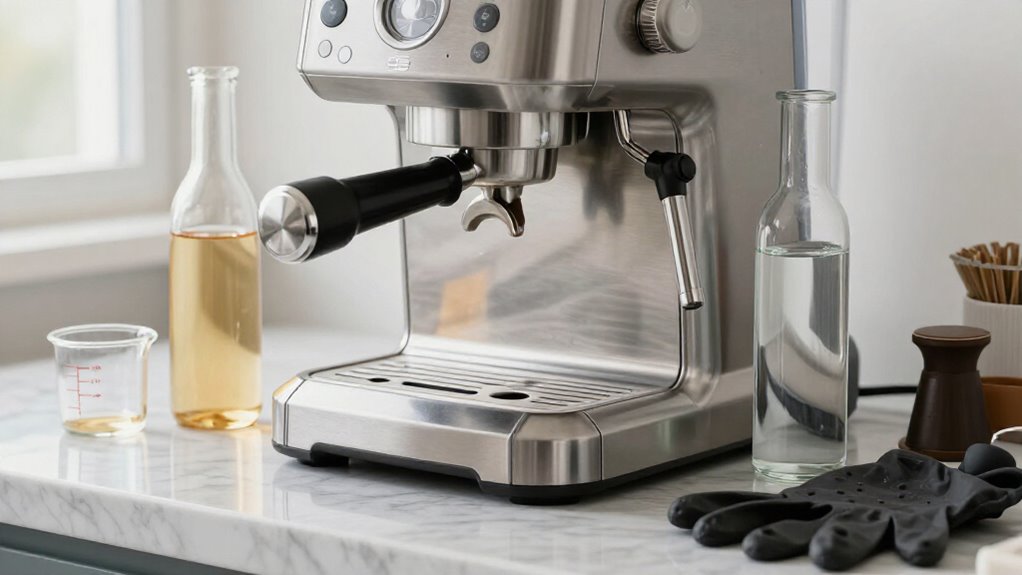
You’ll usually protect your espresso machine better with a manufacturer-approved, preferably NSF-certified descaler than with vinegar.
Purpose-made citric- or lactic-acid formulas dissolve scale consistently, rinse cleaner, and suit machine materials when used as directed.
Vinegar can attack aluminum, stress seals, and leave odor or taste.
Follow the packet’s dilution and dwell time, then run rinse cycles until water is clear and odorless; the guidance below also helps you assess brewing and pump noise more safely.
Acidity, Residue, and Rinsing
Vinegar’s roughly 5% acetic acid concentration and pH of about 2.4–3.4 can dissolve calcium-carbonate scale, but it generally works more slowly and less predictably than a commercial descaler. You’ll need longer contact, and residue can cling to seals. That residue may leave odor or taste, so you’ll need several full-water flushes before brewing. A formulated citric- or lactic-acid descaler targets scale more consistently and typically rinses cleaner. Follow its label; don’t mix acids or exceed contact time.
| Factor | Vinegar versus descaler |
|---|---|
| Acidity | Vinegar acts slowly; formulated acids act predictably. |
| Residue | Vinegar may retain odor; descaler usually rinses cleaner. |
| Rinsing | You’ll need more flushes with vinegar. |
| Safety | Don’t brew until odor remains. |
| Rinse water | Discard the first rinse water. |
Follow machine instructions and rinse until odor disappears.
From Reservoir to Boiler
As descaling solution travels from the reservoir through the feed path and boiler or thermoblock, it must dissolve mineral scale without leaving residues in the hot-water circuit. Run one or more full dispensing cycles, let the solution dwell partway through the circuit for 30–60 minutes where buildup is stubborn, then flush with clean water until discharge runs clear.
Vinegar can dissolve scale, but its weaker, less predictable action may leave deposits in heated sections, while acetic odor can persist through flushes. A purpose-made citric- or lactic-acid descaler offers reliable contact and wetting across aluminium, brass, steel, rubber, and silicone components.
Follow your manufacturer’s dilution, dwell, and disposal instructions; never mix acidic products or exceed the concentration because acidity can stress seals and boiler surfaces.
Post-Descale Crema Quality
Residual descaling chemistry can alter espresso’s aroma, extraction balance, and crema appearance, so you shouldn’t evaluate crema quality until the machine has been thoroughly rinsed.
After rinsing, inspect the first espresso for aroma, balanced extraction, and stable crema. Vinegar’s pungent odor and lingering taste can taint subsequent brews, masking subtle aroma cues that help you judge crema. Its longer contact time may also leave residual acidity or reaction byproducts, reducing consistency if flushing remains incomplete.
A citric-acid descaler, including 100% citric-acid products such as Biocaf, is less likely to create a noticeable flavor off-signal when used correctly. Don’t drink coffee that still smells or tastes acidic; continue cleaning according to the manufacturer’s instructions and confirm clear brew water. Persistent thin crema may signal residue.
Packet Dosing and Rinse Cycles
Once the water runs clear and no acidic odor or taste remains, dose the packet according to its label—not a fixed household ratio; for example, Dezcal may specify one ounce per 32-ounce reservoir. Dissolve it completely, fill the reservoir to capacity, and run the machine’s complete brew or descaling program. Don’t guess concentrations; excessive acid can increase exposure and component stress.
Discard the solution. If the instructions require a pause, stop for the specified 30–60 minutes so the solution can dissolve stubborn scale, then resume the cycle. Next, run multiple full cycles with clean water. Check the discharge after each cycle; continue until it’s clear and odorless. Run one additional full reservoir as a final verification, then empty and rinse the reservoir before brewing.
Aluminum Boiler Acid Tolerance
Treat an aluminum boiler as acid-sensitive: the risk of etching or pitting rises with stronger solutions and longer contact times. You should treat vinegar as a poor default for aluminum: its roughly 5% acetic acid can attack or pit surfaces, especially when solution remains trapped during a 30–60-minute soak. Even diluted vinegar can impose cumulative chemical stress through repeated use.
Choose a citric-acid descaler formulated for espresso machines, such as a Biocaf-style product, and follow its specified dilution and contact time. Don’t increase concentration or extend the cycle to chase stubborn scale. Run the machine’s recommended program, then rinse exactly as directed. If your manual prohibits vinegar, don’t substitute it; unapproved chemistry can damage the boiler and compromise warranty protection over time.
Water Filter Replacement Costs
Protecting an aluminum boiler also depends on replacing the machine’s water filter on schedule. Many cartridges require replacement every two to three months or after a set water volume. When a filter is exhausted, more minerals pass through, accelerating limescale formation and increasing descaling frequency, labor, and costs.
Cartridge prices and availability vary. A proprietary filter may cost more than a generic option, and delays can disrupt maintenance schedules. Check your manual, record installation dates and liters used, and budget replacements as operating costs.
A filter reduces mineral loading; it doesn’t eliminate approved descaling. Using a formulated descaler can manage deposits more predictably than household vinegar, reducing full-cycle frequency. Follow the manufacturer’s interval, dose, and disposal instructions to protect performance and control ownership costs.
Rubber Gasket Compatibility
Because rubber gaskets and O-rings can swell, harden, or degrade after prolonged acid exposure, vinegar may be a poor choice for espresso-machine descaling.
Vinegar’s acetic acid can stress elastomer seals. Don’t expose seals to unnecessarily long soaks or repeated treatment. Choose your manufacturer-approved descaler, or a citric-acid-based product labeled compatible with espresso-machine seals. Use the recommended dilution and contact time; don’t improvise concentrations.
- Inspect gaskets for swelling, softening, cracks, or leaks before and after descaling.
- Minimize solution contact with seals and avoid prolonged soaking.
- Flush thoroughly through the machine to remove acidic residue.
- Replace damaged seals and follow the manual’s maintenance schedule.
A lingering vinegar odor or taste signals incomplete rinsing; residue can contact gasket surfaces between cleanings. Flush thoroughly to preserve seal life.
Pump Noise After Descaling
If your pump sounds louder, rattly, or strained after descaling, trapped air, loosened scale, or concentrated solution may be restricting flow. Run two or three full clean-water cycles, then flush until no vinegar odor or unusual taste remains.
If the noise persists on every cycle, stop using the machine and inspect the tank inlet and internal strainers for debris.
Common Pump Noise Causes
Often, new pump noise after descaling results from cavitation caused by trapped air, especially when the machine stopped mid-cycle or the reservoir wasn’t refilled and bled during rinsing.
Other causes can change pump load or flow resistance:
- Incomplete rinsing: residual descaler can make lines sound louder or gravelly.
- Dislodged scale: loosened particles may briefly restrict the inlet, shower screen, or solenoid, causing rattling or chattering.
- Vinegar exposure: swollen or misaligned gaskets can increase strain, producing squealing or high-pitched vibration.
- Persistent cavitation: air pockets can keep the pump noisy until the hydraulic circuit clears.
Avoid running the pump dry or repeatedly cycling it; sustained cavitation can overheat the pump, while debris-related restriction may increase pressure and accelerate wear in valves, seals, and tubing over time.
Troubleshooting After Descaling
A louder, buzzing, or rattling pump after descaling usually indicates trapped air, residual solution, or loosened scale restricting flow, not immediate pump failure. Run two or three fresh-water flush cycles, and listen for the noise to diminish. If your machine has steam or hot-water dispensing, purge that circuit for 5–10 seconds multiple times to clear solution from boiler and PID pathways.
Follow the manufacturer’s procedure, and avoid operating the pump dry.
If noise persists, reseat the water tank and verify water during pumping. Inspect the tank pickup tube and group screen for blockage. A 30–60-minute soak can dislodge debris that later restricts flow, so rinse afterward.
Vinegar may leave residue; continue flushing until no sharp odor or taste remains. Persistent noise after checks warrants service.
Best for Hard-Water Homes
If you live in a hard-water area, use a purpose-made, citric-acid descaler to tackle heavy mineral buildup more reliably than vinegar. Its machine-safe formulation helps protect aluminium, brass, stainless steel, seals, and other internal components.
Follow the manufacturer’s dosage, contact time, and complete rinse cycle to maintain descaling effectiveness.
Tackles Heavy Mineral Buildup
For espresso machines in hard-water homes, a purpose-made descaler generally removes heavy limescale more safely and completely than vinegar. If you’re seeing restricted flow or chalky deposits, choose a citric- or sulfamic-acid formula approved for your model. It targets stubborn calcium carbonate more predictably than vinegar does.
- Follow the machine’s programmed cycle and use the manufacturer’s dilution; stronger isn’t necessarily safer or more effective for you.
- Expect vinegar to work slowly and less completely; stubborn scale may remain in hidden channels after one treatment cycle.
- Complete the required clean-water flushes until rinse water runs clear and no acidic odor remains before brewing coffee again.
- If buildup persists after descaling, stop using the machine and arrange professional service rather than repeating concentrated treatments alone.
Protects Machine Components
Hard-water scale strains an espresso machine’s boiler, valves, and flow paths, so use a manufacturer-approved descaler to remove deposits while minimizing stress on internal components. Choose a formula with corrosion inhibitors when your machine contains aluminium, brass, stainless steel, rubber, or silicone. These additives help control chemical attack during the cycle, protecting metal surfaces and keeping seals resilient.
Vinegar’s acetic acid lacks protection; repeated or prolonged exposure can swell, soften, or degrade gaskets and O-rings while increasing corrosion risk in metals. That damage can cause leaks, restricted flow, or premature part replacement, especially in hard-water homes that require maintenance. Follow your manual’s dilution, contact-time, and rinse instructions, and never mix descaling agents. If the manufacturer forbids vinegar, using it could also jeopardize warranty coverage.
Extends Descaling Effectiveness
A purpose-made espresso-machine descaler gives you more consistent scale removal in hard-water homes than a vinegar mixture, especially when deposits have accumulated in boilers, valves, or narrow flow paths. Use the machine’s approved formula and dilution; vinegar may dissolve scale more slowly and leave deposits behind.
- Follow the manufacturer’s stated dilution and full descaling program.
- Let the solution contact boilers, valves, and narrow channels as directed.
- Continue clean-water flushes until rinse water runs clear and odor-free.
- Repeat at the recommended interval if your water remains mineral-rich.
A citric-acid cleaner can help control mold and mildew on thick buildup, while formulated wetting agents improve access to internal surfaces.
Don’t shorten the cycle: incomplete rinsing can leave acidic residue, impair flow, and alter espresso aroma.
Choose NSF-Certified Descaler
Choose an NSF-certified descaler to use a product independently evaluated for safety and performance rather than an unverified household acid. Look for labels stating NSF/ANSI recognition, not merely “food-safe.” This distinction helps you select a formulation tested for scale removal and compatibility with espresso-machine materials.
Approved formulas typically reduce stress on metals, seals, and gaskets, while vinegar can leave odor, affect flavor, or prove too weak or corrosive for certain machines.
Use the certified product at the specified dilution and rinse volume. Don’t increase concentration; excess acid can increase residue and material damage. Run manufacturer-required rinse cycle, and confirm the machine manual permits the product. If the manual specifies a particular agent, follow that requirement to protect warranty coverage, equipment longevity, and beverage safety.
Conclusion
Choose a purpose-made, NSF-certified descaler over vinegar for routine espresso-machine maintenance. Its controlled acidity helps dissolve scale while reducing residue, gasket stress, aluminum-boiler risk, and lingering flavor. Follow the manufacturer’s packet dose and complete every required rinse cycle; don’t stop when the reservoir looks clear.
If your pump sounds abnormal or crema changes after descaling, stop using the machine and consult its manual or a qualified technician. You’ll protect both safety and coffee quality consistently.