Gooseneck Kettle Pouring Technique
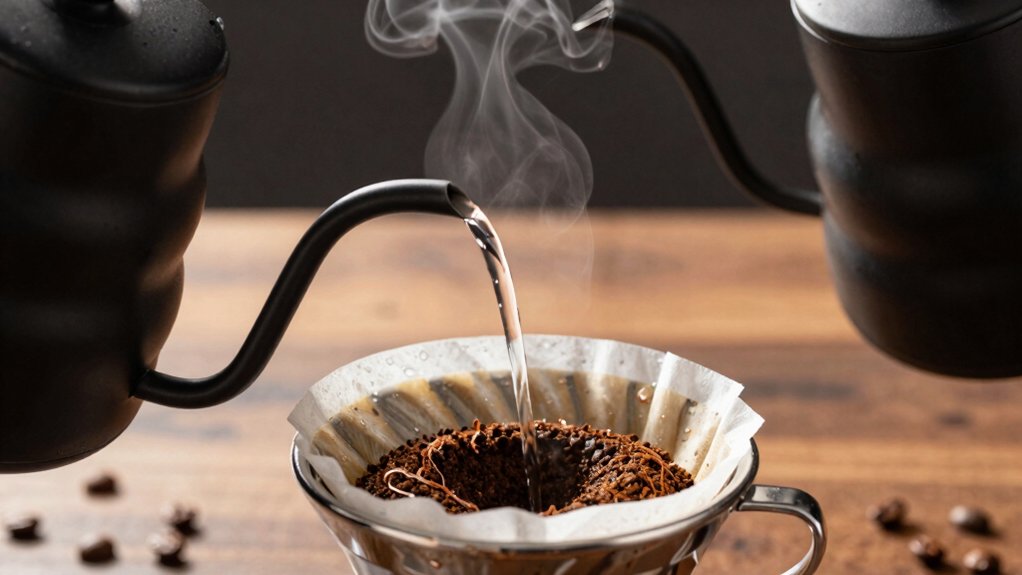
You’ll control extraction by pouring a steady, measured flow from a gooseneck to manage contact time and uniformity. Aim for about ±0.3 g/s consistency and use short ~10 g/s bursts or pulses when you need agitation. Match spout diameter and tip angle to shape stream and coverage.
Keep kettle water around 90–96°C; account for ~1–2°C drift during pours and raise setpoint if needed for repeatability. Continue for step-by-step calibration and corrections.
Quick Overview
- Control flow rate (aim ±0.3 g/s; use steady 10 g/s or timed bursts) to manage contact time and extraction consistency.
- Match spout diameter and tip angle to desired stream shape and volume for precise coverage and minimized channeling.
- Use pulse or spiral pour sequences to keep water level steady, prevent channels, and equalize extraction.
- Preheat kettle and let water settle to target 90–96°C. Adjust for expected temperature drift during pours.
- Measure exit and bed temperatures; record drift and raise kettle setpoint accordingly for repeatable brew temperatures.
Flow Rate vs Time
How fast you pour governs extraction dynamics more than most home baristas realize. You control flow rate to manage contact time and extraction uniformity; keep variance ±0.3 g/s to repeat profiles. Aim for ~10 g/s bursts when appropriate, or slower pulses to avoid >8 g/s turbulence that creates defects.
Thermal stability at pour start matters; overshoot alters effective time and extraction kinetics. Practice 100 g in 10 s to calibrate muscle memory, and adjust for kettle-specific breakup length and cohesion. Use pulse or spiral sequences to maintain consistent water level and minimize channeling.
| Action | Effect |
|---|---|
| Steady 10 g/s | Uniform extraction |
| Risk channeling | |
| Pulse pours | Controlled time |
| High variance | Inconsistent brews |
Spout Diameter & Tip Angle
Why does spout diameter and tip angle matter so much for a gooseneck kettle? You directly control flow rate and how long water contacts the grounds by choosing spout diameter and tip angle. A narrower diameter yields finer, slower streams; a wider one increases volume per second. Tip angle directs the jet and affects agitation and coverage across time-sensitive pours.
- Match diameter to desired flow rate: smaller for pulse, larger for spiral.
- Adjust tip angle to shape the stream: acute for precision, flatter for broad coverage.
- Combine both for timing: calibrate diameter and angle so each pour segment meets your target time.
You’ll think like an instrument maker. Measure, test, and iterate for repeatable extraction.
Water Temperature Tolerance
You’ll target an optimal brew temperature (typically 92–96°C) and monitor how heat stability affects extraction across a brew. Keep in mind the kettle’s thermal retention and temperature tolerance range; this will help you predict degassing, extraction rate, and flavor shifts as water cools.
Use quick, consistent measurements of temperature loss during pours to adjust pour timing, height, and technique for precise results.
Optimal Brewing Temperatures
Wondering what temperature window gives you predictable extraction? You’ll aim for an optimal temperature range, typically 90–96°C, to balance solubility and flavor clarity. That window provides control precision: small shifts change sweetness, acidity, and body. So you’ll adjust within ±1–2°C for desired outcomes.
Use a gooseneck kettle to stabilize pouring while monitoring thermometer or PID readout. Let water sit briefly after boiling to reach target. For lighter roasts, favor upper range to extract bright acids. For darker roasts, lean lower to avoid over-extraction of bitter compounds.
Measure cup-to-cup consistency by recording temperature, grind size, and pour technique. Maintain disciplined routines so temperature becomes a repeatable parameter in your brewing workflow.
Heat Stability Over Time
Water temperature tolerance refers to how steadily your brew water holds within the target range (typically 90–96°C) from kettle to cup. It also considers how small deviations over the brew cycle affect extraction. You’ll monitor heat stability to prevent under- or over-extraction as water cools while you pour.
Quantify time drift by measuring temperature at set intervals during your typical pour sequence; note seconds-to-degree change. A well-designed gooseneck and insulated kettle reduce heat loss, limiting time drift and preserving extraction consistency. You’ll adjust workflow: shorter pour segments, preheat vessels, or brief reheat pulses to maintain thermal equilibrium.
In practice, prioritize repeatable heat stability metrics over anecdotal feel. Record start, mid, end temperatures and correlate them with flavor to refine technique.
Temperature Tolerance Range
How tightly can your brew tolerate temperature swings before extraction shifts noticeably? You’ll measure the tolerance range in degrees Celsius (or Fahrenheit), noting that tight control under ±1–2°C preserves temperature stability and supports repeatable results.
In practice, you’ll define an acceptable window for your recipe: for delicate profiles a narrower band; for forgiving roasts a wider one. Monitor kettle heat loss during pours and adjust pour cadence or preheat equipment to keep water within that window. Consistent technique reduces thermal shock to the bed and aids brew consistency across batches.
Track deviations, correlate them with sensory changes, and iterate: tighten or relax your tolerance range until you hit the reproducible balance between control and workflow.
Effects On Extraction
Why does a few degrees matter so much to extraction? You’ll find that temperature shifts change solubility rates; this alters how acids, sugars and bitters dissolve from the grounds. Maintain tight tolerance and you control extraction kinetics: higher temps accelerate solute release, while lower temps slow it. That changes perceived balance and body without changing pour technique.
Monitor flow metrics during brews. If flow slows unexpectedly, temperature may be dropping and under-extraction will rise. Conversely, fast flow at high temp can over-extract bitter compounds. Grind impact is decisive; finer grinds amplify temperature sensitivity, while coarser grinds blunt it. Match kettle heat to grind and target extraction yield. Then use your gooseneck to reproduce consistent pours that preserve that thermal window for repeatable results.
Measuring Temperature Loss
Curious how much heat you actually lose between kettle and cup? You’ll measure temperature drift by recording kettle exit temp and cup or bed surface temp immediately after pour. Use a fast-response digital thermometer or thermocouple placed at brew bed center; log times to quantify decline per second.
Run repeat trials at set pour heights and flow rates to isolate variables. Calculate average drift and standard deviation to understand variability. Heat retention of your gooseneck and kettle insulation changes results: thinner walls show faster drift; insulated kettles preserve temperature.
Apply corrections to target brew temp: raise kettle setpoint by measured drift over pour duration. This empirical approach gives repeatable, technical control of final extraction temperature.
Frequently Asked Questions
How Do I Hold the Kettle for Best Control and Comfort?
You grip the handle near its top with a relaxed wrist, using a thumb-on-top finger wrap for steady holding technique and ergonomic balance. Keep elbows tucked and distribute weight for comfort considerations. Adjust your pour height to 8–10 inches for steady flow.
Time your bloom duration (30–45 seconds) before using controlled pour patterns: spiral or pulse to ensure even saturation and channeling avoidance. Practice steady, precise motions for artisanal control.
What Is the Ideal Pour Height Above the Coffee Grounds?
The ideal height is about 8–10 inches above the grounds so you control flow without excessive agitation. You will minimize direct ground contact while keeping a steady stream. Maintain that height to balance stream cohesion and ground contact timing.
Practice pouring 100 g through an empty dripper in 10 seconds to train rate. Adjust slightly for grind or bloom; however, stay within that 8–10 inch window for consistent, technical pours.
How Long Should I Bloom Before Starting the Main Pour?
Bloom for 30–45 seconds before the main pour. You’ll adjust bloom duration based on grind size: finer grinds may need the full 45 seconds to release CO2, while coarser grinds can bloom closer to 30 seconds.
During bloom, pour twice the coffee weight gently and let gases escape. Watch for visible expansion and steady bubbling to subside. Then proceed with your spiral or pulse pours for consistent extraction.
Should I Use Spiral or Pulse Pours for Espresso-Style Brews?
Use pulse pours for espresso-style brews; they give tighter control over water delivery and extraction. You’ll employ pulse pours to maintain stable water level and avoid over-agitation. Then combine short, measured bursts with micro-adjustments.
Consider spiral pours only when you need broader saturation in coarser, filter-style brewing. Mastering pulse pours keeps extraction even, repeatable, and precise; this matches the technical, artisanal demands of espresso preparation.
How Can I Avoid Channeling During Pouring?
You prevent channeling by controlling agitation and ensuring even saturation: use precise pour technique. Start with a proper bloom, then employ a steady spiral or timed pulse pour to distribute water uniformly.
Maintain consistent pour height and rate; keep the spout centered and move smoothly. Avoid pouring too forcefully or too close to the filter. Adjust ergonomics for stability, and practice repeatable motions to achieve reliable channeling prevention.
Conclusion
You’ve learned how flow rate, spout geometry, and temperature stability interact to shape extraction. Use a narrow-diameter, angled tip and steady slow pours to control flow over time. Preheat the kettle and factor in the kettle’s thermal tolerance to keep water within the optimal brewing window.
Monitor temperature loss during transfer and adjust pour speed or starting temperature to compensate. With measured technique and consistent hardware, you’ll reproducibly hit target extraction and flavor balance.