
How to Remineralize Distilled Water for Coffee
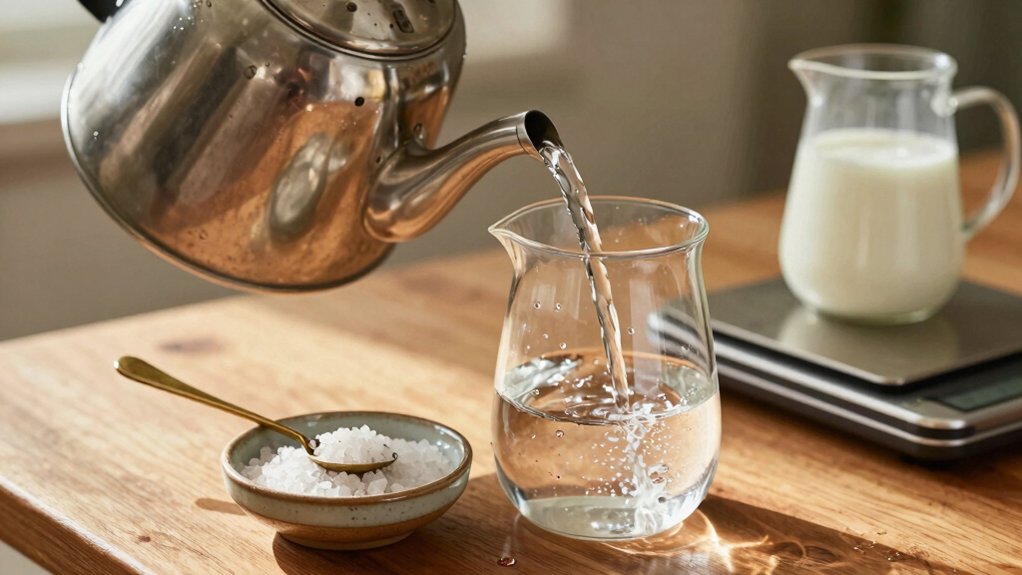
You’ll aim for about 150 ppm total hardness: roughly 50–70 ppm Ca2+ and 10–30 ppm Mg2+. Use calcium chloride (CaCl2·2H2O) for Ca because it’s soluble and precise. Add a magnesium salt (MgSO4) to reach the Mg target.
Prepare a concentrated stock; calculate mg/L dosing from molecular weights; and verify with hardness/TDS tests. Keep bicarbonate 35–50 ppm to stabilize pH. Follow safety procedures. Continue for step‑by‑step calculations and practical dosing tips.
Quick Overview
- Decide target minerals: aim for ~150 ppm total hardness with Ca 50–70 ppm, Mg 10–30 ppm, and bicarbonate 35–50 ppm.
- Use calcium chloride (CaCl2·2H2O) and a magnesium salt (e.g., MgCl2) to dose precise Ca2+ and Mg2+ ppm.
- Calculate mg/L dosing from molar masses; prepare concentrated stock solutions; and dose by volume for repeatability.
- Verify results with TDS meter and hardness/bicarbonate test kits. Then, iterate until targets are reached.
- Handle salts with gloves and eye protection. Store dry and adjust bicarbonate separately to stabilize brew pH.
Mineral Target: 150 Ppm
Why aim for 150 ppm? You’ll hit an evidence-based balance: sufficient hardness for extraction without scale risk. Aim for 50–70 ppm Ca, 10–30 ppm Mg, and 35–50 ppm bicarbonate to stabilize pH (6.5–7.5).
That composition preserves acidity, body, and machine longevity while supporting predictable coffee pairing decisions and consistent sensory outcomes. Position concentrates and dosing tools according to equipment placement for repeatable results.
| Parameter | Target (ppm) | Function |
|---|---|---|
| Calcium | 50–70 | Body, extraction power |
| Magnesium | 10–30 | Brightness, flavor lift |
| Bicarbonates | 35–50 | pH buffer, acidity control |
| Total Hardness | 120–150 | Optimal extraction range |
Target: 150 Ppm Ca/Mg
Having set the 150 ppm overall target and its split between calcium, magnesium, and bicarbonate, you now focus on specifying the Ca/Mg portion of that hardness. Typically, this is 50–70 ppm Ca and 10–30 ppm Mg because the Ca:Mg ratio drives extraction kinetics and sensory outcomes. You’ll quantify Ca and Mg contributions to total hardness; prioritize reproducible dosing, and monitor with TDS and hardness test strips.
Aim for a Ca:Mg ratio that supports desired taste balance without overemphasizing astringency or softness. Ca accelerates extraction and body; Mg accentuates acidity and solute solubility through specific mineral interactions.
- Define target Ca and Mg ppm precisely.
- Calculate dosing from molecular weights.
- Prepare concentrates and verify with meters.
- Adjust iteratively, noting sensory changes.
Prefer Calcium Chloride Dosing
You’ll prefer calcium chloride because it delivers soluble Ca2+ efficiently, requires smaller mass for a given ppm of hardness, and has predictable effects on extraction and flavor. Dose by calculating mg/L from the salt’s molecular weight and purity. Prepare a concentrated stock for repeatable 1–2 ppm increments, and verify with a TDS/hardness test or titration.
Handle CaCl2 as a hygroscopic irritant: use gloves, keep dry, store sealed, and avoid overdosing which can increase chloride levels and alter acidity buffering.
Why Calcium Chloride
How does calcium chloride improve coffee extraction compared with other calcium salts? You should choose calcium chloride because it provides soluble Ca2+ ions efficiently, raising water hardness predictably without undissolved residue.
Its high solubility and dissociation constant let you control ionic strength and cation activity; this directly influences extraction kinetics of acids and bitter compounds. Compared with calcium sulfate, calcium chloride yields faster equilibrium and smaller dosing volumes for the same Ca2+ ppm.
It also minimally affects alkalinity, so you can adjust bicarbonate separately to meet SCA buffering targets. Analytically, chloride anions have negligible complexation with key flavor compounds, reducing unintended chemical shifts.
For reproducible brews, calcium chloride offers precise, evidence-based control of hardness and ionic composition.
Proper Dosing Rates
Why choose calcium chloride as your primary dosing chemical? You’ll pick it because it reliably raises calcium hardness without adding problematic alkalinity. It dissolves fully, yields predictable ionic strength, and minimizes complex removal techniques in your workflow.
For dosing, calculate mg/L (ppm) Ca2+ from CaCl2·2H2O molecular weight; convert to grams per liter and scale to your batch. Aim for SCA-aligned hardness (e.g., 40–70 ppm CaCO3 equivalent) by targeting specific Ca2+ ppm and supplement with Mg if needed.
Monitor pH implications: CaCl2 doesn’t buffer alkalinity, so expect limited pH change but require bicarbonate adjustments separately. Dose conservatively, validate with TDS and hardness tests, and document each concentration for repeatability.
Measuring Techniques
Start by selecting calibrated instruments and a clear calculation workflow so you can dose calcium chloride (CaCl2·2H2O) with repeatable accuracy. Use an analytical balance (±0.01 g) for solids; a graduated pipette or positive-displacement syringe for liquid concentrates; and a spreadsheet or calculator that converts desired Ca2+ ppm (or CaCO3-equivalent hardness) into grams of CaCl2·2H2O per liter using its molecular weight and hydration state.
Next, prepare a concentrated stock (e.g., 10 g/L) and verify concentration by mass and dilution math. Use volumetric glassware for transfers and record lot-specific purity and water content. Validate your dosing by measuring TDS and calculating ionic contribution against expected ppm. Avoid treating measurement as an irrelevant topic or conflating methods with any unrelated concept. Document uncertainty and repeatability.
Water Chemistry Effects
Curious about which mineral most reliably improves extraction and flavor balance? You’ll find calcium chloride delivers predictable increases in ionic strength and calcium hardness (expressed as ppm CaCO₃); this enhances solute solubility and extraction kinetics. Dose incrementally: small mg/L changes shift perceived body and acidity.
Use measured concentrates and verify with TDS and hardness tests. Consider bicarbonate pairing to maintain pH buffering. Without adequate alkalinity, increased calcium can over-emphasize brightness. For precise recipe work, you’ll run two word discussion ideas with magnesium sources to compare flavor modulation versus pure CaCl2 dosing.
Monitor water taste objectively; sweetness, mouthfeel, and acidity responses correlate to specific ion concentrations. Record results and iterate to reach SCA-aligned targets.
Safety And Handling
How should you handle calcium chloride safely when remineralizing distilled water for coffee? You should follow established safety protocols: use gloves, eye protection, and work in a well-ventilated area to avoid dust inhalation and skin contact.
Measure by mass with a calibrated scale and transfer powders using a funnel or scoop to minimize spills. Store labeled, airtight containers away from moisture and incompatible substances; include date and concentration notes.
For concentrate preparation, add salt to water slowly with mechanical stirring to prevent localized supersaturation and heat. Rinse spills with copious water and neutralize residues per material safety data sheet instructions.
Document batch concentrations and handling best practices in your checklist to ensure repeatable, compliant remineralization for brewing.
Frequently Asked Questions
Can I Use Tap Water Instead of Distilled for Remineralization?
Yes, you can use tap water instead of distilled, but you should test and adjust. You’ll analyze ion content, hardness and alkalinity; then decide dosing to reach SCA targets. Two word discussion ideas are “baseline testing” and “ion control.”
Remineralization benefits include consistent extraction and flavor balance. However, municipal variability and unwanted ions (chloride, iron) can skew results, so filter or blend tap water when necessary for precise, repeatable dosing.
Will Remineralized Water Harm My Espresso Machine Seals?
No, properly formulated remineralized water won’t harm seals if you match recommended hardness and alkalinity. It will maintain machine compatibility and long-term durability. You should use low-chloride calcium/magnesium sources, keep sodium under 10 mg/L, and avoid particulate or aggressive ions.
Monitor TDS and bicarbonate; follow manufacturer specs, and flush regularly. Incorrect mineral balance or high chloride/sulfate levels can accelerate seal corrosion and deterioration.
How Long Does Prepared Concentrate Stay Usable?
Prepared concentrate remains usable typically 6–12 months if stored properly; storage duration depends on sterile technique and ingredient stability. You should keep concentrate in sealed, opaque containers at cool temperatures (4–20°C), minimizing air and light exposure.
For DIY mixes using Epsom salt and baking soda, microbial growth is negligible. However, verify clarity and odor before use. Discard if precipitation, cloudiness, or off-smells appear; label with prep date.
Can I Use Table Salt Instead of Sodium Bicarbonate?
No, you shouldn’t use table salt instead of sodium bicarbonate. Table salt (NaCl) raises sodium and chloride, not alkalinity; therefore, it won’t buffer acidity or mimic recommended bicarbonate levels.
Use proper salt alternatives like sodium bicarbonate or potassium bicarbonate for alkalinity. Measured chloride salts should only be used to adjust flavor within SCA limits.
Follow calculated dosing, verify with TDS/alkalinity tests, and avoid excess Na+ to protect taste and health.
Does Remineralization Affect Decaf Differently Than Regular Coffee?
Yes, you’ll see decaf mineral differences. Decaffeination alters soluble compounds; thus, water hardness impact can shift extraction balance. You’ll need slightly higher bicarbonate buffering and modest hardness (Ca/Mg) to compensate for reduced acid-binding and flavor intensity.
Measure TDS and adjust concentrate dosing incrementally. Typical SCA hardness targets still apply; however, expect to raise alkalinity 5–15 ppm and hardness 2–5 ppm to restore perceived brightness and body.
Conclusion
To reach about 150 ppm total dissolved minerals (primarily Ca/Mg) for optimal coffee extraction, add calcium chloride because it reliably raises ionic strength without bitter sulfates. Dose precisely: aim for Ca ~100–120 ppm and Mg ~30–50 ppm, using analytical-grade CaCl2·2H2O and gravimetric or volumetric dilution to achieve mg/L accuracy.
Measure with TDS and ICP/AA or titration for Ca/Mg confirmation. Handle salts with gloves; store solutions labeled; and adjust slowly while re-testing until you hit the 150 ppm target.