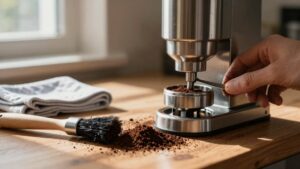
Burr Grinder Vs Blade Grinder Differences
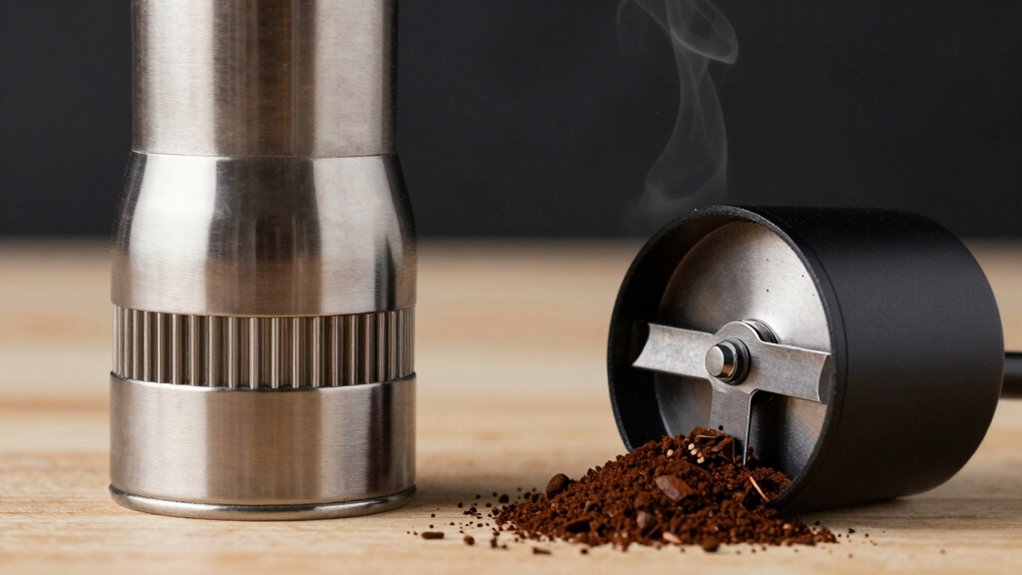
You want consistent extraction, so pick a burr grinder: its matched-geometry burrs shear beans to a narrow, repeatable particle distribution suited to espresso, pour-over, or press ranges. It offers controlled grind settings and shorter runs to limit heat.
Blade grinders chop irregularly, producing fines and boulders, wider thermal spikes, and less predictable extraction. Higher RPMs amplify heat, noise, and wear, especially on blades. Keep going and you’ll get specifics on size ranges, RPM effects, and maintenance.
Quick Overview
- Burr grinders produce a narrow, consistent particle size distribution; blade grinders create a wide mix of fines and boulders.
- Consistent grinds from burrs enable predictable extraction and easier dialing for espresso and pour-over.
- Blades spin fast and unevenly, generating more heat and hotspots that can alter coffee aroma and flavor.
- Burrs operate at lower RPM with controlled shearing, reducing heat, noise, and vibration compared with blades.
- Burr mechanisms and materials generally offer greater durability and repeatable settings than inexpensive blade units.
Grind Size Consistency Chart
How fine should you grind for each brew method? You’ll match micron targets to extraction: espresso ~180–380 µm, pour-over ~410–930 µm, French press ~690–1300 µm. Grind size consistency determines predictability. Burr vs blade implications are stark; burrs deliver narrow distributions, while blades produce wide scatter.
| Brew Focus | Typical Microns |
|---|---|
| Espresso/High-pressure | 180–380 |
| Filter/Pour-over | 410–930 |
| Immersion/French Press | 690–1300 |
| Versatile/AeroPress | 320–960 |
Use burr grinders to hit target ranges with repeatable clicks or dial rotations. Expect predictable extraction and easy dialing. With blades, you’ll see fines and boulders, uneven extraction, and limited control. This is acceptable for casual brews but unsuitable for precision methods.
Grinding Time & Heat Limits
When you grind, time and speed directly control heat generation and hence flavor preservation. So limit long, high-speed grinding runs that raise bean temperature and risk volatile loss. You’ll notice burr grinders require shorter, controlled grind time to reach a target particle distribution while keeping within strict heat limits. Blade grinders force you into repeated brief pulses that still create hotspots and wider thermal variance.
Compare thermal profiles: burr shear minimizes frictional heating; blade chopping concentrates energy into blade-bean collisions.
- Burr: consistent particle evolution, lower sustained temperature, predictable grind time.
- Blade: rapid temperature spikes, uneven particle sizes, grind time governed by pulse duration.
- Practical: measure dose temperature and limit cumulative run seconds to protect aroma.
Motor RPM Impact
When you compare motor RPMs, faster-spinning blade units generate more heat and inconsistent particle sizes. High-RPM burrs can still control grind uniformity through precise burr geometry. You’ll notice higher RPMs increase noise and vibration; this accelerates wear on bearings and blades or burr shafts and shortens overall durability if cooling and materials aren’t engineered accordingly.
We’ll contrast specific RPM ranges, thermal rise, and resulting extraction variability to show how motor speed influences performance and longevity.
Motor Speed Effects
Why does motor speed matter for grinders? You need to understand motor speed because RPM directly alters how burrs or blades interact with beans: higher motor speed increases throughput but accelerates wear and changes particle fracture dynamics.
In burr grinders, you’ll find lower RPMs preserve controlled shearing, yielding consistent particle size and limited heat generation. Higher RPM burrs can speed production but require stiffer burr materials and tighter tolerances to maintain uniformity.
In blade grinders, very high RPMs create chaotic chopping, wide particle distribution, and rapid temperature rise. You’ll compare torque, stability, and thermal transfer: low-speed, high-torque motors favor precision and stability; high-speed, low-torque motors favor quick breaks but sacrifice uniformity and demand more cooling design consideration.
Heat Generation Risks
How fast should a grinder’s motor spin before heat becomes a problem? You should assess motor RPM against design: high-RPM blade grinders (often >10,000 RPM) produce rapid heat generation through blade friction and turbulent air, while typical burr motors run slower and transfer less energy into the bean mass.
Measure surface and internal temperatures during extended runs. A rise above ~60–70°C can start altering oils and aroma. Consider duty cycle, cooling gaps, and material thermal conductivity. Safety implications include motor overheating, insulation breakdown, and increased fire risk with trapped fines.
You’ll mitigate risk by choosing low-RPM burrs, enforcing short run intervals, and ensuring ventilation or thermal cutoffs are present in the grinder’s design.
Particle Size Consistency
Curious about how motor speed shapes grind uniformity? You’ll examine motor RPM’s direct effect on particle size consistency between burr vs blade systems. High-RPM blade motors fling beans against blades unpredictably; particle distribution widens as centrifugal force and chop frequency vary. You can’t dial a target size.
Conversely, burr grinders use controlled rotational speed to regulate shear rate at the abrasion interface: consistent RPM preserves steady cut intervals and particulate geometry. Lower, stable RPMs in conical or flat burrs reduce fines and heat; this tightens the particle histogram for reproducible extraction.
When you prioritize a consistency focus, choose a burr unit with a precise motor governor. Avoid high-RPM blade units if you need narrow particle distributions.
Noise And Vibration
Wondering how motor RPM affects the noise and vibration you’ll hear from grinders? Higher RPM in blade grinders creates a broad-spectrum noise comparison: sharp high-frequency whine from blade tips plus intermittent thumps as beans collide.
Burr grinders run at lower RPMs; overall acoustic energy shifts to lower frequencies with steadier tonal output. You’ll notice different vibration patterns too: blade units produce chaotic, high-amplitude impulses tied to irregular particle impacts. Burr units exhibit consistent, low-amplitude mechanical vibration tied to rotational balance of the burr set.
When evaluating units, check motor RPM spec, mounting stiffness, and damping design; those determine whether you’ll hear tonal hums, rattles, or impulsive spikes. Use accelerometer or sound-level readings for objective comparison.
Grinder Durability Impact
You can link the noise and vibration behavior of a grinder directly to its motor RPM when evaluating durability. Higher RPMs increase mechanical stress on bearings, shafts, and mounting interfaces because each rotation multiplies centrifugal forces and impact loads from irregular bean contacts.
You’ll find burr grinders typically run at lower RPMs, reducing cyclic loading and improving grinder durability compared with high-speed blade units whose motors amplify vibration and accelerate wear. Technically, lower RPMs lower bearing fatigue life equations and reduce resonance excitation of the chassis.
For maintenance best use, plan scheduled bearing lubrication, burr inspection, and motor cooling checks. Blade grinders demand more frequent blade replacement and motor checks.
Compare mean time between failures and vibration spectra when choosing for longevity.
Frequently Asked Questions
Which Grinder Type Is Better for Espresso at Home?
You should choose a burr grinder for espresso home use. Burr vs blade: Burrs deliver consistent, uniform particle size and precise adjustable settings; this lets you dial in fine espresso grinds. They produce less heat, so flavor and crema stay intact. Blade grinders create uneven particles and heat; this causes channeling and bitterness.
For technical control, repeatable extraction, and true espresso results at home, a quality burr grinder is the clear choice.
How Often Should Burrs or Blades Be Cleaned?
You should perform burr cleaning every 1–3 months depending on use, and do blade maintenance monthly. For burr cleaning, disassemble, brush out grounds, vacuum crevices, and use a manufacturer-approved grinder brush or pellet cleaner to remove oils.
For blade maintenance, wipe housing, remove residue with a soft brush, and avoid water on motors. Sharpen or replace blades when chopping efficiency drops. Record intervals and adjust for roast oiliness and usage.
Can Blade Grinders Handle Oily Beans Without Clogging?
Yes, but oily beans often reduce grinding efficiency and demand more blade maintenance. You’ll find oils coat the blades and chamber, causing clumping and inconsistent particle sizes. You’ll need to stop frequently to scrape and wipe residues. Short pulses help; however, they won’t match burr uniformity.
Regular deep cleaning is essential: disassemble if possible and use a brush and solvent-safe wipe to restore performance and minimize clogging. Nevertheless, blade grinders still struggle more with oily roasts.
Are Replacement Parts Easy to Find for Each Grinder?
Yes, but it varies by type. You’ll find replacement parts for blade grinders readily available and inexpensive; however, compatibility and availability depend on model simplicity and shorter lifespans.
For burr grinders, you’ll get broader, long-term compatibility availability for burr sets, shafts, and housings from manufacturers and third-party suppliers; however, parts cost more. You’ll need to check model numbers and spec sheets to ensure part compatibility before ordering.
Which Grinder Gives Better Aroma Preservation Over Time?
Burr grinders give better aroma retention over time because their grind consistency produces uniform particles that extract evenly and release volatile oils predictably. You’ll see less heat and cellular damage with burrs; especially conical types; so aromatic compounds stay intact.
Blade grinders create irregular particles and more frictional heat, degrading aromatics and accelerating staling. Practically, choose a burr for long-term flavor stability. Blade units suit casual, short-term use.
Conclusion
You’ll prefer a burr grinder when you need precise, repeatable particle-size control and minimal heat buildup, since its matched burrs and lower RPMs keep fines and flavor loss low.
A blade grinder cuts faster but produces wide particle distribution, more heat, and inconsistent extraction, which can ruin brew balance. For longevity and quieter operation, choose burrs. If you value low cost and occasional use, a blade can suffice; however, expect trade-offs in consistency and thermal risk.