Burr vs Blade Grinding Consistency: Why It Changes Your Coffee
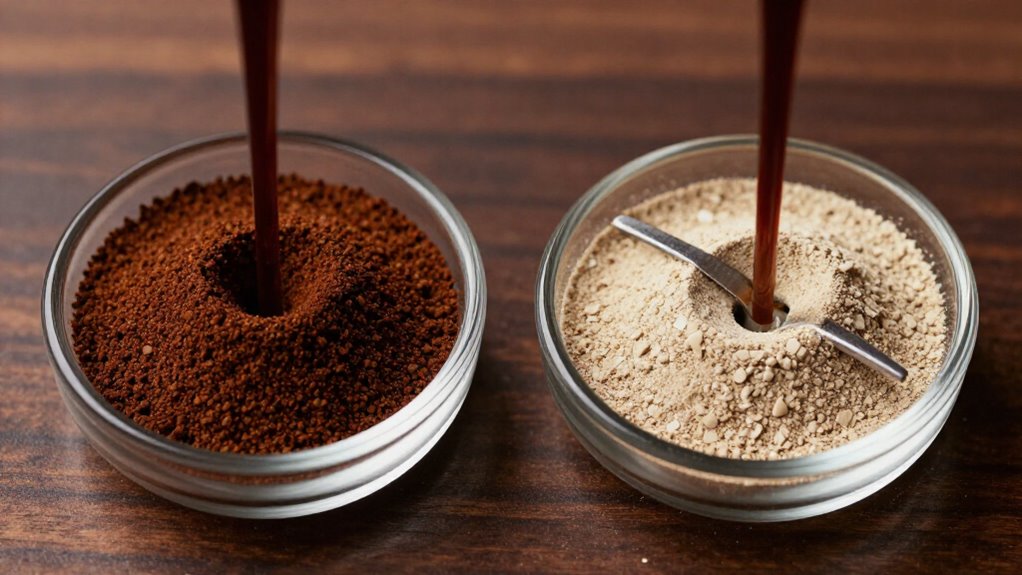
A burr grinder gives you more consistent extraction because its burrs crush beans through a controlled gap, producing a narrower particle-size distribution. A blade grinder chops unpredictably, creating fast-extracting fines and slow boulders that can taste bitter, thin, or sour.
For espresso, choose aligned burrs, weigh doses, and manage retention, static, and clumps.
For French press, coarse burr-ground coffee still improves clarity and limits bitter fines.
Further details will help you choose the right setup.
Particle Size Uniformity Snapshot
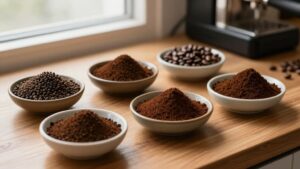
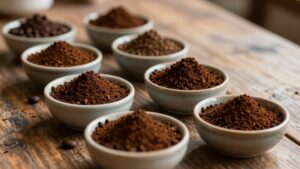
Particle-size uniformity describes how tightly the ground coffee particles cluster around a target diameter within one dose. You can assess it through particle-size distribution (PSD), using D50, D10, D90, spread, coefficient of variation, and fines percentage. A narrow D90,D10 range gives you more predictable extraction; a wide, bimodal profile combines fast-extracting fines with slow boulders.
| Metric | What you measure | Brewing implication |
|---|---|---|
| D50 | Median diameter | Sets target grind |
| D90–D10 | Distribution width | Narrower is steadier |
| Fines | Particles below 100–150 µm | More bitterness and sludge |
| Boulders | Oversized particles | More sourness and weakness |
For measurement, use sieves, laser diffraction, or image analysis. Burrs create a narrower, unimodal PSD; blades create a broader spread, over twice as wide at same nominal D50. Choose burr grinding for repeatable flavor and dialing-in.
Flat vs. Conical Burrs
Once you’ve compared overall grind uniformity, burr geometry becomes the next consideration. Flat burrs use two parallel discs and typically produce a more unimodal distribution. That tighter pattern supports precise, repeatable espresso dialing, especially when you adjust grind size in small increments across a 25–30-second shot window.
Conical burrs place a cone-shaped inner burr inside a ring burr. Their geometry often creates a more bimodal distribution, which can alter extraction balance during careful calibration. They commonly cost less and generate less excess heat, making them practical for many home setups. Flat burrs may cost more and run warmer, but they tend to deliver the tightest uniformity. For repeatable shots, choose a flat burr grinder; choose a conical when you value cooler operation and cost.
Fines, Boulders, and Flavor
Your grinder’s output directly shapes how quickly each coffee particle extracts. Fines, the powdery fraction, extract extremely fast and can reach harsh, drying compounds during a 25–30-second espresso shot. Boulders extract slowly; in that brief window, they may contribute little flavor, leaving the cup thin or unbalanced.
A blade grinder creates both extremes because its high-speed blades chop rather than crush to a controlled gap. That mixed distribution forces multiple extraction speeds into one puck, producing muddy, unpredictable flavor. A burr grinder narrows the distribution, limiting fines-heavy bitterness and boulder-heavy under-extraction.
For espresso, adjust burr spacing in increments, then evaluate flow and taste together. You’re aiming for particles that extract within a compatible range, preserving sweetness, clarity, and repeatability instead of harshness or sourness.
Retention After Single-Dose Grinding
Account for retained grounds after every single-dosing cycle: coffee can remain in the burr chamber or chute and contaminate the next dose. You’ll find retained coffee changes both delivered mass and effective particle distribution.
Burr geometry usually makes residue more predictable than a blade grinder’s irregular pockets of dust and chunks. If fines dominate the retention, your next espresso may extract faster, producing harsh or dry notes within a 25–30-second shot.
- Weigh each dose before grinding and verify the grounds afterward; retention can shift your actual dose.
- After changing grind size, purge a dose or two to clear older particles before judging the new setting.
- Clean the chute and burr chamber regularly, then repeat your purge routine when switching coffees to preserve shot consistency.
Counter Space and Noise
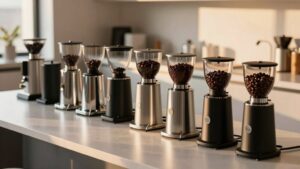
After accounting for retention, consider whether the grinder’s footprint and operating noise fit your workflow. A blade grinder usually occupies less counter space and costs less, but its blade creates more noise and heat. A burr grinder needs room for its hopper, motor, and adjustment assembly; yet it delivers controlled particle size for more predictable extraction.
If you’re making several espresso shots daily, an electric burr grinder may justify its larger footprint and motor noise through faster, convenient operation. For early-morning, office, dorm, or travel use, a manual burr grinder offers compact dimensions and near-silent operation, although you’ll supply the torque yourself. Choose a location where you can grind without relocation. A tolerable, countertop-ready setup makes on-demand grinding easier and supports repeatable brewing reliably.
Timer Accuracy and Dosing
During a 25–30-second espresso extraction, even a small dosing error can alter puck resistance enough to make the shot taste sharper or more bitter.
Your timer alone can’t guarantee a repeatable dose. Burr grinders help because uniform particles make grind time translate more reliably into output. Blade grinders keep chopping, so elapsed seconds produce unpredictable mixes of fine dust and coarse chunks.
For dependable timer-based dosing, use this workflow:
- Weigh your target dose on a scale, then calibrate the timer to that mass.
- Check output periodically; bean density and hopper fill can change grind rate.
- Distribute and tamp the measured dose consistently, then adjust one variable at a time.
A few grams or seconds can shift puck resistance and extraction speed.
Burr Alignment and Wear
Even a well-calibrated burr grinder can drift when its burrs shift out of alignment or wear down. Rough handling, refitting, or inaccurate calibration can change the gap between the stationary and moving burrs, widening particle distribution and disturbing extraction balance.
Check for uneven clearance around the burr circumference; a small misalignment may produce extra fines in one adjustment region, making a 25–30-second espresso pull taste muddy or uneven.
Wear changes the burr’s geometry and bite, typically increasing fines and unpredictability. Conical and flat burrs wear through different contact patterns, so your dialed-in setting may drift differently. Clean on schedule, and use a grinder cleaner such as GRINDZ to remove oily buildup.
Recheck calibration regularly, then replace worn burrs when adjustment can’t restore consistency.
Static and Clumping Behavior
You’ll see static charge pull fine particles toward each other, the filter, and the grinder walls. Blade grinders typically create more ultra-fines, which form clumps and disrupt dosing and water flow.
Burr grinders limit extreme fines, but you can still reduce clumping with a quick tap, settle, or dry-brush sweep.
Static Charge Effects
Static charge builds as coffee moves through the grinder, especially in dry winter air or through plastic hoppers. Charged grounds cling to walls, then release in batches, so your delivered dose and bed distribution vary. Espresso becomes less repeatable even when your burr setting is correct.
- Dose stability: Retained particles alter the mass you transfer and can carry over into the next shot.
- Flow stability: Fine particles concentrate locally, extracting faster and increasing the chance of harsh or sour notes.
- Equipment choice: Blade grinders amplify static effects through their wide particle-size mix; burr grinders usually moderate them.
Keep the hopper dry, brush retained grounds away, and purge when appropriate.
Weigh each dose and check distribution to catch static-driven variation before brewing begins.
Clump Formation Causes
During grinding, dry coffee grounds can accumulate static, especially in low-humidity rooms, causing them to cling to the chute and pack into sticky clumps instead of falling evenly. Blade grinders often produce more fine dust and mixed particle sizes, and fines electrostatically pack together, creating uneven doses. Even with a burr grinder, very fine settings increase surface area and can encourage clumping, so grounds may land in dense pockets rather than a uniform bed.
In espresso, those clumps disrupt extraction. Water can channel around dense masses and through thin areas, changing extraction speed during the 25–30-second window. After dosing, gently tap or stir the grounds in your portafilter to break apart charged particles and distribute them evenly. Keep humidity reasonable; you’ll reduce static and improve shot repeatability.
Espresso vs. French Press
For espresso, you need a burr grinder’s fine, tightly controlled output to dial in consistent 25–30-second extractions. French press uses coarse grounds and tolerates more variation, but consistent coarseness still improves clarity and limits bitter fines.
If you’re using a blade grinder, choose French press over espresso, where unpredictable particle sizes make repeatable adjustment difficult.
Espresso Grind Precision
Espresso exposes grind inconsistency more severely than French press because its 25–30-second brew time leaves little room for uneven extraction. You’ll notice that tiny fines can over-extract quickly, while larger boulders may contribute little during that short window. A burr grinder narrows the distribution, so water moves through the puck more evenly under pressure and produces clearer sweetness and acidity, with fewer harsh or dry notes.
Use this workflow:
- Choose a burr grinder with fine, adjustable settings; stepless control helps you make precise dial-in changes.
- Adjust one variable at a time, because blade-grinder runtime changes particle distribution unpredictably and weakens repeatability.
- If you brew both methods, select a grinder that shifts reliably from espresso-fine to coarser settings without sacrificing calibration.
That choice protects consistency.
French Press Coarseness
At the grinder, espresso demands fine, uniform particles for a roughly 25–30-second extraction, while French press needs coarser grounds for its several-minute steep. Espresso’s fine particles provide enough surface area for rapid extraction; a coarse espresso grind tastes sour or sharp because water can’t extract enough in about 30 seconds.
For French press, that setting would raise resistance and expose fines to prolonged contact, releasing bitter, drying compounds before you skim and plunge.
Choose a coarse setting that limits fines without creating chunks. Blade grinders make this difficult: dust can over-extract while fragments remain under-extracted, making muddy coffee. A burr grinder lets you select a coarse setting for immersion. Switching methods, adjust the burr gap—not grind time—because French press needs drinkable grounds after minutes.
Matching Grind Consistency
Although both methods benefit from an even grind, espresso exposes inconsistency more severely because small particle-size changes alter puck resistance and shot timing within its roughly 25–30-second extraction. Dial in with a burr grinder; its narrower distribution keeps flow more uniform and makes adjustments repeatable.
- For espresso, adjust grind size in tiny steps, watching time and taste; fines can over-extract while coarse particles leave sour, weak zones.
- For French press, choose a coarse, even setting to limit fines through the mesh.
- You can use a blade grinder here, but pulsing and shaking won’t match burr consistency; expect muddy bitterness beside under-extracted chunks.
Because immersion is more forgiving, you may still get a drinkable cup, but consistent burr grinding improves overall clarity, balance, and repeatability.
Check Grind Adjustment Range
Before choosing a grinder, check whether its adjustment range reaches the ultra-fine settings required for espresso and provides enough resolution to dial in a roughly 25–30-second extraction. If the range is too narrow, you may not create enough puck resistance to slow flow, leaving you with thin, sharp shots. Blade grinders commonly lack grind adjustment, relying on grind time and agitation, so they can’t reach or repeat espresso settings.
A burr grinder gives you control. Stepless adjustment lets you make micro-corrections instead of jumping between clicks. Stepped settings can work, but they limit positions and make shot-to-shot consistency harder.
Once you find the sweet spot, keep it stable; tiny changes at espresso settings can quickly shift extraction toward under-extracted or bitter flavors. That protects brewing repeatability.
Conclusion
When you choose a grinder, prioritize particle-size control over marketing claims. Burrs generally give you a more uniform grind than blades, improving extraction across espresso and French press, but alignment, wear, retention, static, and clumping still matter.
Compare flat and conical designs, check the adjustment range, and consider noise and counter space. If you single-dose, verify that the grinder clears its chute. You’ll taste the difference whenever your equipment matches your brew method with precision.