
Espresso Machine Leaking Water Causes
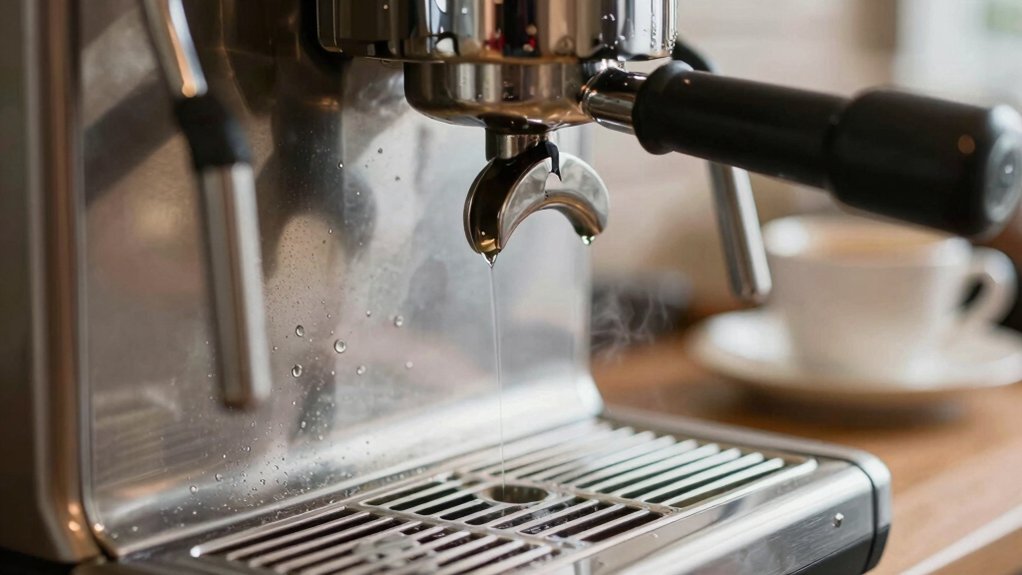
If you see water where it shouldn’t be, start with seals, fittings and drain paths: worn gaskets, cracked hoses or clogged drains let boiler or brew water escape.
Check the three-way/pressure-relief valve and its spring setpoint; weak springs, corroded seats or wrong orifice sizes trigger intermittent discharges under brew pressure.
Measure leak flow (ml/min or bubbles) and compare to a 0.5–2 L/hr practical threshold. Keep diagnostics and specs handy and you’ll find targeted fixes if you look further.
Quick Overview
- Worn grouphead gaskets or portafilter seals commonly drip during or after brewing, especially under brew pressure.
- Faulty or misadjusted three-way (dump) valves cause continuous weeps or sprays after extraction.
- Cracked or loose water lines, fittings, or drain hoses produce visible leaks and higher flow rates.
- A leaking or improperly set pressure relief valve (PRV) will discharge water when setpoint, spring, or orifice are compromised.
- Condensation, overflowed drip trays, or minor seepage under 2 L/hr can mimic leaks; however, they rarely indicate immediate failure.
Leak Flow Rate Chart
How much is “a leak” in an espresso machine? You gauge leak flow by measurable rates: 4–7 cc/min at 1–2 bar is typical for water systems, but espresso components need tighter control.
You’ll use pressure testing to detect pressure-dependent leaks; solenoid or gasket failures often show only under brew pressure. Monitor bubble counts or ml accumulation to convert perception into numbers: 0.1 cc/s gives ~24 bubbles/s; 0.01 cc/s is ~2 bubbles/s.
Replace seals or service valves if rates exceed acceptable limits for espresso hardware.
| Parameter | Typical Value |
|---|---|
| Test Pressure | 1–2 bar |
| Acceptable Leak | 4–7 cc/min |
| Bubble Rate (0.01) | 2/s |
| Conversion Tip | Use air decay tests |
.5–2 L/Hr Limits
Why set a 2 L/hr limit for espresso machine leaks? You use 2 L/hr as a practical threshold: below it, small weeps often stem from condensation or minor seal seepage; above it, you’re facing component failure that can damage electronics or flooring. This limit ties to service intervals and safety protocols.
Inspect leak sources when measured flow exceeds 2 L/hr. Compare against l/hr limits in maintenance logs. Verify components against valve pressure rating specs to ensure relief and check valves aren’t allowing excess flow.
Prioritize repairs (gaskets, three-way valve, drain hoses) when persistent flow nears or exceeds 2 L/hr to prevent escalation. Use measurable l/hr limits to trigger diagnostics and protect hardware.
Pressure Relief Valve Specs
Check the pressure relief valve for its pressure rating and spring tension specs so you know the force and setpoint it’s designed to hold. Measure the orifice size and confirm relief setpoint adjustment range. Undersized or corroded ports or weakened springs will cause unintended draining.
Inspect valve materials for corrosion resistance and wear. Degraded surfaces change flow characteristics and shift the operating setpoint.
Valve Pressure Rating
A pressure relief valve (PRV) on an espresso machine is rated to open at a specific pressure to protect the boiler and brew circuit. You should match that rating to the machine’s design pressure and pump output. You’ll check the valve pressure rating against the system’s maximum allowable working pressure; mismatches let the PRV either chatter or stay closed until overpressure occurs.
Specify the valve flow capacity so the valve can evacuate steam or water fast enough within the expected pressure range without causing undue backpressure. Inspect manufacturer datasheets for pop‑open setpoint tolerance, reseat characteristics, and flow coefficients (Cv). When you replace a PRV, choose one with compatible materials and certified ratings. Improper selection risks persistent leaks or catastrophic failure.
Spring Tension Specs
How tightly should the relief valve spring be set to protect your boiler without causing nuisance releases? You’ll set spring tension to open the pressure relief valve at the manufacturer’s specified psi; this prevents overpressure while avoiding valve leakage from an over-sensitive spring.
Check the calibration mark on the valve cap and use a spring tester or calibrated gauge when adjusting. Small turns change set points significantly. If the spring is weak or corroded, it will lower the opening pressure and cause persistent leakage even though boiler pressure reads normal. Conversely, an overtightened spring risks unsafe pressure.
Replace springs with exact-spec parts and document the target set point. After adjustment, run multiple heat cycles and monitor for consistent opening behavior and absence of valve leakage.
Orifice Size Measurement
After you set the relief spring to the manufacturer’s psi, measure the valve orifice to confirm flow capacity and release characteristics match that setting. You’ll remove the valve, clean the seat, and use pin gauges or a calibrated bore micrometer to determine orifice diameter to ±0.01 mm. Record the measurement against the spec sheet; orifice sizing directly affects how quickly pressure bleeds when the relief opens.
For reliable flow calibration, bench-test the valve with a controlled pressure source and measure discharge flow versus pressure. Adjustments require swapping to the specified orifice insert or replacing the valve assembly. Document final orifice size, test pressure, and flow rate so service intervals and parts ordering remain traceable and repeatable.
Relief Setpoint Adjustment
Why set the relief valve precisely? You calibrate the relief setpoint to control system pressure margins and prevent excess leak flow through seals or auxiliary drains. If the setpoint is too low, the valve opens frequently; this produces continuous weepage into the drip tray and masks other faults. If the setpoint is too high, you risk overpressurizing groups; this stresses gaskets and expansion valves until they fail.
Use a calibrated gauge and incrementally adjust the screw or shim. Then run pressurization cycles while monitoring steady-state and transient pressures. Measure leak flow rate after adjustment to confirm closure integrity under brew and steam load. Record the factory spec, final setpoint, and measured leak flow for routine maintenance and diagnostics.
Material And Corrosion
What materials are best for a pressure relief valve depends on the water chemistry and operating temperature of your machine. You’ll choose metals and elastomers that offer corrosion resistance and proven material compatibility with boiler water, softeners, or RO-treated supplies.
Stainless steel (316) resists pitting from chlorides and high temperatures; brass alloys are common but need dezincification-resistant grades in aggressive water. Silicone or EPDM seals tolerate heat and steam; Viton suits higher temps and chemical exposure.
Specify valve spring and fastener coatings to prevent galvanic corrosion where dissimilar metals meet. Test valves in your expected pH and conductivity range, and document material certificates.
Correct specification prevents premature leaks, maintains relief setpoint accuracy, and extends service intervals.
Frequently Asked Questions
Why Does Coffee Leak Around the Portafilter Rim?
Because worn group head gaskets no longer seal, water and coffee escape around the portafilter rim. You’ll see poor extraction, grounds in the cup and drip tray, and reduced espresso compatibility with certain baskets.
To fix it, remove the dispersion screen, extract the old gasket, and install a new seal. For topic ideas, include gasket wear diagnostics, replacement steps, and compatibility of gasket sizes and materials with your machine.
How Often Should I Replace Group Head Gaskets?
Replace group head gaskets every 6–12 months under normal use. Inspect sooner with heavy daily brewing. You’ll watch for gasket wear by checking the portafilter rim for coffee leaks and irregular spray patterns.
During maintenance, remove the dispersion screen to view the seal and measure compression. Timely gasket swaps restore proper sealing, prevent leaks, and maintain consistent pressure for optimal extraction. Keep spares and a gasket pick handy.
Can I Clear a Blocked Drain Hose Myself?
Yes, you can usually clear a blocked drain hose yourself. You’ll disconnect the hose, inspect for kinks or ruptures, and flush it with water or a mild descaling solution to remove debris.
Use a flexible brush or compressed air for stubborn clogs. After hose maintenance, reinstall securely and test for leaks.
If the hose is damaged or internal piping leaks, stop and call a technician to avoid voiding warranties.
Why Does Steam Wand Drip After Descaling?
You’re seeing a steam wand drip after descaling because descaling effects loosen mineral deposits and trapped water in the wand and valves. This lets residual fluid escape.
You should purge and flush the steam wand; operate valves to expel trapped solution; and run several steam cycles until clear. Check valve seating and clean any softened scale remnants. If dripping persists, the expansion/steam valve seals may be degraded and need inspection or replacement.
What Causes Continuous Drainage From the Water Tank?
Continuous drainage usually happens when the water tank isn’t seated correctly, which opens the intake or release valve and floods the drain. You should perform leak detection by checking tank alignment, intake seals, and the release valve. Reposition the tank and reseat seals.
Maintenance tips: Verify sensory resets after emptying drip trays. Clean and inspect seals regularly, and replace worn gaskets to prevent ongoing drainage and protect internal components.
Conclusion
You’ve now got the key checks to stop an espresso machine from leaking: measure leak flow against the 0.5–2 L/hr guideline, inspect the pressure relief valve for correct pressure rating and spring tension, and verify orifice size and condition for corrosion.
Adjust the relief setpoint only after confirming material integrity and sealing surfaces. Follow precise measurements and specs, replace corroded parts, and document settings so you can reliably maintain safe, leak-free operation.