Single Boiler Vs Dual Boiler Espresso
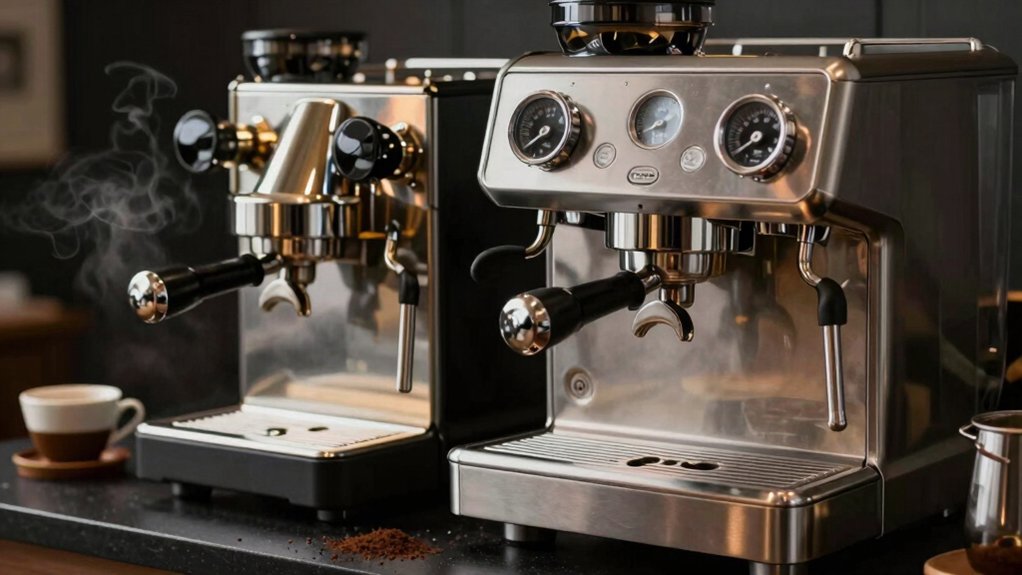
You’ll pick a single-boiler if you want lower cost, faster startup and better energy use for mostly espresso with occasional steaming. It heats in about 5–15 minutes and uses less standby power but needs mode switching and has slower recovery.
A dual-boiler costs more and takes 25–45 minutes to stabilize; however, it gives simultaneous steaming and extraction with PID-level temperature steadiness for high throughput. Keep going and you’ll get the heat-up, PID and safety-valve details that clarify the choice.
Quick Overview
- Single-boiler machines heat faster and use less standby power, but require mode-switching between brewing and steaming.
- Dual-boiler machines take longer to warm up; however, they allow simultaneous, stable steaming and extraction for high throughput.
- PID temperature control greatly improves single-boiler consistency and makes dual-boiler stability even more precise.
- Thermoblock systems reach ready state fastest; they are suitable for quick single shots but offer less thermal mass stability than boilers.
- Regular maintenance—monthly valve inspections, descaling, and seal checks—prevents safety and performance issues in both types.
Boiler Heat-Up Time Comparison
CURIOUS HOW LONG YOU’LL WAIT BEFORE PULLING YOUR FIRST SHOT? YOU’LL NOTICE THERMOBLACK INSIGHT FAVORS THERMOBLOCK AND SINGLE-BOILER MACHINES FOR RAPID READINESS: THERMOBLOCKS HEAT IN 1–5 MINUTES, SINGLES IN 5–15. DUAL BOILERS NEED 25–45 MINUTES FOR FULL STABILITY; THOUGH THE BREW CIRCUIT OFTEN REACHES OPERATING TEMP SOONER.
| Machine Type | Warm-Up Time | Practical Note |
|---|---|---|
| Thermoblock | 1–5 min | Fastest start |
| Single Boiler | 5–15 min | Quick but mode-switching needed |
| Dual Boiler | 25–45 min | Longer warm-up, steady temps |
FOR ENERGY BUDGETING, SINGLES CONSUME LESS STANDBY POWER AND AVOID COOLING FLUSHES. DUALS DRAW MORE BUT GIVE CONSISTENT EXTRACTION AND SIMULTANEOUS STEAMING, IMPROVING THROUGHPUT FOR HEAVY USE.
PID Temperature Settings
How precisely do you want your brew temperature held? You’ll find PID temperature settings change the game between single and dual boilers. With a PID, you monitor pid stability and tune proportional, integral, derivative gains to reduce overshoot.
On a single boiler, you’ll get +/-1–2°F when you’re patient; it still demands mode switching and longer recovery. A dual boiler with PID gives rock-solid setpoints and minimal drift, ideal for light roasts and repeatable shots.
Consider these visual cues:
- Tiny LED readout steady as a heartbeat.
- Needle barely quivering on a dial.
- Steam wand idle while brew temp holds.
- Shot after shot identical in crema.
You’ll weigh heat control debates: complexity and cost versus consistent extraction.
Steam Pressure Safety Valve
You’ll want to check the steam pressure safety valve to understand how it limits maximum boiler pressure, how typical setpoints differ between single and dual boiler machines, and how the mechanism vents excess steam to prevent overpressure.
Compare valve settings and wear patterns: dual boilers usually run higher sustained steam pressures, so their valves and inspection schedules are more demanding than on single-boiler units. If a valve sticks, leaks, or chimes frequently, you’ll need targeted maintenance, calibration, or replacement rather than simple cleaning.
Purpose Of Valve
Why does a steam pressure safety valve matter in an espresso machine? You rely on it to prevent dangerous overpressure by relieving excess steam when boilers exceed safe limits. Functionally, it’s a mechanical fail-safe that protects you, the machine, and the brew quality.
When comparing single and dual boilers, valve placement and valve material become critical choices. On a single boiler, the valve often sits near the combined steam/brew chamber; it must tolerate temperature swings and corrosion. Dual boilers let you place dedicated valves on the steam boiler, simplifying calibration and reducing cross-contamination risk. Brass or stainless valves resist scale and high heat; spring design and seat finish determine response consistency.
Proper selection and placement improve safety, serviceability, and steam reliability.
Pressure Settings Explained
Having the right safety valve in place is only the start. Setting its pressure determines how the boiler behaves under load and how safe the system stays. You’ll set lower relief pressure on single boilers because they combine brew and steam duties. Too high, and you risk overpressurizing during steaming cycles.
Dual boilers can tolerate higher steam-valve settings since the steam boiler is dedicated and designed for sustained pressure. Don’t confuse this with an irrelevant topic like pump pressure; the safety valve specifically protects against boiler overpressure, not extraction dynamics. Avoid treating it as an unrelated concept to thermal management.
You should follow manufacturer specs, adjust incrementally, and verify with a calibrated gauge so safety margins and steam performance remain predictable and compliant.
Safety Mechanism Operation
A steam pressure safety valve prevents the boiler from exceeding safe limits by opening at a preset pressure. You’ll want to understand how its set point, response speed, and maintenance differ between single- and dual-boiler machines. You’ll notice dual boilers often use valves calibrated to tighter tolerances because independent steam boilers run higher, sustained pressures. Their quicker response reduces risk during heavy steaming.
Single-boiler valves can be simpler and are set with slightly wider margins since the machine cycles between brew and steam modes. In both designs, you should regard valve sizing, blow-off capacity, and placement; they affect how fast excess pressure vents.
For topic ideas unrelated to the listed H2s, compare valve reset types, fail-safe redundancy, and manufacturer calibration protocols.
Maintenance And Inspection
Curious how to keep the steam pressure safety valve reliable? You’ll inspect it monthly: look for mineral buildup, corrosion, and smooth spring action.
On single boilers, the valve experiences wider thermal swings; so test it after steam cycles. On dual boilers, it’s under steadier load but still needs periodic manual lift to clear deposits.
Use a soft brush and descaler per manufacturer instructions, and replace seals at the first sign of hardening. Don’t treat valve care as an irrelevant topic or dismiss it as an unrelated concern. Failure risks pressure faults and voided warranties.
Keep clear records of inspections and parts replaced so you can compare wear patterns between single- and dual-boiler machines over time.
Troubleshooting Common Issues
How do you tell when a steam pressure safety valve is starting to fail, and what should you do first? Listen for irregular hissing or clanking during steam cycles; increased cycling, weak steam, or continuous leaks signal wear.
First, shut down and depressurize the machine. Then, inspect the valve and surrounding fittings for mineral buildup: water filtration reduces scale that accelerates failure. Compare single and dual boiler behavior: singles may show more frequent cycling because of mode shifts, while duals run steadier yet still need valve checks.
For noise comparison, note whether sounds change with load; persistent high-pitched releases or rattles mean replacement. Follow manufacturer torque specs when reseating or replacing the valve, and test pressure with a gauge after service to ensure safe operation.
Frequently Asked Questions
Can I Brew and Steam Simultaneously With a Single Boiler?
No, you can’t brew and steam simultaneously with a single boiler. You’ll need to switch modes; so your brew timetables must include warm-up and recovery delays. Compared to dual boiler steam dynamics, a single boiler yields slower pressure recovery and variable temperature during steaming.
You can manage occasional milk drinks, but you’ll sacrifice speed and consistency. If you want simultaneous operation and stable steam dynamics, a dual boiler is the better choice.
Which Boiler Type Is Better for Travel or Small Kitchens?
You’ll prefer a single boiler for travel or small kitchens because its compact design and energy efficiency suit tight spaces and lower power budgets. It’s lighter, cheaper, and draws less standby power. Thus, you’ll save on footprint and running costs.
A dual boiler gives superior workflow and steam consistency for heavy use; however, its larger size, higher energy draw, and longer warm-up make it less practical for portable or space‑limited setups.
Do Dual Boilers Require More Maintenance Than Single Boilers?
Yes, dual boilers usually need more maintenance. In a maintenance comparison, you’ll manage two heating systems, extra plumbing, and potentially two PID circuits; this increases inspection points and service costs. Longevity considerations favor regular descaling, gasket checks, and wand cleaning to prevent issues. If you keep up, dual systems can last longer thanks to less thermal cycling.
If you want simpler upkeep, a single boiler will be easier and cheaper to maintain.
Can I Retrofit a PID Into My Single Boiler Machine?
Yes, you can retrofit a PID into many single boiler machines. Retrofit feasibility depends on space, wiring, and sensor access. You’ll assess PID retrofit potential by checking heater type, existing thermostat, and boiler probe spots.
You’ll need basic electrical skills, a compatible SSR, RTD or thermocouple, and careful wiring. Compared to buying a PID-equipped dual, retrofitting is cost-effective; however, it requires time, calibration, and accepting limited temperature dynamics.
How Does Boiler Type Affect Espresso Taste Over Time?
Boiler type affects espresso taste over time by changing espresso flavor stability and extraction consistency. You’ll get steadier shots from dual boilers with precise temps and PID; single boilers can drift during mode switches and need temperature surfing or a retrofit to improve stability.
Boiler material durability also matters. Brass or stainless lasts and resists scaling better than softer alloys, preserving heat stability and reducing off-flavors as the machine ages.
Conclusion
You’ve seen how single and dual boiler machines differ in heat-up time, PID control, and steam-pressure safety valves. Choose a dual boiler if you want near-instantaneous steaming and separate PID tuning for brew and steam. Pick a single boiler to save space and simplify maintenance while accepting trade-offs in recovery time and workflow.
Inspect valves and follow maintenance schedules to keep safety mechanisms reliable. Troubleshoot with pressure and PID checks to maintain consistent espresso performance.