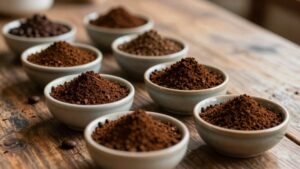
Coffee Grind Size and Consistency Glossary for Better Brewing
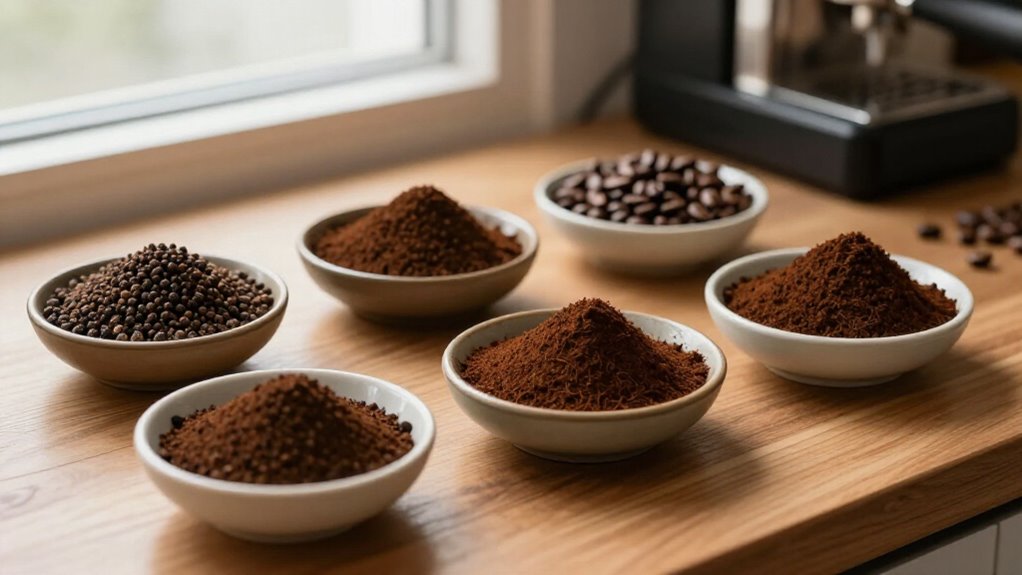
To brew more consistently, use your burr grinder’s setting to control particle size: finer grounds extract faster, while coarser grounds slow extraction. Flat burrs emphasize precision; conical burrs often run quietly and feed efficiently.
Check particle-size distribution (PSD), not just its average: fines can clog filters and slow flow, while boulders may underextract. Track dose, retention, and grind changes, then adjust finer for fast brews or coarser for slow ones. You’ll find dial-in guidance next.
Reading Burr Grind Settings
Burr grind settings indicate the gap between the burrs: a smaller gap produces finer particles, while a larger gap produces coarser ones. On a stepped grinder, each click makes a repeatable change, so record the setting with your dose, brew time, and taste. A stepless grinder lets you adjust continuously, which helps you make smaller corrections during dialing-in.
For espresso, change only one or two notches at first; a slight shift can move the shot from bitter and drying to sour and weak. Use extraction time and flavor to guide each adjustment: coarsen if brewing runs too long, or grind finer if it runs too short. Don’t assume the number stays permanent. Wear, alignment changes, and seasoning can alter particle size at the setting.
Flat vs. Conical Burrs
Once you’ve recorded your grinder setting, the burr shape becomes the next factor to evaluate. Flat burrs use two matching, serrated discs: one rotates while the other stays fixed. Conical burrs use a rotating inner cone inside an outer ring, letting gravity assist feeding and reduce motor load. Both crush and shear beans between hardened steel or ceramic surfaces, but their geometry changes heat, speed, and exit path.
| Aspect | Guidance |
|---|---|
| Flat | Flat burrs suit precision-focused commercial espresso and high-end home grinders. |
| Conical | Conical burrs commonly suit versatile home grinding and quieter operation. |
| Selection | Selection depends on your brew methods, workflow, and machine design; don’t assume one shape always wins. |
| Calibration | Calibration remains essential: compare results within your specific grinder, because diameter, RPM, alignment, and burr material alter your results directly. |
Particle Size Distribution Terms
When you evaluate particle size distribution (PSD), you assess how your grind spans from fines to boulders rather than relying on one setting. You’ll compare the modal particle size—the most common size—with the mean particle size, the arithmetic average.
You’ll also use D10, D50, and D90 to identify the sizes below which 10%, 50%, and 90% of your particles fall.
Particle Size Distribution
Particle size distribution (PSD) describes how many coffee particles fall within each size range, rather than reporting only the average grind size. A unimodal PSD has one dominant size range, so you can expect more predictable extraction and cup balance. A broad or multimodal PSD spreads particles across distinct ranges, making results less consistent.
PSD sharpness indicates uniformity: a narrower peak signals tighter control. Burr grinders usually produce a more controlled distribution because burr teeth crush coffee across a fixed gap. Blade grinders create greater variability because their spinning blades chop unevenly.
For deeper analysis, laser particle analysis (LPA) measures size ranges and can reveal whether a grinder produces a unimodal distribution. Use a burr grinder and record settings to improve repeatability across brews.
Fines And Boulders
Your brew contains both extremes and mid-size grains, so an uneven distribution extracts inconsistently. Excess fines clog filters, slow flow, and add sediment; boulders leave soluble material behind. You’ll get tighter results from a burr grinder than a blade grinder, which creates more extreme particles.
Keep your dose, water, and recipe fixed while judging flow and flavor. Bitterness or drying suggests fines: grind slightly coarser. Sourness, weakness, or thinness suggests boulders: grind slightly finer. Record settings and results so you can repeat improvements.
Modal Particle Size
To understand how evenly a grinder performs, look at its modal particle size—the size produced most often in a batch. This mode identifies the peak in your particle-size distribution (PSD). A concentrated mode means more particles cluster near one size, so you can expect more predictable extraction.
If the PSD spreads from fine to coarse, fines and large chunks increase uneven extraction.
Check whether the distribution is unimodal or multimodal. A single dominant peak is generally easier to dial in than several peaks. Burr geometry influences this shape; large flat burrs often create a more unimodal distribution, while other designs may produce a wider mix.
To evaluate your grinder, use a particle analysis if available, or compare repeated brews for flow and taste.
Mean Particle Size
Mean particle size is the average grind size, typically reported in microns, and it helps you estimate how quickly water will extract coffee solids during a given brew time. A smaller mean generally exposes more surface area, speeding extraction; a larger mean slows it.
Check the particle-size distribution around the mean. When most particles cluster tightly near it, you’ll usually get cleaner, more predictable extraction. A wide distribution combines fines that extract quickly with coarse particles that extract slowly, potentially increasing muddiness or uneven flavor.
A single peak suggests a more uniform grind, while multiple peaks may signal inconsistent grinding. Burr geometry influences this pattern: large flat-burr grinders can produce a uniform distribution. Record your grinder setting, brew time, and taste, then adjust incrementally.
D10, D50, And D90
A mean or median alone can’t show how widely your grind varies, so particle-size reports often use D10, D50, and D90.
D10 is the size at which 10% of total particle mass consists of grains smaller than that value. Treat it as a marker for the fine-dust tail, including fines.
D50 is the median: 50% of mass lies below it and 50% above it. Use this central value to check whether your grind suits a target method, such as espresso or medium pour-over.
D90 is the size below which 90% of mass falls, so it identifies the coarse-chunk end and shows how large your upper particles become. Read values together: D10 helps you detect fines, D50 centers your setting, and D90 flags coarse particles that may affect extraction.
Distribution Span
Distribution span describes the effective range between the smallest and largest particles your grinder produces, rather than one representative size. A narrow span groups particles together, helping you limit fast-extracting fines and slow-extracting chunks. That tighter range can make control of brew time and flavor easier.
A wide span mixes different sizes. Water reaches the smallest particles quickly, increasing the risk of bitter flavors, while larger particles extract more slowly and can leave a sour, thin impression. Burr geometry influences this range: large flat burrs often create a unimodal distribution, narrowing the spread.
You can assess span with particle-size data or texture comparisons, adjust your grinder and recipe. Keep dose, ratio, temperature, and contact time consistent while testing, so you don’t mistake other variables for distribution effects.
Grind Uniformity
When you examine grind uniformity, you’re evaluating how closely the particles match in size, not just the grinder’s average setting. More uniform particles extract on roughly the same timeline, making your brew more predictable. Two grinds with the same average can still taste different if one contains extra fine dust and large chunks.
Look for a narrow grind range and a balanced distribution rather than judging consistency by texture alone. A mixed distribution combines distinct particle groups, whereas a more unimodal distribution clusters sizes more closely.
Even quality burrs produce some fines; excessive fines can over-extract and add bitterness. Use a burr grinder, inspect its output, and weigh doses consistently. If your cup tastes bitter or muddy, check retained fines and clean the grinder.
Cumulative Size Curves
Use a cumulative size curve to see what fraction of your coffee grounds falls at or below each particle-size cutoff. It reveals your fines fraction and coarse tail, so you’ll compare grinds beyond average size. A steep rise means particles occupy a narrower range, indicating greater uniformity.
A gradual slope signals wider variation, while multiple inflection points can indicate multimodal, uneven production.
When you inspect curves, look for a single peak (unimodal distribution) and a steep shift. Flat and conical burrs can produce different shapes; some flat burrs create more unimodal results. If many particles fall below about 200 microns, expect extra fines and bitterness from over-extraction. Use the curve alongside brew time and taste, then adjust your grinder one step at a time.
Retention vs. Dosing Accuracy
Retention can cause dosing errors when retained grounds vary with grind size, grinder wear, or purge habits. Measure retained grounds by comparing the input dose with the grinder’s output, especially after changing settings.
Purge the grinder and weigh each dose to improve consistency and isolate grind-size effects.
Retention Causes Dosing Errors
A grinder can retain grounds after a dose, so its input weight won’t always match its output weight. When retention is high, your dose may fall short, especially for espresso. Smaller particles lodge in the burr path and exit chute, so changing from medium to fine can reduce output until the grinder clears.
The error continues. Your next dose may contain retained grounds, shifting its effective mass and freshness even when you weigh doses. An under-dose weakens contact with water and produces weaker extraction. A later dose may overfill your recipe and over-extract.
To stabilize brewing, purge 1–3 grams after changing settings, or weigh the grinder’s output each session. Keep your brew ratio consistent while dialing in, so retention doesn’t masquerade as a grind-size problem.
Measuring Retained Grounds
Start by weighing the beans before grinding and the grounds delivered into the portafilter or brew vessel afterward. Weigh both with the same scale and calculate retention as input dose minus output dose. A difference shows how much coffee remains inside the grinder.
Compare this value with your intended dose: if you load 18 grams but deliver 17.5, you have a 0.5-gram shortfall.
Repeat the measurement across several identical doses, because retention can increase at finer espresso settings. Track input, output, grind setting, and brew results in a log. If output changes while input stays constant, your delivered dose and shot behavior may shift even when the setting hasn’t moved. Use the measured shortfall to correct your dose.
Purging For Accuracy
After changing grind settings, purge the first 1–3 grams to clear older particles from the burr path and chute. This purge makes the next output better represent your new grind distribution, rather than a mixture of retained finer or coarser particles. Without it, your first shot or brew may extract unpredictably, even when the dial appears correct.
Retention is coffee left inside the grinder after dosing, and it often increases at fine espresso settings. That retained mass can make your actual output lower than your intended dose, while purging removes part of the carryover. Use this routine after significant stepped adjustments or when switching between espresso and filter settings. It creates a cleaner starting state for evaluating extraction time, flavor, and grind and dose accuracy.
Improving Dose Consistency
Purging clears old grounds, but accurate dosing also depends on how much coffee your grinder retains during normal use. Retention is the coffee left inside: input mass minus output mass. It often increases at very fine, espresso-range settings, so your portafilter may receive less than your intended dose.
Espresso grinders thereby demand weighing.
Measure your output for each grind setting; you can’t rely on hopper fill or grind time. Weigh beans before grinding and grounds afterward, then record the difference with your setting and bean. If output falls short, adjust input dose or clear retained grounds, but keep basket dose stable. Recheck after changing grind size because burr drift can alter retention. Reducing retention or accounting for it keeps shot weight, strength, and extraction more consistent.
Dialing In a V60 Recipe
To dial in a Hario V60, set your burr grinder to a medium grind of about 700 microns and target a 3:00-3:30 drawdown. Keep your dose, water ratio, temperature, and pouring pattern constant as you’ll evaluate flow and flavor. If the brew finishes early and tastes sour, thin, or lacks finish, tighten the burrs 1–2 notches. The finer particles slow flow and increase extraction.
If the drawdown runs long and the cup tastes bitter, hollow, or drying, open the burrs 1–2 notches. Use a burr grinder, not a blade grinder, because uniform particles extract more evenly. Treat microns as your reference instead of vague texture terms. Record each setting, drawdown time, and tasting note, then change one variable at a time. Adjust per bean.
Avoiding Grinder Heat Buildup
Once your V60 grind and drawdown are consistent, control grinder heat so each dose behaves the same. Burr grinders can heat during grinding, especially when fines accumulate or retention is high. Grind your weighed dose in one controlled run, rather than repeated stop-starts that keep the motor working inefficiently.
Use shorter bursts with brief rest periods between doses to limit temperature rise and protect volatile aromatics.
If grounds linger inside, they can warm and recirculate flavor compounds into the next dose. Clear retention regularly and weigh output when consistency matters. At the day’s start, run one or two discard doses to stabilize the grinder’s thermal profile. Record your routine alongside grind setting and brew notes, so you can distinguish heat-related changes from dialing adjustments.
Turkish-Fine Grind Benchmark
Turkish coffee requires an extra-fine grind of roughly 40–220 µm, with a texture similar to powdered sugar. Aim for this benchmark to create the drink’s dense body and cohesive texture during short, hot-water contact. The tiny particles expose enormous surface area, so extraction happens quickly.
- Set: Use a burr grinder and choose its finest setting.
- Check: Rub the grounds between your fingers; they should feel flour-like, without obvious grit.
- Adjust: If the cup tastes bitter or harsh, go slightly coarser; if it tastes weak or sour, go finer.
Keep your grinder consistent, because drift or excess fines can intensify harshness. Change only one step at a time, and record the setting with your dose, water temperature, contact time, and bean. You’ll reliably reproduce a balanced, full-bodied cup consistently.
Conclusion
Use your burr grinder’s setting as a starting point, then judge the result by particle distribution, retention, and dose accuracy. Whether you’re dialing in a V60 or checking a Turkish-fine benchmark, adjust gradually and keep your brew variables controlled.
Watch for heat buildup, which can shift flavor and consistency. Record each change so you’ll build a repeatable reference. With consistent technique, you’ll turn grind size from a number on the dial into a brewing tool.