Coffee Maker With Grinder vs Separate Grinder: Which Is Better?
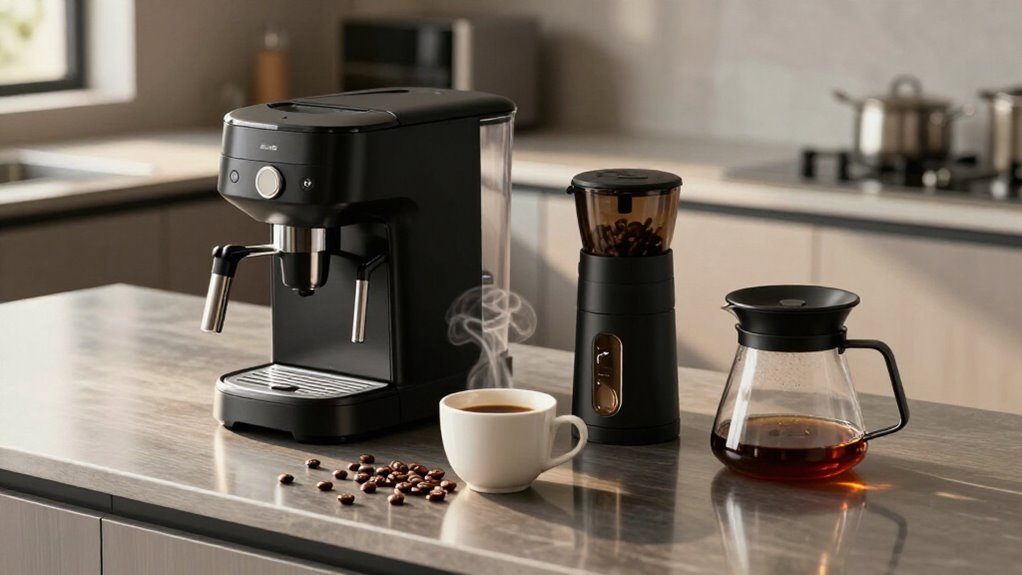
A built-in grinder gives you faster, cleaner one-touch brewing and saves counter space, but it usually uses smaller burrs, stepped adjustments, and offers less repair or upgrade flexibility.
A separate grinder and brewer take more room and add transfer steps, yet you’ll gain finer control, more uniform particles, and replacement options.
Choose integrated convenience for everyday drip coffee; choose separate equipment for espresso, experimentation, and maximum dialing accuracy.
Compare trade-offs below to find your fit.
Countertop Footprint Snapshot
If counter space is limited, a coffee maker with a built-in grinder usually occupies less horizontal area than a separate grinder and brewer, but it may be taller and deeper than a standard drip machine.
You gain one footprint and clutter, yet you must measure cabinet clearance, appliance depth, and access around the unit. Separate equipment needs more counter area when active, but you can move the grinder elsewhere or store it between brews.
| Setup | Counter demand | Main spatial concern |
|---|---|---|
| Built-in | Lower horizontal area | Height and depth |
| Separate | Higher when active | Two placements |
| Best fit | Small counter | Check clearance |
| Flexible | Store one unit | Requires moving |
Before buying, tape footprints on your counter, open cabinets, and confirm airflow and access. You’ll prevent crowding and returns.
Built-In vs. Standalone Burrs
Beyond footprint, the burr design determines how precisely you can control extraction. Built-in grinders typically use smaller 40–50mm burrs and stepped settings, so you’ll get fewer adjustment points and less room for espresso’s micron-level changes. They can still suit convenient drip brewing, especially when you value a repeatable, minimal-step routine.
Standalone grinders often use 55mm-plus burrs and may offer stepless dialing, producing more uniform particles and finer control across brew methods. You can also upgrade the grinder independently of your brewer, raising your system’s performance ceiling. Check dose consistency, retention, and cleaning access, because specifications don’t guarantee repeatability. Choose built-in burrs for simplicity and everyday coffee; choose standalone burrs if you’ll dial in light roasts, espresso, or varied recipes and want precise, upgradeable control.
Boiler-Driven Extraction Quality
Burr precision can’t compensate for unstable brewing temperature, so boiler performance deserves equal attention. For extraction, your brewer should maintain roughly 195–205°F throughout the cycle. Some tested machines reached only about 185°F, leaving well-ground coffee underextracted.
Others required three to five minutes to heat, then developed end-of-cycle spikes that shifted flavor balance. One GE Smart Grind model overshot its 200°F target, reaching 209°F.
When you compare an integrated coffee maker with a separate grinder and brewer, evaluate heating control independently from burr quality. The dose and grind can taste different when a boiler warms or stabilizes inconsistently. If temperature remains outside the target window, better grinding won’t rescue the cup. Choose a machine that documents stable brew temperatures, not merely one that offers grinding.
Dial-In and Puck Prep
Dialing in puck prep starts with a repeatable dose and grind, and an integrated grinder can simplify that process by measuring grounds automatically. However, verify output with a scale: some machines miss targets, dosing about 14 grams too much or 8 grams too little. Recalibrate when necessary.
In drip brewing, water temperature can limit dialing; 185°F falls below the 195–205°F target, so grind changes alone may not produce consistent flavor.
For espresso, puck preparation demands finer control. Stepped settings can make micron-level adjustments difficult, while a standalone stepless grinder lets you tune extraction. Automated tamping reduces variation but can’t fix coarse increments. Weigh your dose, distribute evenly, tamp level, and change one variable at a time. Choose integrated convenience; choose a separate grinder for precision.
Hopper Size and Switching
A larger hopper, such as the roughly 1-pound hopper on the Breville Grind Control, lets you brew more often without refilling and helps preserve your grind setting between sessions. That capacity suits routine brewing, but switching beans becomes a workflow decision.
The smart reservoir can select a brew amount with a full reservoir; it still depends on the hopper’s current beans.
- Choose a larger hopper if you favor one roast and brew frequently.
- Choose a separate grinder if you alternate light, dark, and decaf beans.
- Expect an all-in-one espresso machine to require dose and grind redialing after a switch.
- Check hopper access and emptying procedures before buying.
If you switch, prioritize practical changeover and stable adjustment over capacity. Separate equipment usually makes switching cleaner.
Dose Retention and Purging
When grounds remain in the grinder-to-brew path, a built-in coffee maker can deliver a different dose than its setting indicates. Retained grounds make timed dosing drift between cycles, so you’ll often receive too much or too little coffee even when the programmed volume stays unchanged. In testing, Gevi delivered 14 grams over a 36-gram target, while Capresso and Cuisinart averaged about 8 grams under it.
Separate grinder setups reduce this effect because you can weigh the output and purge consistently before brewing. If the first shot changes after machine sits or you switch beans, purge retained grounds and repeat the dose. Use a built-in machine’s calibration routine when available; Breville Grind Control provides a calibration routine.
Expect waste grounds after adjustments, purging, or switching beans.
Noise and Cleaning Burden
After managing retained grounds and purge waste, you’ll also need to take into account noise and maintenance. An integrated machine transmits grinder vibration, heat, and sound through one chassis, so you may perceive louder operation at the brewer and expose nearby components to more mechanical disturbance. A separate grinder isolates those effects from your coffee maker or espresso machine.
- Choose separate equipment if noise or vibration near your brewer matters.
- Expect tighter internal spaces when removing built-in burrs or wiping chutes.
- Include the hopper, grounds chute, and dosing path in routine cleanup.
- Clean a separate grinder independently, without opening or disturbing the brewer.
A combined unit can increase your maintenance burden because both systems share one housing. Oily or flavored beans accelerate residue buildup.
Repairability and Upgrade Paths
When you choose an all-in-one machine, grinder repairs may require shipping or replacing the entire unit, while separate components let you replace only the failed part. You’ll also find modular grinders easier to access, service, and maintain than tightly integrated systems.
If you expect to upgrade over time, separate equipment lets you improve the grinder or brewer independently instead of replacing both together.
Access To Repairs
If the built-in grinder fails, an all-in-one coffee maker may require service for, or replacement of, the entire machine. You’ll also face more complex repairs because tightly packed assemblies restrict access to burrs, motors, and wiring.
A separate grinder usually lets you isolate the fault, service that unit, and keep brewing with the existing machine. Before buying, check:
- Whether the manufacturer sells burrs, motors, and switches
- Whether you can access service manuals or exploded parts diagrams
- Whether authorized technicians operate near you
- Whether the warranty covers labor, shipping, and diagnostic fees
Choose a model with removable grinder components and documented maintenance procedures. You should also ask how calibration and dosing changes interact with descaling or brewer service; integrated controls can tie both tasks to one chassis.
Upgrade Flexibility
Beyond repair access, separate components give you more flexibility as your coffee setup evolves. You can keep a capable grinder, such as a Baratza or Breville, while upgrading from an entry-level espresso machine to a better model. You’ll invest in the grinder once and carry it forward, rather than replacing both functions when an all-in-one brewer or grinder fails.
Separate equipment also makes servicing more practical: you can replace the failing side independently, while tighter integrated packaging can complicate burr removal and maintenance.
An all-in-one locks you into its grinder’s adjustment range and burr limitations. One failure can force whole-unit service or replacement, shortening the upgrade horizon. For longevity, choose modular, repairable designs; they may last 10–15 years versus roughly 2–8 for typical consumer units.
Busy Morning Workflow
For one-touch morning brewing, you can start faster with an all-in-one machine because it grinds, doses, and brews in sequence. A separate grinder and brewer require more countertop setup time, but you gain easier control and independent operation.
Compare cleanup and refilling needs, since integrated systems can retain grounds while separate units are often easier to access and maintain.
One-Touch Morning Brewing
A built-in grinder can streamline your morning by combining dosing, grinding, and brewing in one touch; models such as the Breville Barista Express Impress add automated tamping and dosing feedback to simplify espresso preparation.
For a routine, check these factors:
- One-touch brewing reduces transfers and speeds time-to-first-cup, but doesn’t guarantee accurate dose.
- Test your machine’s output: Gevi over-dosed by about 14 grams for a 20-ounce brew, while Capresso and Cuisinart averaged roughly 8 grams too little.
- Expect some machines to heat only to about 185°F, below the ideal 195–205°F; three to five minutes before brewing.
- Calibrate strength and dosing when possible; Breville Grind Control reaches its 36-gram target only at the highest strength setting.
A separate setup lets you replace only failed components.
Countertop Setup Time
Morning speed usually favors an all-in-one machine because it combines grinding, dosing, and brewing without requiring you to transfer grounds between devices. On a busy morning, you can load beans, select a brew size, and start one programmed cycle. A separate grinder requires grinding into a catch cup, dosing, and transferring grounds to the brewer, adding handling and counter space.
However, integrated speed isn’t automatic. Inconsistent dosing may force you to weigh or adjust grounds; tests found errors from about 8 grams low to 14 grams high on a 20-ounce brew. Temperature ramp-up also matters: some machines need three to five minutes to approach extraction temperature, while others reach only about 185°F instead of the 195–205°F target.
Choose all-in-one for speed; choose separates for control.
Cleanup And Refilling
When speed matters, an all-in-one coffee maker usually simplifies cleanup because you don’t transfer grounds between separate devices. You’ll still refill the shared water reservoir and monitor the hopper, so one larger task replaces several smaller ones. For example, a 60-ounce reservoir and one-pound hopper support batch brewing, but you must check both before starting.
- You wipe fewer surfaces because grounds stay contained.
- You may need deeper internal cleaning when oils and fines accumulate.
- You clean a separate grinder more easily, but you’ll wipe transfer spills and drips.
- You refill only the empty component, improving modular control.
Choose the all-in-one for the fastest busy-morning routine; choose separate equipment if accessible parts, independent servicing, and flexible refilling matter more than minimal steps on busy mornings.
Warranty Coverage Breaks Ties
Warranty coverage can break the tie when performance and convenience are otherwise comparable. Check whether the policy covers the grinder, brewer, labor, shipping, and parts, and note exclusions for wear, oily beans, or improper cleaning. An all-in-one warranty may protect your purchase, but a failure in either subsystem can require sending the entire machine for service. If repair isn’t practical, you could face replacement costs after coverage ends.
Separate components isolate risk. With a Gaggia Classic costing about $600 and a Baratza Virtuoso about $250, your system totals roughly $850; if the grinder fails, you replace that unit. Compare warranty duration, service access, support, and turnaround time. Because integrated designs can be harder to service, choose the warranty that best protects long-term repairability, not the term.
Conclusion
When you choose between a coffee maker with a grinder and separate equipment, match the setup to your priorities. Choose an integrated model if you value speed, fewer appliances, and a compact counter. Choose separate burrs if you want finer control, easier cleaning, quieter upgrades, and longer repair options.
Compare extraction consistency, hopper flexibility, workflow, and warranty terms before buying. Either way, you’ll get better results by weighing convenience against control, maintenance, and replacement costs.