
Bottomless Portafilter Compatibility Guide
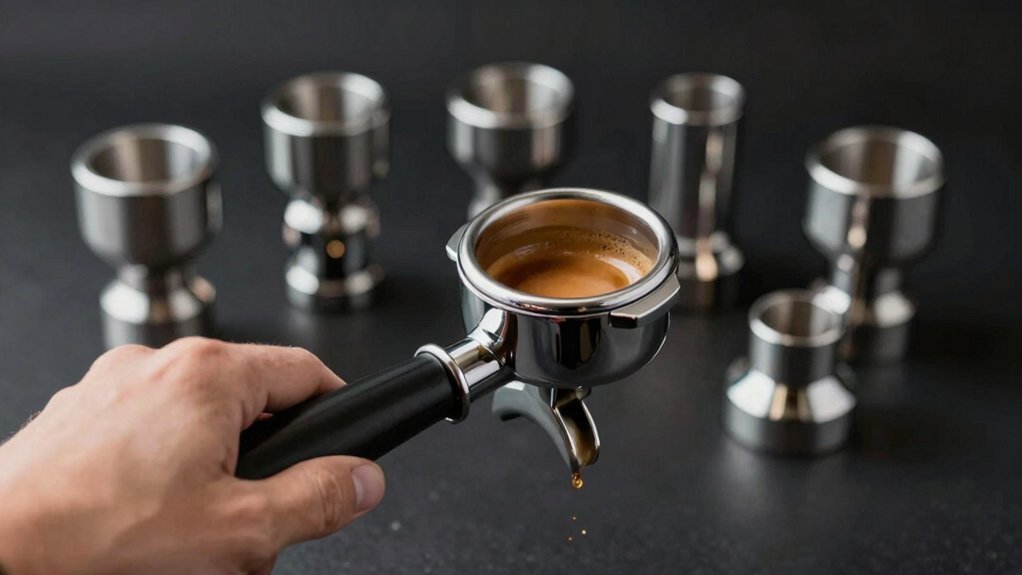
You’ll verify an 8mm portafilter fits the group head by checking ear configuration, thickness, and radial clearance so it seats without tilt. Measure vertical brewhead clearance to basket rim, shower screen diameter and height, and gasket thickness to ensure a reliable seal and correct dispersion.
Torque retention bolts to spec and test for wobble under pressure. Maintain gasket runout ±0.2–0.5 mm and optimal screen-to-basket distance for stable extraction; continue for step-by-step checks and adjustments.
Quick Overview
- Verify portafilter diameter, ear configuration, and thickness match your group head specifications before attempting fitment.
- Confirm shower screen diameter and radial clearance to prevent basket lip contact and uneven spray patterns.
- Measure gasket thickness and group face-to-screen gap. Maintain tolerances within ±0.2–0.5 mm for proper sealing.
- Check vertical clearance from group rim to basket top to ensure consistent dispersion. This prevents splash or starvation.
- Test seating under operating pressure and torque retention bolts/lever arms to eliminate wobble and ensure repeatable seal.
8mm Portafilter Fitments
Which portafilter size fits your machine? You’ll verify mm fitment before buying a bottomless compatibility upgrade, since diameter alone doesn’t guarantee fit. Check ear count, ear thickness, and ear offset against your group head. 58mm is common but not universal. Match filter basket diameter precisely to the portafilter opening to avoid leaks and extraction issues.
| Size (mm) | Typical use | Notes |
|---|---|---|
| 58 | Commercial/pros | Ear configs vary; E61 implications |
| 54 | Home/compact | Good accessory availability |
| 51 | Entry-level | Limited tampers/dosing |
| 49–57 | Variants | Model-specific fits |
Physically compare original portafilter specs and consult manufacturer docs to confirm seating. This will help avoid costly incompatibility surprises and respect portafilter nuances.
Brewhead Clearance & Torque
How much space sits between your machine’s group head and the bottom of a bottomless portafilter matters. Insufficient brewhead clearance can prevent a proper seal, interfere with steam wand operation, or cause spattering during extraction. You’ll measure vertical clearance from the group rim to the lowest external edge of the portafilter basket. Target clearances vary by machine but must allow unobstructed steam wand movement and cup placement.
Check torque specs for portafilter retention bolts and lever arms to ensure consistent seating without deforming the gasket.
- Measure clearance with portafilter inserted and a test cup in place.
- Verify torque specs on mounting hardware with a calibrated wrench.
- Inspect gasket contact for even compression.
- Test for wobble under operating pressure.
- Log measurements for future checks.
Shower Screen Clearance Specs
You’ll need to verify shower screen height and diameter against your bottomless portafilter to ensure the basket clears the screen without contact. Check gasket thickness limits and screen alignment tolerances so the portafilter seats squarely; the dispersion plate doesn’t obstruct flow.
Measure the clearance with the dispersion assembly in place to confirm a consistent spray pattern and prevent channelling or physical interference.
Shower Screen Height
Ever wondered why some bottomless portafilters sit snug while others wobble or leak? Shower screen height determines the vertical clearance between the group head face and the portafilter basket. You must measure from the group head gasket plane to the lowest point of the shower screen. Even 0.5–1.0 mm variance can prevent full seating, cause leaks, or create uneven seal pressure.
Incorrect height contributes to scaling issues by trapping water paths and accelerates gasket wear that may trigger warranty concerns if nonstandard parts were used. When checking compatibility, verify manufacturer specs and physically test fit with the basket installed. If clearance is marginal, don’t force components; adjust screen shims or consult service documentation to restore correct height tolerances.
Shower Screen Diameter
Shower screen diameter determines the lateral clearance between the group head’s water dispersion plate and the portafilter basket lip. It directly affects seating, water flow uniformity, and gasket compression. You need to measure the dispersion clearance to confirm the portafilter rim won’t contact or shadow the screen edge. Even 1–2 mm interference alters spray pattern.
Check the outer diameter of the shower screen against the portafilter basket OD and calculate radial clearance. If clearance is minimal, seating may tilt; gasket seal can vary, and flow uniformity will degrade. Use calipers for repeatable checks and document machine-specific shower screen diameter specs before purchase.
Prioritize consistent dispersion clearance to preserve extraction symmetry and avoid mechanical interference.
Gasket Thickness Limits
How thick should the group gasket be relative to your portafilter and shower-screen clearance? You need gasket thickness to sit within the machine’s designed clearance so the portafilter seals fully without contacting the shower screen. Measure the gap from the group face to the shower screen with the portafilter engaged. Subtract the portafilter flange compression allowance to determine maximum gasket thickness.
Stay within manufacturer tolerances, typically ±0.2–0.5 mm, to avoid leaks or premature contact. If your gasket is too thick, you’ll lift the seal and risk coffee escaping. If it is too thin, the portafilter can bottom out against the screen. Replace or shave gaskets to meet specified tolerances for consistent, damage-free sealing.
Screen Alignment Tolerances
After you verify gasket thickness and confirm the portafilter seals without contacting the shower screen, check the shower-screen clearance and alignment to ensure consistent water distribution. You’ll measure radial runout and axial gap to verify screen alignment within ±0.5 mm concentricity and 1.0 mm axial tolerance for typical commercial groups.
Confirm dispersion clearance between the shower screen face and the basket top; too small invites contact, and too large increases spray pattern variability. Use feeler gauges or a flattened test wafer and secure the group head at operating temperature before final checks. If alignment exceeds tolerance, service the screen mounting or replace shims.
Document measured values so you can repeat checks after maintenance and maintain repeatable extraction behavior.
Clearance With Dispersion
Why does the clearance between the dispersion screen and the basket top matter? You need a controlled gap to preserve brewing stability and ensure consistent water distribution across the puck. Measure the vertical distance from screen face to basket rim; typical acceptable clearances range narrowly and vary by machine design.
Too little clearance compresses the spray, increasing channeling risk and harming puck uniformity. Too much clearance creates uneven spray patterns and temporal pressure fluctuations that destabilize extraction. When selecting a bottomless portafilter, verify manufacturer specs against your group head and confirm spacing with a shim or feeler gauge if needed.
Adjustments to grind, dose, and tamp can compensate slightly; however, correct mechanical clearance is the primary factor for repeatable results.
Frequently Asked Questions
Can a Bottomless Portafilter Affect My Machine Warranty?
Yes, installing a bottomless portafilter can affect your machine warranty. Warranty implications hinge on seal compatibility and whether the aftermarket part alters the group head or voids manufacturer claims.
You should verify manufacturer policies, confirm dimensional and seal compatibility, and keep original parts. If damage occurs from an incompatible fit, manufacturers often deny coverage. Therefore, document checks and get written approval to protect your warranty rights.
Will a Bottomless Fit on a Non-E61 Commercial Machine?
Sometimes, you can’t assume it. You’ll face incompatibility warnings unless you verify group-head type, diameter (often 58mm), and basket fit against your machine’s specs. Measure the portafilter and test seating before purchase; consult manufacturer docs.
If it fits, expect adjusted maintenance routines because bottomless designs expose basket interiors. They demand more frequent cleaning and inspection to prevent channeling, wear, and extraction issues.
Do Bottomless Portafilters Change Extraction Pressure Readings?
No, bottomless portafilters don’t directly change pump pressure readings; they alter diffusion analysis and perceived pressure behavior. You’ll still read the same boiler/grouphead pressure. However, visual extraction differences reveal channeling and flow instability that affect pressure profiling outcomes.
Use the naked portafilter to correlate stream behavior with pressure curves. Refine dose/tamp/grind and interpret transient spikes or drops more accurately during real-time pressure profiling and diffusion analysis.
Are Aftermarket Baskets Compatible With My OEM Portafilter?
Yes, aftermarket baskets can fit your OEM portafilter, but you’ll need to verify dimensions and specs. Measure basket diameter, rim thickness, and notch positions; don’t rely on brand matching. Compatibility myths often overlook subtle tolerances that cause poor sealing or extraction.
Check machine documentation to avoid warranty concerns and keep receipts. If tolerances match and you test for secure seating and flow, aftermarket baskets can perform equivalently.
Can Bottomless Use Cause Increased Group Head Wear?
Yes, bottomless use can increase group head wear if fit or handling’s poor. You’ll see bottomless wear from repeated impact, misalignment, or abrasive debris causing group head abrasion where the portafilter seats.
To prevent this, verify precise dimensional fit; avoid forcing mismatched parts; keep baskets clean of grit; and use careful lock-in technique. Regularly inspect the seal area and service threads to catch early abrasion and maintain long-term group head integrity.
Conclusion
You’ve now got the exact fitment specs and tolerances you need to install a bottomless portafilter without damaging seals or distorting the shower screen. Use the listed brewhead clearance, gasket thickness, and screen height/diameter limits to confirm compatibility before fitting.
Verify torque and alignment during initial installs; then recheck gasket compression and spray pattern. If any dimension falls outside the stated tolerances, don’t force the portafilter. Adjust or source the correct part.