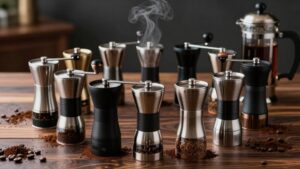
Grind Size for French Press Coffee
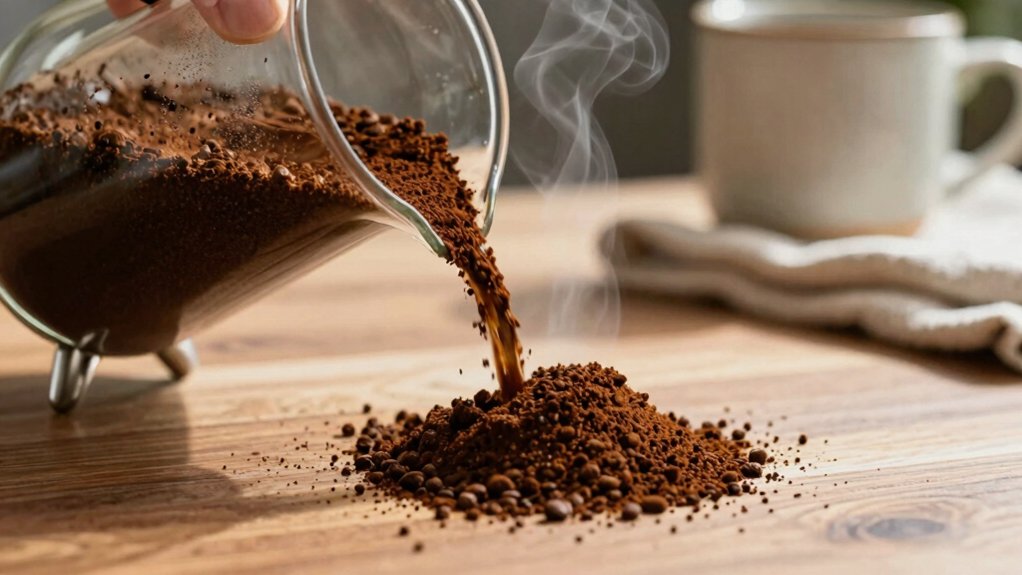
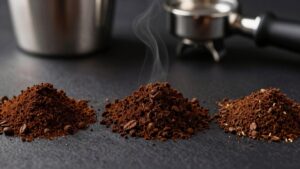
Use a coarse grind about the size of chunky sea salt for French press, so extraction stays even and sediment is minimized. Aim for roughly 690–1300 microns (or the coarser clicks on common hand grinders) and keep particles consistent.
Pour hot water (195–205°F / 90–96°C), stir once, steep four minutes, then plunge slowly to avoid fines. If your brew tastes sour, tighten the grind slightly. Keep going and you’ll find helpful tweaks.
Quick Overview
- Use a coarse grind resembling chunky sea salt to prevent over-extraction and reduce sediment.
- Target particle sizes roughly 690–1300 microns for consistent French press results.
- Adjust grinder settings: ~6–11 clicks on Porlex Mini or ~22–30 clicks on Timemore C2.
- If brew tastes sour, tighten (finer) the grind slightly. If overly bitter or silty, coarsen it.
- Combine coarse grind with a 4-minute steep, a single stir, and a slow plunge for balanced extraction.
French Press Grind Chart
Wondering how coarse your grind should be for a French press? You want 690–1300 μm: think sea salt or small breadcrumbs. Aim for grind consistency with a burr grinder to minimize fines that cause sediment and clogging. Match your grinder model to the chart below; then adjust for taste and plunge feel.
| Grinder Model | Setting Range | Unit |
|---|---|---|
| Zerno Z1 | 690–1300 | Microns |
| Porlex Mini | 6–11 | Clicks |
| Timemore C2 | 22–30 | Clicks |
Keep particle sizes even: uneven grinds increase sediment and over-extraction. If the plunger drags, coarsen slightly. If the brew tastes sour, tighten the setting a touch.
Ideal 4-Minute Steep
Now that you’ve got your grind dialed in, the ideal four-minute steep gives the coarse particles time to extract evenly without pulling out excess bitterness. You’ll want a consistent coarse grind and a precise steep time to balance body and clarity. Start the timer as soon as you pour, stir gently, and let the immersion work.
- Use a coarse grind resembling chunky sea salt for even extraction.
- Start a 4-minute steep time immediately after pouring hot water.
- Stir once to saturate grounds; then let the brew rest undisturbed.
- Plunge slowly after 4 minutes to avoid agitating fines into your cup.
- If the plunge’s too slow, coarsen the grind; if too fast, grind finer.
This routine keeps bitterness low and mouthfeel full.
Water Temperature Range
You’ll want water between about 195–205°F (90–96°C) to extract flavors cleanly without pulling excessive bitterness. Small shifts in temperature change extraction; so test slightly cooler or hotter water if your grind or taste is off. Note how grind size and steep time interact with heat.
Finish pouring into a warmed carafe or let the press sit briefly so the coffee cools to a pleasant serving temperature.
Ideal Temperature Range
Temperature matters because it controls extraction speed. For French press, you want water just off the boil: about 195–205°F (90–96°C). You’ll get predictable results when you aim for that range because temperature stability keeps extraction consistent across the coarse particles.
Use a kettle with good thermal conductivity and pour immediately to avoid drops below ideal. Preheat your French press to reduce heat loss when water hits the grounds. A warmed metal carafe retains heat better than thin glass.
If your setup loses temperature quickly, raise brew time slightly rather than overheating water. Measure with a thermometer until you learn how long your kettle needs to sit after boiling. Consistent temperature control helps you judge grind adjustments and repeat a balanced, full-bodied cup.
Temperature Effects On Extraction
How hot should your water be to pull the flavors you want? You’ll aim for a range where temperatures impact extraction without scorching delicate notes: roughly 195–205°F (90–96°C). Hotter water speeds chemical solubility; this increases extraction speed and pulls more bitters and body. Cooler water slows extraction; this risks sour or underdeveloped flavors.
With a coarse French press grind, that 195–205°F window balances contact time and particle size so you don’t over-extract during a typical four-minute steep. Adjust slightly within the range for roast level and taste: lower for light roasts to preserve acidity; higher for dark roasts to extract sweetness and body. Measure once, note results, and tweak temperature in small steps for consistent cups.
Practical Temperature Testing
Want to dial in the best range for your French press? Test water temperatures between 195°F and 205°F (90°C and 96°C) to see how extraction shifts with your coarse grind. Heat water; let it sit 30 seconds if boiling. Then brew identical doses and steep times while only changing temperature.
Taste for brightness, body, and bitterness: cooler ends highlight acidity and can taste under-extracted. Hotter ends increase body but risk bitterness. Record results: you’re running controlled experiments, not subtopic unrelated guesses, so you can repeat winners.
Use practice topics like single-variable trials and small adjustments (2°F to 3°F/1°C steps) to refine preferences. Keep notes on grind setting and steep time. Temperature testing should narrow choices, not replace grind tweaks.
Temperature And Grind Interaction
Curious how water heat and grind size team up? You’ll notice temperature dynamics directly affect extraction speed: hotter water (around 93–96°C) extracts more quickly from coarse particles. You might shorten steep time slightly or coarsen the grind to keep flavors balanced.
Cooler water (about 88–92°C) slows extraction; a stable coarse grind helps avoid sourness by maintaining consistent contact without producing fines that under-extract. Maintain grind stability with a burr grinder to prevent variable particle sizes that amplify temperature effects.
When you tweak temperature, adjust grind incrementally and watch taste and plunge resistance. Small changes in heat can expose inconsistencies; aim for reproducible temperatures and stable coarse particles for predictable French press results.
Cooling And Serving Temperature
Wondering when your French Press Coffee is cool enough to sip? You’ll want to let brewed coffee drop from brew temp (about 93–96°C) into a safer drinking range. Aim for serving temps between 60–70°C for immediate enjoyment; aim for 55–60°C if you prefer cooler sips.
Use simple cooling methods: pour into a pre-warmed carafe briefly to stabilize, or decant to a room-temperature mug to speed descent. Stirring or adding a tiny splash of cooler water will lower temp faster without ruining balance.
Keep in mind coarser grinds retain heat differently than fine ones, so check temps after your first experiments. Measure with a thermometer until you learn how fast your setup cools.
Frequently Asked Questions
Can I Reuse French Press Grounds for a Second Brew?
You can, but reusing grounds has limited second brew viability. You’ll get a much weaker, under-extracted cup because most soluble flavors are gone after the first steep.
To make the second brew drinkable, grind slightly finer initially, add hotter water, and extend steep time. However, expect muted acidity and body. For best flavor, use fresh grounds. Reserve reused grounds only for emergencies or a milder, low-extraction cup.
How Long Can Brewed French Press Coffee Sit Before Tasting Stale?
You should drink brewed French press coffee within 30 minutes for peak flavor. After about an hour, it starts developing a stale taste. If you keep it on a hot plate or thermal carafe, you can stretch usable brew timing to 1–2 hours; however, notes will dull.
Refrigerate promptly for up to 24 hours and reheat gently. However, expect some loss of aroma and freshness compared with just-brewed coffee.
Does Grind Size Affect Crema or Espresso-Style Foam?
Yes, grind size strongly affects crema formation and foam stability in espresso. You’ll need a fine, consistent grind so pressure extracts oils and microbubbles quickly. Too coarse gives weak crema and unstable foam.
Uneven or too-fine (clogging) grinds also harm crema by channeling or over-extracting. Use a burr grinder and dial grind, dose, and tamp to optimize crema formation and ensure long-lasting foam stability.
Can I Use Flavored or Oily Beans in a French Press?
Yes, you can use flavored beans and oily beans in a French press, but expect differences. Flavored beans will give pronounced added tastes that hold up in immersion brewing.
Oily beans can clog your metal mesh and leave more sediment and a slick mouthfeel. They will also gum up grinders and the filter faster. You will get bold, full-bodied cups; so rinse equipment regularly, adjust grind slightly coarser, and enjoy experimenting.
How Do I Clean and Maintain the Mesh Filter Assembly?
You should disassemble the mesh filter assembly after each use and rinse parts under hot water to remove grounds. For deeper cleaning, soak in warm soapy water, scrub gently with a soft brush, then rinse and air-dry.
Periodically inspect screens for tears; tighten screws and replace worn gaskets. Establish regular cleaning routines and follow simple maintenance tasks weekly or monthly to preserve seal integrity and prevent buildup or off-flavors.
Conclusion
You’ve learned that a coarse, consistent grind and 4-minute steep give the best French press results. The water temperature should be between about 195–205°F (90–96°C) to extract flavor properly. Temperature affects how quickly solubles dissolve; therefore, test within that range and tweak grind if coffee tastes weak or bitter.
Remember how grind and temperature interact: finer grinds speed extraction, and hotter water does too. Cool slightly before pouring, and enjoy a balanced, full-bodied cup.