Cleaning Tablets vs Vinegar for Coffee Makers: Which Cleans Better?
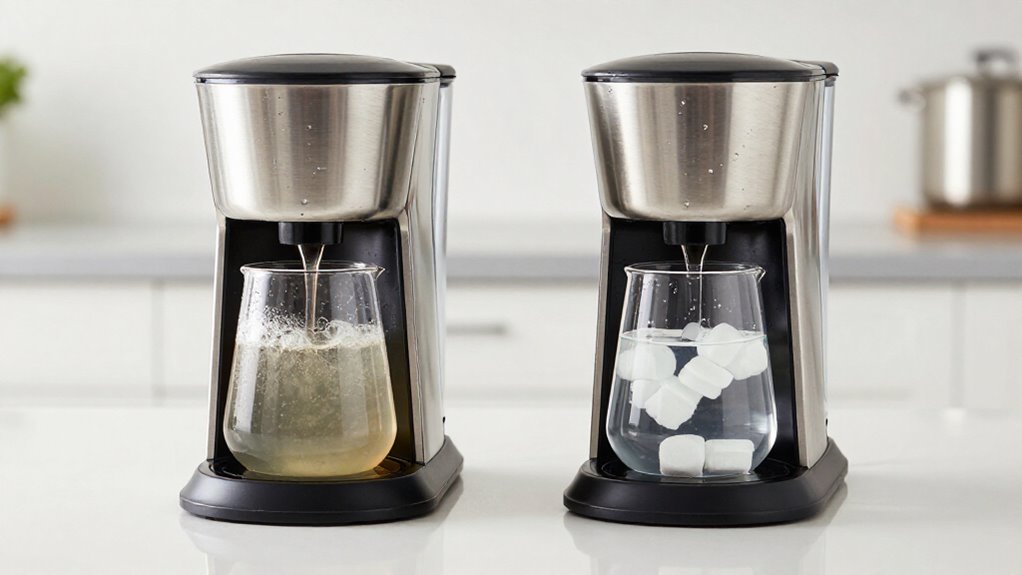
Most coffee makers, properly used cleaning tablets clean more consistently than vinegar.
Their measured formulas can target scale, coffee oils, and films, while vinegar provides diluted acetic acid and may leave a sour odor.
Follow brewer’s manual, use approved products, and rinse as directed.
Run water cycles, then smell and taste cooled water until water seems neutral.
Tablets usually need fewer rinses, making them practical for offices and turnarounds.
More below covers checks and costs.
Post-Cleaning Taste Test
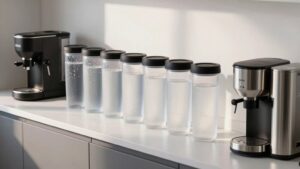
How clean will your next cup taste after descaling? Taste testing reveals a difference: tablets usually reach neutral flavor with fewer rinse cycles, while vinegar can leave an acetic odor or tang. Follow your machine’s cleaning and rinsing program; incorrect dosing can leave either product’s residue.
| Test point | Tablets | Vinegar |
|---|---|---|
| First post-clean brew | Usually neutral | May taste or smell acidic |
| Rinsing needed | Typically 1–2 cycles | Often several flushes |
For a test, run the prescribed rinse cycles, brew water, and smell and taste it after cooling. Repeat until no sour or perfumed note remains. Then brew coffee and compare aroma, acidity, and finish with your baseline.
If vinegar’s character persists, don’t add grounds; continue flushing. A neutral water test protects your cup and confirms readiness.
Active Ingredients: Tablets vs. Vinegar
The key difference is that tablets deliver a measured cleaning formula, while vinegar supplies mainly diluted acetic acid. Tablets may contain citric acid, enzymes, or alkaline blends, depending on their purpose. Citric acid supports acidic cleaning, while enzymes and alkaline agents break down coffee oils and organic films.
These formulations activate directly in the reservoir and travel through the brew path, so you don’t need to calculate a concentration. Some products fizz immediately, signaling rapid dissolution, though bubbling alone doesn’t prove complete cleaning.
Vinegar offers one primary active component: acetic acid diluted with water. Its performance depends on the final concentration and contact time, and it lacks the buffering or multi-action chemistry found in many appliance cleaners. Check your manual before choosing either product.
Scale Removal and Odor
For scale removal and odor control, citric-acid cleaners and dedicated descalers generally outperform diluted vinegar. In testing, a 1:1 vinegar solution scored 2.5/5 and left debris in the chamber, despite improving the pot’s appearance. Dezcal scored 4/5, producing a clean reservoir and crystal-clear rinse water by the third brew.
If you live in a hard-water area, use a manufacturer-approved descaler on the schedule your machine specifies; citric acid dissolves calcium-carbonate scale more consistently than vinegar.
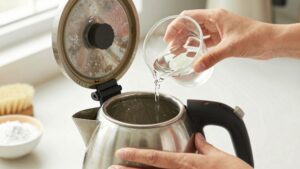
Vinegar can work, but you’ll need contact time, correct dilution, and water rinses. Otherwise, its acetic odor can linger in your reservoir and tubing, creating a vinegary smell during brewing. Run rinse cycles until you detect no odor or off-taste, and follow your manual to protect seals and metals.
Drop-In Tablet, No Measuring
Once you’ve ruled out vinegar or a dedicated descaler according to your machine’s manual, a drop-in tablet offers a simpler option because you don’t need to measure solution strength.
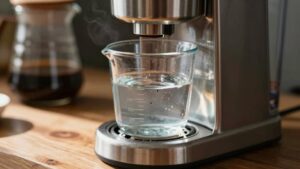
Fill the reservoir with water to its maximum line, drop in the tablet, and let it dissolve. The immediate fizzing indicates the tablet has dispersed through the water, though bubbling alone doesn’t prove complete cleaning.
Run the brewer for two cycles, discarding the dirty water between them. Then run a final cycle with clean water to flush dissolved cleaner and loosened residue. This measured dose reduces dilution errors and avoids liquid acid spills, making the process quicker and more repeatable than home-mixed vinegar.
In testing, brewing improved by the next day, but the reservoir remained fairly dirty and a faint, wipeable oily film persisted. Treat the tablet as a convenient maintenance step, not a guarantee that every surface is fully clean each time.
Check Your Brewer’s Manual
Before choosing vinegar or a cleaning tablet, check your brewer’s manual for the approved product, dilution, cycle count, and required rinse procedure. Manufacturers may specify a descaler, a tablet type, or a vinegar prohibition to protect seals, metals, finishes, and warranty coverage. Treat instructions as controlling, even when vinegar is commonly recommended elsewhere.
Follow the stated ratio and sequence precisely: dissolve the cleaner as directed, run the required program, pause or let the solution sit only when instructed, and discard the output. Complete the rinse cycle before brewing coffee. If your machine has a clean or descale light, use that trigger and the manual’s schedule; frequent use or hard water may require monthly service. Don’t wait for stale flavor or slow flow, which can indicate buildup.
Shelf Life and Storage Needs
Your cleaning method will work as intended only if the product remains stable in storage. Tablets and citric-acid granules can absorb humidity, soften, clump, or lose predictable dissolution. Keep them sealed in their original packaging, in a cool, dry cabinet away from steam and temperature swings. Check the printed expiration date; expired doses may not fizz or dissolve correctly, reducing the concentration you’ll expect.
- Store tablets and packets upright, tightly closed, and away from the coffee maker.
- Use one intact tablet per labeled cycle or one packet per 32 ounces of warm water.
- Discard damp, fused, or visibly degraded doses rather than estimating a replacement amount.
Vinegar behaves differently: sealed white vinegar has essentially indefinite usable life, although odor and overall quality can change.
Tablet Residue in Reservoirs
Tablet cleaning can leave a faint film or dissolved byproduct in the reservoir, even after the tablet has fully dissolved. In Affresh testing, fizzing began immediately, yet the reservoir retained a faint, oily coating that you could wipe away between cycles.
The recommended method used two brew cycles without coffee grounds, with dirty water discarded after the first. That result shows dissolution doesn’t guarantee complete removal: residue can remain in the chamber and require additional flushing.
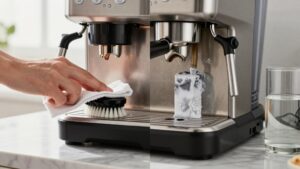
Follow your machine’s instructions, then inspect the reservoir under light. If you see a film, wipe it with a clean, nonabrasive cloth and run another cycle using fresh water. Repeat until the water runs clear and no slickness remains. Don’t brew coffee until you’ve removed byproducts and odors.
Cost per Cleaning Cycle
You’ll usually pay more upfront for tablets, but one measured dose simplifies cleaning and can reduce repeat cycles. Vinegar costs less per bottle, yet extra rinse and brew cycles can increase your effective cost per completed cleaning.
Compare each product’s dose, reservoir capacity, and total cycles required, not just its purchase price.
Tablet Cost Per Cycle
At first glance, vinegar appears cheapest per cleaning cycle, but the comparison changes when you account for labor and rinse water. For tablets, calculate the dose as product price divided by cycles per package: one Affresh tablet equals one cleaning cycle. You’ll pay a predictable per-cycle amount, with no measuring error or leftover solution.
Biocaf and similar citric-acid granules use one package per 32 ounces, so divide package price by its single-cycle dose.
- Check the label’s dose, package count, and machine reservoir capacity before comparing prices.
- Include the two required post-cleaning brew cycles when estimating water use and operating time.
- Choose the product your manufacturer approves; avoiding damage or warranty problems protects your long-term budget.
This makes your annual maintenance budget easier to forecast.
Vinegar Cost Per Cycle
Vinegar has the lowest product cost per cycle, but the tested method uses a full reservoir of equal parts white vinegar and water, a 30–60-minute mid-cycle rest, and multiple clean-water rinses.
Your liquid expense stays low, especially when you buy bulk vinegar, yet the procedure consumes water, time, and attention. Because vinegar scored only 2.5/5 overall, you may add rinse cycles to remove odor, taste, and uncertainty about residue. Those extra cycles increase practical cost, particularly if you value your time or use the machine frequently.
Best for Office Coffee Stations
For fast cleaning between brews, you’ll find that premeasured tablets simplify dosing, reduce spills, and leave less odor than vinegar. Your office team can follow a consistent routine—run the tablet cycle, discard the dirty water, and complete the required rinse cycles—without mixing solutions.
In hard-water stations, a manufacturer-approved descaler such as Durgol generally removes more scale and visible debris than vinegar while keeping shared maintenance practical.
Fast Cleaning Between Brews
When an office coffee station needs to stay ready between brews, a cleaner tablet is usually the fastest option. Add the tablet to the reservoir, select the machine’s cleaning or brew cycle, and run it without grounds. The dissolved cleaner flushes the brew path quickly, making the unit available sooner.
- Use one tablet at the manufacturer’s specified dose.
- Discard the first dirty-water output, then complete the required rinse cycle.
- Schedule cleaning during a gap, not during service.
Vinegar typically needs a brew cycle, a 30–60-minute mid-cycle dwell, and clean-water flushes. That procedure delays the next pot and demands staff attention.
In testing, Affresh fizzed immediately and needed two brew cycles with discarded water. Its 3/5 convenience-and-effectiveness rating exceeded vinegar’s 2.5/5. Follow manufacturer cycle instructions.
Less Odor, Less Mess
A citric-acid cleaner or purpose-made tablet is usually the best choice for an office coffee station because it minimizes odor, spills, and staff cleanup. When you run a citric-acid product such as Biocaf, you get visible debris removal with less lingering smell than a 1:1 vinegar-water mixture.
Vinegar can brew with a strong odor, then require extra flushing before coffee tastes normal. Affresh tablets fizz immediately, but may leave a faint oily coating that’s easy to wipe away. Dezcal produced crystal-clear water by the third brew in testing, reducing residue concerns.
Always follow your machine’s manual, use the specified dose, and protect your hands and eyes from cleaner. In a shared station, choosing a low-odor, measured formula keeps the counter and area more professional.
Keep an office coffee station on a monthly cleaning schedule, or clean it sooner if brewing slows, the machine gets louder, or the reservoir looks cloudy. Post these steps beside the machine:
- Tablets: Fill the reservoir, add one citric-acid tablet, run one or two brew cycles, discard the solution, then run one full clean-water cycle.
- Vinegar: Mix equal parts vinegar and water, pause for 30–60 minutes mid-cycle, discard the solution, and run extra water cycles to remove odor.
- Ownership: Assign a rotating cleaner; you’ll record the date and report persistent scale, leaks, or unusual noise before the next shift.
Tablets usually rinse faster and leave fewer lingering concerns; vinegar costs less but can’t clean internal parts as consistently. Use your manufacturer-approved cleaning products only.
Affresh Tablets Win
Affresh tablets edged out vinegar in your side-by-side test, scoring 3/5 versus 2.5/5 because they removed more buildup with less preparation. You filled the reservoir to its maximum line, dropped in one tablet, and ran the cleaning program. The tablet fizzed immediately, signaling dissolution without measuring vinegar and water or managing a strong odor.
You then ran two brew cycles, discarding the first batch of dirty water. Although the reservoir still looked fairly dirty afterward, the machine brewed faster the next day, indicating improved internal cleanliness. Between cycles, you found only a faint, oily coating that wiped away easily, rather than a stronger residue concern associated with vinegar’s uncertain internal results.
Choose Affresh when you want a premeasured dose and fewer preparation errors. Follow your machine’s manual, run required rinse cycles, and inspect the reservoir before brewing. Vinegar costs less, but Affresh delivered more cleaning with less hassle overall.
Conclusion
After your post-cleaning taste test, choose cleaning tablets when you want consistent, low-odor results with minimal effort. Affresh tablets dissolve measured cleaning agents that target coffee oils and mineral buildup without vinegar’s lingering smell or guesswork. You should still check your brewer’s manual, rinse the reservoir thoroughly, and run fresh-water cycles to remove residue.
Vinegar costs less, but tablets win for offices and routine maintenance because they’re simpler, cleaner, and more repeatable for daily use.