Heat Exchanger Espresso Machine Explained
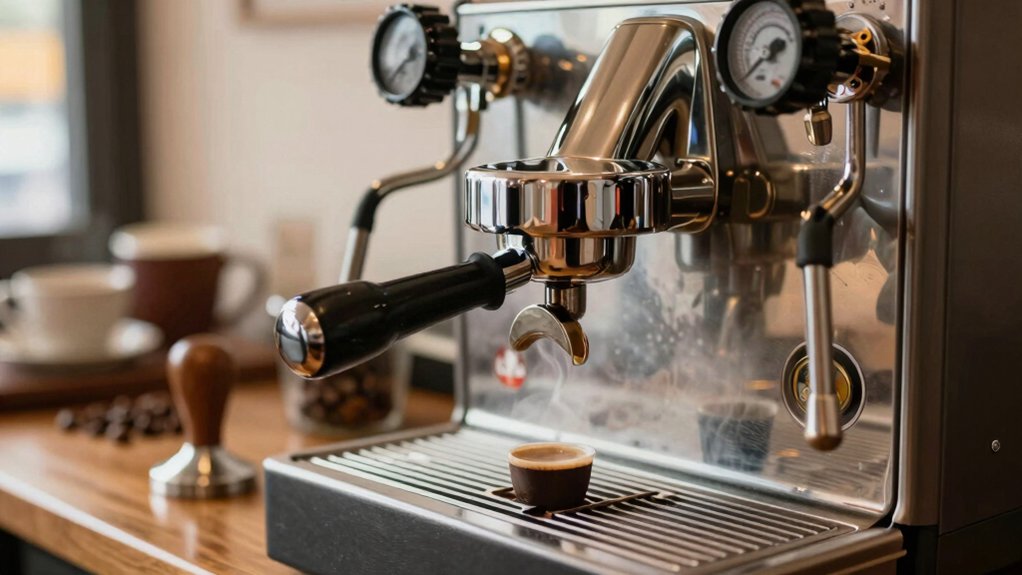
A heat‑exchanger espresso machine uses one boiler to supply steam and brew water by routing brew water through a tube inside the steam boiler. This design allows you to get simultaneous steaming and pulling. You’ll rely on boiler thermal mass and heating power to keep brew temperature stable while flow and grouphead mass cushion fluctuations.
Smaller boilers need faster recovery and stronger elements; PID control tightens temp swings versus a thermostat. Keep going to see setup, tuning, and tradeoffs.
Quick Overview
- A heat-exchanger (HX) machine uses one boiler with an internal tube routing brew water so simultaneous brewing and steaming are possible.
- HX relies on boiler temperature and water flow rate to set brew temperature; flow affects final extraction temperature.
- Larger boiler volume increases thermal stability. Micro-boilers need stronger heating or HX preheat to avoid temperature drift.
- HX machines require balancing boiler pressure, recovery time, and group-head thermal mass for consistent shot temperatures.
- PID control tightens temperature stability and recovery compared with thermostats; it improves consistency under variable demand.
Boiler Size vs. Flowrate
How does boiler size change the way water flows through an HX machine? You’ll see boiler sizing directly affects flowrate, pressure response, and thermal stability. A larger boiler offers inertial resistance to temperature swings from shot-volume influx. Smaller boilers need stronger heating elements or faster HX preheat to keep flow steady.
Flow and system resistance set output pressure; therefore, changes in flow alter extraction dynamics. Practical takeaway: match boiler volume, heating power, and HX design to your target g/30s to avoid pressure drift.
| Boiler Type | Volume | Impact |
|---|---|---|
| Traditional | 1.5L+ | High thermal stability |
| Micro | 100–250mL | Needs aggressive heating |
.6L Boiler Quick Checklist
Want a compact boiler that still delivers steady steam and stable brew temps? You’ll use this boiler quick checklist to evaluate an L boiler’s fit for your workflow. Focus on capacity, recovery rate, and how the smaller shell interacts with the heat exchanger tube and group head thermal mass.
Consider maintenance needs and how two word discussion ideas like “recovery time” or “thermal mass” simplify decisions. Check accessibility for descaling and the placement of the fill solenoid to avoid mid-shot refills.
- Capacity vs. peak demand: can it sustain consecutive milk drinks?
- Recovery rate: seconds to return to steaming pressure.
- Service access: easy descaling and tube inspection.
- Integration: group head and exchanger tuning for stable shots.
PID vs. Thermostat Control
When you compare PID and thermostat control, focus on how each holds temperature and how quickly they react to load changes. PID gives tighter, faster stabilization and usually uses less energy by avoiding large overshoots. A thermostat is simpler and can be easier to set, but it swings more.
Consider response time, calibration effort, and your tolerance for occasional temperature drift when choosing.
PID Versus Thermostat
Curious which control system gives you tighter temperature control for a heat-exchanger machine? You’ll compare PID vs thermostat directly. A thermostat cycles the boiler on/off around a set point, so it’s simple, robust, and economical. That cycling causes wider short-term swings at the group head because boiler temperature moves above and below target before thermal mass evens it out.
A PID continuously modulates heater power to minimize error; this reduces overshoot and holds setpoint more precisely. For a heat-exchanger machine, you’ll find PID gives finer temperature stability and quicker recovery after steam or back-to-back shots.
Thermostats work if you accept larger deviations and fewer electronics. Choose based on how much temperature precision you need, maintenance tolerance, and budget constraints.
Temperature Stability Differences
Having compared PID and thermostat basics, you now need to look at how each affects short-term and shot-to-shot temperature stability on a heat-exchanger machine. You’ll notice a PID holds target temperature tighter, using feedback to correct deviations quickly. This improves temperature stability and consequently brew consistency between shots.
A thermostat cycles boiler power more coarsely, letting wider swings occur; that can still work if you manage thermal mass and flush routines. However, you should expect more variation. On a heat-exchanger setup, the group head’s thermal mass dampens swings, so a thermostat’s drawbacks are partly mitigated.
If you want repeatable extraction with minimal intervention, choose PID. If you tolerate manual adjustments and routine flushing, a thermostat can be acceptable and simpler to maintain.
Response Time Comparison
How quickly does the controller correct a temperature deviation, and why does that matter for shot consistency? You want minimal lag: PID controllers sample temperature continuously and adjust power in small increments, giving a fast, proportional response time that keeps group head and exchanger tube near target despite changing flow rate.
A thermostat uses hysteresis and switches full power on/off, creating larger swings and slower correction after a sudden high-flow shot. Practically, PID reduces recovery time between shots and stabilizes extraction temperature during variable flow rates. This ensures you get more consistent puck saturation and flavor.
If you chase repeatability, choose PID control for tighter, faster corrections. Thermostats are simpler but tolerate longer deviations and greater variability.
Energy Efficiency Considerations
Why does controller choice matter for energy use? You’ll see a PID controller modulates power in short bursts, keeping boiler temperature steady with minimal overshoot. This improves energy efficiency by reducing cyclical heating and associated waste heat. A thermostat toggles full power on/off, causing larger temperature swings, more frequent full-power cycles, and greater cumulative waste heat loss to the cabinet and environment.
Practically, PID control lowers runtime of the element and trims thermal cycling; so you use less electricity over continuous service. Thermostats are simpler and cheaper but can cost you in higher energy bills and uneven brew temperature during heavy use. Choose PID when you prioritize efficiency and consistent shots. Pick thermostat only if upfront cost and simplicity dominate.
Ease Of Calibration
After energy use, calibration becomes the next practical concern because a controller’s behavior directly affects how you tune temperature for shots. You’ll find PID control gives finer adjustments: setpoint stability, programmable ramping, and quicker recovery after pulls. That reduces calibration nuance; you dial in temperature, watch minimal drift, and compensate less for ambient or shot-to-shot changes.
Mechanical thermostats are simpler but coarser; they toggle heating, causing wider swings and more noticeable temp rebound after a shot. With a thermostat you’ll chase offsets and perform routine flushing or cooling flushes to manage group-head recovery. For practical setup, choose PID if you want repeatable, data-driven calibration and fewer interventions. Pick thermostat for simplicity and lower cost, accepting more hands-on tuning.
Frequently Asked Questions
Can I Brew and Steam at the Same Time Continuously?
Yes, you can brew and steam at the same time continuously on a heat-exchanger machine. You’ll get brewing parallel operation because the exchanger tube flash-heats brew water while the boiler stays at steam temperature. This setup lets you steam simultaneously.
Expect very stable shot temperatures if the group head’s thermal mass is good. However, watch for boiler level drops and limescale. Flush the group head and descale regularly to maintain consistent performance.
How Often Should I Descale the Exchanger Tube?
You should descale frequency for the exchanger tube every 3–6 months, depending on water hardness and usage: that’s the practical exchanger maintenance schedule.
If you use hard water or run the machine many times daily, descale closer to 3 months. Soft water and light use let you stretch to 6 months.
Monitor flow, shot temperature, and pressure; any drop signals immediate descaling. Keep records and adjust intervals accordingly.
Does Water Hardness Affect Shot Temperature Consistency?
Yes, water hardness directly affects shot temperature consistency. Hard water promotes limescale in the exchanger tube, which reduces heat transfer and undermines temperature stability. As a result, your shot temperature will drift lower and become less consistent.
You should monitor mineral content, descale regularly, and consider a water softener or conditioning cartridge. Those steps restore heat transfer, improve temperature stability, and keep your shot temperature consistent shot after shot.
Can I Retrofit a PID to an HX Machine?
Yes, you can retrofit a PID to an HX machine; however, expect retrofit challenges and PID control limits. You’ll improve boiler temperature stability. Yet the exchanger’s thermosyphon, group head thermal mass, and steam-pressure setpoint still drive brew temp.
You’ll need solid wiring, a probe location, and firmware tuned for hysteresis and safety. Don’t expect perfect shot-to-shot control. Treat the PID as a useful stabilizer, not a complete override.
How Does Group Head Temperature Surfing Work?
You control group head temperature surfing by timing shots and flushes to manage sharp group temperature swings. You use the group’s thermal inertia to absorb brief heat pulses from the exchanger. If the group’s too hot, you perform cooling flushes and short idle periods. If it’s too cool, you pull a short blank shot or preheat.
This practical adjustment keeps extraction temperature stable shot-to-shot.
Conclusion
You’ll now know how boiler size and flowrate shape shot quality and steaming power. A .6L boiler demands careful technique and quick recovery. PID control gives tighter, faster temperature management than a thermostat; this improves stability and responsiveness while often using energy more efficiently and easing calibration.
Match control type to your workflow: pick PID if you want precision and consistency; choose thermostat for simplicity and lower cost. Adjust habits to your machine’s limits.