Water Temperature Chart for Coffee Brewing
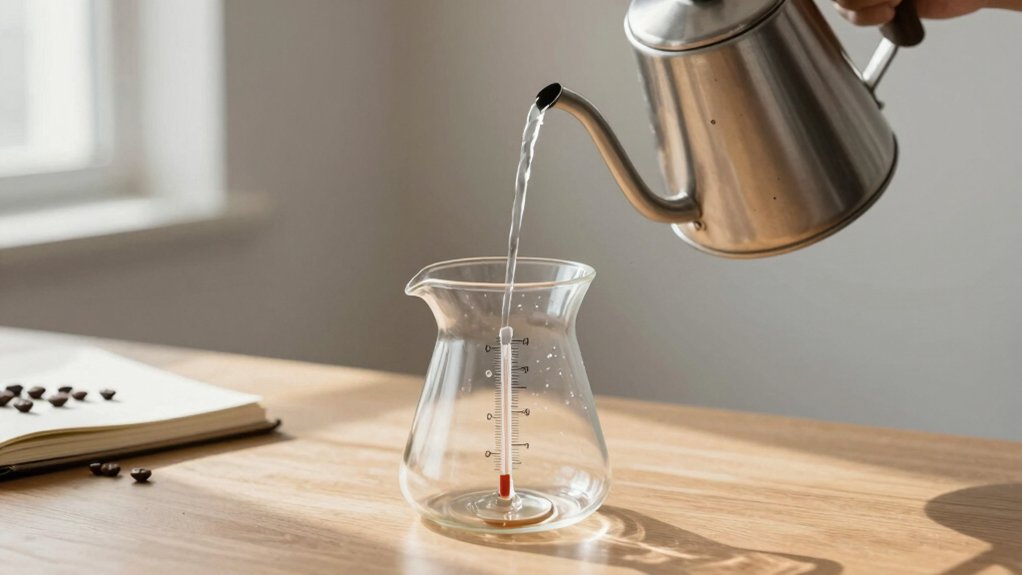
You’ll get the most consistent cups when you brew between 195–205°F (90–96°C). Use slightly lower temps for fine grinds and pour-over/percolation methods; use slightly higher temps for coarse grinds and immersion brewers like French press.
Preheat gear and account for ~5–10°F (3–6°C) heat loss during pours. Calibrate your thermometer and scale against ice and boiling points. Then tweak grind and contact time in 1–3°C steps to dial balance—more guidance follows.
Quick Overview
- Aim for 195–205°F (90–96°C) as the general ideal brewing range for balanced extraction.
- Use higher temperatures (near 205°F/96°C) for coarse-immersion methods like French press.
- Use slightly lower pre-contact water (around 195–200°F / 90–93°C) for pour-overs (V60, Chemex).
- Adjust temperature ±1–3°C with grind and contact time: finer grind → lower temp; coarser → warmer.
- Calibrate thermometer and account for heat loss (+5–10°F / 3–6°C) so measured brew temperature hits the target.
Brew Temperatures by Method
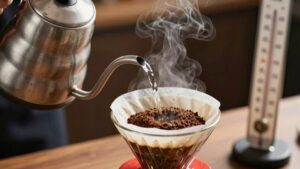
When you brew coffee, aim for 195–205°F (90–96°C) as your baseline. This range gives the most balanced extraction across methods; then adjust by method: immersion brewers like French press and Aeropress tolerate higher temps (near boiling) because they retain heat. Percolation brewers like V60 and Chemex need slightly lower pre-contact water to compensate for rapid cooling and thicker filters.
| Method | Temp cue |
|---|---|
| Immersion (French press) | Coarser grind, higher end |
| Aeropress | Versatile; near boiling OK |
| V60 / Chemex | Slightly lower pre-contact |
| Espresso / Drip | Machine-controlled target |
You’ll tweak temperature in concert with coffee grind to shape flavor profiles. Finer grinds extract faster, so lower temps prevent bitterness. Coarser grinds benefit from warmer water.
Optimal Extraction Temperature Checklist
Ready to dial in your brew? You’ll use a simple checklist to target 195–205°F (90–96°C): the evidence-based sweet spot just below boiling. Remember boiling point vs freezing point: extremes change extraction kinetics; so stay between them for balanced solubles. Watch steam pressure as a cue; vigorous steam often means too-hot water for delicate methods.
- Preheat equipment and measure water to net brew temp around 195–205°F (90–96°C).
- Account for temperature loss: adjust kettle temp +5–10°F (3–6°C) for pour-over; less for immersion.
Tune grind and contact time with ±1–3°C adjustments to correct under- or over-extraction.
Follow this checklist, and you’ll make reproducible, balanced cups without guesswork.
Scale Calibration Procedure
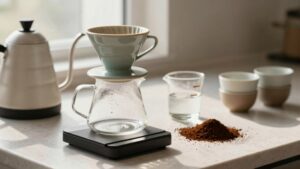
Before you start dialing in temperatures, prepare your calibration equipment and confirm your thermometer and scale are functioning properly. Check thermometer accuracy against known temperature standards (like an ice bath and boiling water) and adjust the scale readings using calibrated weights or the manufacturer’s offset function.
Finally, verify calibration consistency by repeating measurements and documenting any corrections so your brew temperatures stay reliable.
Prepare Calibration Equipment
Accuracy matters: you’ll want a reliable scale before you brew. Calibrate it using a known weight (or calibration weights) and follow the manufacturer’s procedure to confirm zero, span, and repeatability.
Next, gather a stable surface, the designated calibration weights (or accurately known coins), a damp cloth, and the scale’s user manual. Clean the pan and check sensor placement visually; debris or misalignment can cause calibration drift.
Warm the scale by powering it on for the recommended time to stabilize electronics. Use incremental weights to verify linearity across the range you’ll use for dosing. Record results and repeat measurements to assess repeatability. If readings stray beyond manufacturer tolerances, service or replace the scale before brewing.
Check Thermometer Accuracy
You’ve verified your scale, so now check your thermometer to make sure the temperature readings you rely on are accurate. Place the probe in a stable, stirred water bath at a known reference point and wait until the reading stabilizes. Compare against the reference and note any offset. Small, consistent offsets indicate thermometer drift.
If your device shows greater than ±0.5°C (±1°F) deviation, recalibrate or replace it. Record the offset and set a calibration interval: monthly for heavy use, quarterly for occasional use, to catch gradual drift before it affects extraction. Keep a simple log with date, reference temperature, observed reading, and action taken.
Regular checks reduce brewing variability and help you maintain the recommended 90–96°C extraction window.
Use Known Temperature Standards
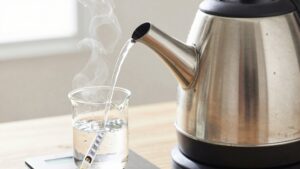
How will you know your thermometer readings are truly accurate? Use known temperature standards: ice point (0°C/32°F) and boiling point (100°C/212°F at sea level) to check your scale. Fill a sealed bag with crushed ice and distilled water. Insert the probe without touching the bag sides and confirm a 0°C/32°F reading.
For boiling, bring distilled water to a rolling boil and verify 100°C/212°F, correcting for altitude if needed. Document any offset and note it on your brew log so taste balance and flavor profiling stay consistent across sessions. Regularly repeat these checks, especially after drops or battery swaps.
Calibrating to standards gives you measurable confidence that extraction temperatures match your recipe.
Adjust Scale Readings
Now that you’ve confirmed your thermometer’s readings against ice and boiling points, apply the same methodical approach to your scale. Place a known mass (calibration weight or packaged 100 g) on the platform and record the reading.
Repeat with additional masses across the scale’s range to detect nonlinearity. If readings differ beyond the manufacturer’s tolerance, use the scale’s calibration function or adjust with certified weights until errors are within acceptable limits. Track calibration drift by logging results over time; frequent small shifts signal mechanical wear or environmental effects.
Be aware that thermometer lag can mask true brew temperature during simultaneous checks. Therefore, separate thermal measurements from weight calibration to avoid conflating errors. Recalibrate whenever accuracy is compromised.
Verify Calibration Consistency
Why check calibration consistency regularly? You want reliable weight and temperature readings every brew. Start by placing a certified test weight on your scale multiple times over several days; note any systematic variance that suggests calibration drift.
For thermometers, use an ice bath and boiling point check to expose thermometer lag or offset; record response times and steady-state errors. Compare results to manufacturer tolerances and log them. If drift exceeds acceptable limits, recalibrate per the device instructions or send equipment for service.
Repeat checks after firmware updates, battery changes, or physical shocks. Consistent verification minimizes extraction variability; therefore, your adjustments to grind or temperature rest on measured, not assumed, conditions.
Frequently Asked Questions
Can Tap Water Minerals Affect Coffee Temperature and Taste?
Yes, tap water minerals influence both mineral effects and water flavor, and they can subtly change extraction temperature dynamics. You’ll notice hard water (calcium, magnesium) enhances extraction; it often boosts body and perceived sweetness. However, high sodium or sulfates shift flavor balance.
Minerals also alter heat capacity slightly, so water with more dissolved solids cools a bit differently during brewing. Adjust grind and temperature to compensate for your tap’s profile.
How Does Altitude Change Recommended Brewing Temperature?
You should raise your brewing temperature slightly at higher altitude because altitude impacts lower water’s boiling point, reducing extraction speed. Increase brewing temperature by about 1–3°C (2–5°F) per significant elevation to maintain proper extraction.
Adjust grind and brew time too, since extraction depends on multiple factors. Taste and dial in: if coffee tastes sour or under-extracted, nudge the brewing temperature upward; if bitter, lower it.
Can I Reuse Heated Kettle Water for Brewing?
Yes, you can reuse heated kettle water for brewing if it’s been stored safely and not boiled repeatedly. Reusing heated water saves time and energy; however, watch for taste changes from dissolved minerals concentrating or stale oxygen levels affecting extraction.
For water safety, keep it covered, use it within a few hours, and avoid reheating more than once daily. If flavor suffers, refresh with filtered water and reheat to brewing temperature.
Does Milk Temperature Influence Extraction When Brewing Espresso?
Yes, milk temperature can influence extraction when you brew espresso because it changes brewing thermal dynamics and taste balance.
You’ll notice crema and shot temperature shift if you pour very hot milk into the cup; that can mute acids and make extraction seem sweeter. For consistent results, aim for proper milk texture and dairy foam temperatures (around 55–65°C/130–150°F) so your espresso extraction and mouthfeel stay balanced.
How Do Flavored or Oily Coffees Alter Temperature Needs?
Yes, you’ll usually need slightly higher temperatures for flavored oils and oily coffees because oils slow extraction and mute acids. Temperature interaction raises solubility; thus, bumping toward 200–205°F helps release oils and volatile aromatics for clearer flavor perception.
Be cautious: too hot risks harsher bitter notes from over-extraction. Adjust grind coarseness and raise or lower temperature by 1–3°C to fine-tune balance for oily beans.
Conclusion
You’ve now got the tools to brew consistently: follow method-specific temperature targets, use the checklist to hit optimal extraction, and keep your scale and thermometer calibrated.
Prepare proper equipment, compare your instruments to reliable temperature standards, and adjust readings as needed. Verify calibration regularly so your measurements stay consistent. Doing this will help you extract flavor predictably and reproduce great cups every time.
These are small technical steps with big sensory payoff.