Coffee Machine Water Filter Replacement Schedule
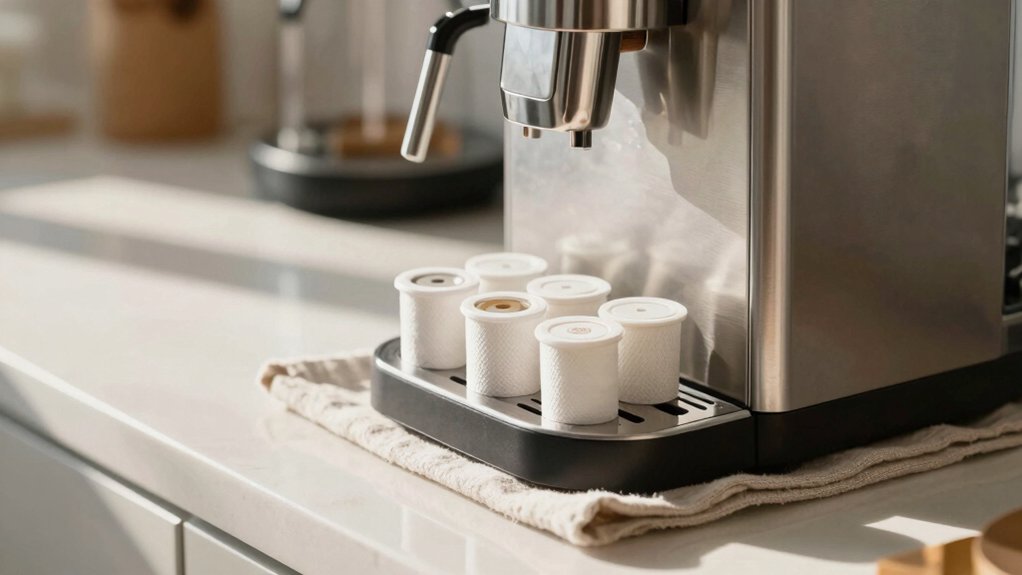
You should replace and service your coffee machine water filters on a schedule based on filter type, water hardness, and daily use. Change activated-carbon coffee filters every 2–3 months. Change general carbon filters every 6–12 months. Change sediment filters every 3–6 months. Change RO prefilters every 6–18 months and membranes about 2 years.
Use flow, taste, or meter readings to override intervals. Descale monthly in hard water or after >100 L/day; flush thoroughly post-descale. Keep logs and test results to refine your schedule if you want more detail.
Quick Overview
- Replace activated-carbon coffee machine filters every 2–3 months or sooner if taste or flow worsens.
- Use hardness and daily liters to adjust intervals; high hardness shortens filter life significantly.
Pre-filters typically change every 8–12 weeks. Carbon cartridges are changed every 12–24 weeks based on rated capacity.
Descale monthly for hard water or >100 L/day. Otherwise, descale every 6–8 weeks (moderate) or quarterly (soft).
Override schedule with flow restriction, taste shift, meter readings, or pressure-differential or sensor warnings.
Filter Lifespan by Model
How long should you expect each filter to last? You’ll follow model-specific timelines: carbon 6–12 months, sediment 3–9 months depending on commercial load, coffee-machine activated carbon 2–3 months, RO prefilters 6–18 months, RO membranes ~2 years. Don’t treat this as an unrelated topic to equipment care; do not confuse it with marketing angles.
| Model Type | Typical Lifespan |
|---|---|
| Coffee machine (activated carbon) | 2–3 months |
| BWT/Vivo systems | 3–12 months |
| Carbon filters (general) | 6–12 months |
| Sediment filters (commercial) | 3–6 months |
| RO prefilters/membranes | 6–18 months / 2 years |
You’ll adjust intervals for water hardness and throughput. Prioritize flow and taste checks, and replace immediately on flow restriction.
Filter Cartridge Change Chart
When should you replace each cartridge, and based on what metrics? You’ll use a chart that ties filter replacement to liters processed, water hardness, and daily usage. Build rows for cartridge type, rated capacity (L), hardness multiplier, and recommended interval (weeks). Update maintenance timing when hardness or volume changes.
- Pre-filter: 5,000 L; hardness x1; replace every 8–12 weeks.
- Carbon cartridge: 10,000 L; hardness x1.5; replace every 12–24 weeks.
- RO prefilter: 6,000 L; hardness x1.2; replace every 12–18 months.
- Specialty scale-reduction: capacity variable; hardness x2; replace every 4–8 weeks.
Use flow restriction, taste shift, or meter readings to override charted intervals.
Monthly Descaling and Flushing
Check for scale by monitoring flow rates, heating time, and visible deposits. You’ll descale when those signs appear or on the manufacturer’s monthly schedule adjusted for local water hardness. Use approved descaling agents and tools; follow the machine-specific procedure to circulate and soak. Then perform a thorough multi-tank flush until pH and taste return to normal.
In harder-water areas, increase frequency and document agent concentrations, contact times, and post-descaling flush volumes for compliance and equipment longevity.
When To Descale
Why should you descale monthly? You’ll maintain optimal heat transfer, consistent flow rates, and prevent hard-mineral accumulation that shortens component life. Establish a descale frequency based on measured water hardness and daily liters processed: high hardness or >100 L/day -> monthly; moderate -> every 6–8 weeks; soft water -> quarterly.
Monitor pressure differentials, prolonged brew times, and sensor warnings as triggers to override schedule. Use system logs to record each cycle, note chemical concentration, contact time, and post-rinse conductivity to verify mineral removal.
Beware descaling risks: improper chemical dilution, insufficient flushing, or missed neutralization can corrode valves, seals, and electronics. If you detect corrosion, stop operation and service immediately. Schedule monthly checks when usage and hardness demand it.
Safe Descaling Procedures
Begin descaling by isolating the brewer from power and water supplies. Then drain residual water to prevent chemical dilution and electrical hazards. You’ll wear PPE, follow manufacturer chemical concentration, and measure solution volume precisely.
Apply descaler to accessible circuits and heat-exchange surfaces. Circulate per timed protocol, then allow dwell time specified by appliance documentation. Use dedicated hoses and labeled containers to avoid cross-contamination during this dusty routine.
Rinse pump seals and valves with minimal pressure to avoid cavitation damage. Inspect gaskets, flow meters, and sensors for scale removal; replace degraded parts. Record cycle parameters, chemical lot, and contact time in maintenance logs.
Perform quiet maintenance to avoid disrupting service. Secure warning signage until systems are verified clean and leak-free.
Flushing After Descaling
How will you verify the system is free of descaler and safe to return to service? You’ll perform a controlled flush sequence immediately after descaling. Isolate sensors and remove the filter housing cap. Then reconnect and run potable water through the boiler and lines for a minimum of three full reservoir cycles or manufacturer-specified volume.
Collect effluent samples and confirm neutral pH and absence of sour odor. Refit or replace the water filter cartridge before reintroducing the machine to service to prevent residual chemistry contact. Log the descaling frequency and flush volume in maintenance records.
If any sample fails criteria, repeat flushing until results meet safety thresholds. Only return the machine to production when chemical residues are conclusively absent.
Frequency By Water Hardness
When should you increase descaling and flushing frequency based on water hardness? You’ll schedule monthly descaling and flushing when water hardness exceeds about 180–200 ppm or when filters show accelerated saturation. First, measure water hardness and log readings. Use those values to set service intervals.
Second, if hardness is high, perform descaling and flush cycles every 4 weeks and inspect flow rates after each cycle. Third, correlate liters processed with hardness: higher mineral load means shorter filter life regardless of calendar time.
Fourth, document two word discussion ideas (meter calibration, interval verification) during maintenance. Finally, adjust frequency upward if you observe reduced flow, increased extraction variability, or visible scale. You should reduce only after sustained hardness reductions are confirmed.
Tools And Cleaning Agents
Which tools and cleaning agents will you need for an effective monthly descaling and flushing cycle? You’ll need a calibrated scale or measuring cup, a dedicated descaling solution (manufacturer-approved or citric acid at specified concentration), a soft-bristled brush, insulated gloves, a funnel, and replacement O-rings.
Use distilled water for final flushes.
Procedure: Isolate water supply, drain reservoir, dose descaler per label, run the descaling program, then perform three full distilled-water flushes. Record concentrations, volumes, and cycle duration in your maintenance log.
Safety: Ventilate, avoid metal tools contacting heaters, and neutralize spills.
Discussion ideas: Test different descalers’ effectiveness in hard-water scenarios and track results in the maintenance log for trend analysis and schedule optimization.
Frequently Asked Questions
Can I Use Bottled Water Instead of Machine Filters?
Yes, you can use bottled water, but weigh bottled water concerns and filter lifecycle impacts. You will avoid some scale and sediment if the bottled water is low-mineral. Yet, you will still need routine filter checks because carbon and RO components age, clog, and harbor bacteria.
Verify mineral content; change prefilters per manufacturer intervals; monitor flow and taste; and document usage so you do not unknowingly shorten filter lifecycles or compromise equipment.
How Do Filters Affect Espresso Crema and Extraction?
Filters directly change crema formation and extraction by altering water chemistry and flow. You should monitor mineral content: balanced minerals aid crema and stable extraction. Excessive minerals cause mineral scaling, clogging groupheads and reducing flow. This leads to under-extraction and thin crema.
Replace or adjust filtration when you see slow flow, flavor shifts, or scale. Use filter ratings and consumption-based schedules to maintain consistent pressure, contact time, and optimal crema extraction.
Are There Eco-Friendly Filter Disposal Options?
Yes, you can choose eco friendly disposal options. First, separate components: compost biodegradable fiber pads, recycle plastic housings per local codes, and send spent carbon cartridges to manufacturer take-back or specialized recycling programs.
Second, drain residual water and bag activated carbon for municipal hazardous-waste collection if required. Third, document disposals for compliance and switch to refillable or certified biodegradable filters to minimize future waste and simplify handling.
Can I Extend Filter Life With Pre-Filtration?
Yes, you can extend filter life with pre-filtration. Install a sediment or softening pre-filter to remove particulates and reduce mineral content impact. This lowers clogging and scale.
Regularly monitor pre-filter pressure drop and replace it on a schedule based on liters processed. Pair pre-filtration with periodic testing of water hardness, and document maintenance intervals to optimize cartridge longevity and maintain consistent flow, taste, and equipment protection.
Do Water Filters Void My Machine Warranty?
No, using water filters doesn’t automatically void your machine warranty, but you must follow manufacturer guidance. Check warranty implications and ensure filter compatibility with your model.
Install approved cartridges, document purchases and service dates, and keep receipts. If you fit third-party parts that cause damage, the manufacturer can deny claims. When in doubt, get written approval or use certified filters to preserve warranty coverage and avoid disputes.
Conclusion
You’ve now got a clear, practical schedule to keep your coffee machine’s water filter and internal parts working reliably. Follow the model-specific filter lifespan; swap cartridges per the chart, and descale based on your water hardness.
Use recommended tools and safe descaling agents. Flush thoroughly after each descaling, and record dates to stay consistent. Doing these routine, procedural steps prevents scale buildup, preserves brew quality, and extends the life of your machine.