Coffee Bar Power and Outlet Safety
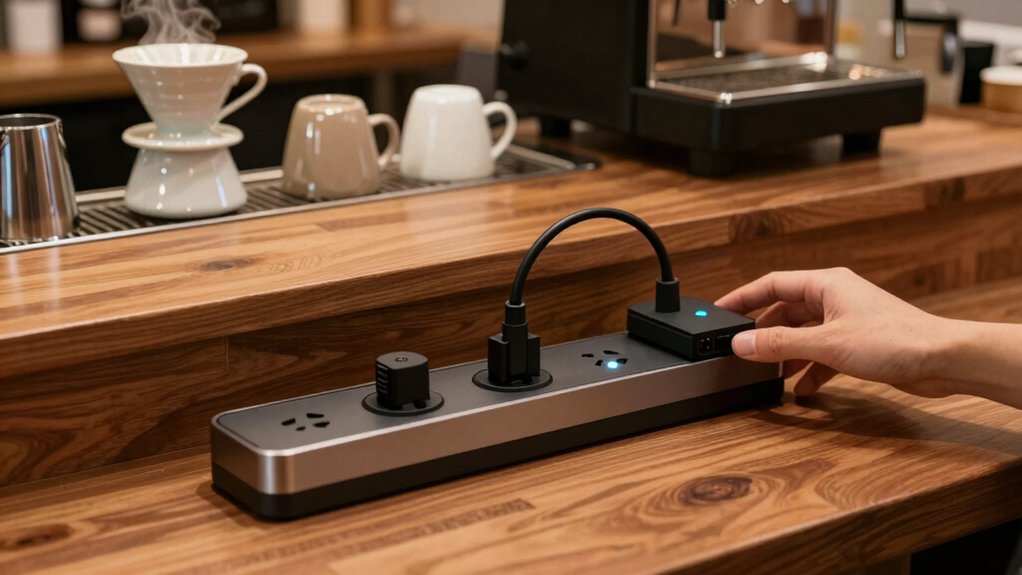
You should plan dedicated, GFCI-protected circuits for espresso machines and grinders; size breakers and conductors to at least 1.25× the nameplate load and use the 80% continuous-load rule.
Keep countertop outlets within six feet of sinks; label circuits, avoid extension cords, and stagger receptacles for simultaneous use.
Check voltage (120/208/240V) and calculate voltage drop on long runs. Use point-of-use surge/EMI filters. Work with a licensed electrician to verify permits and compliance; keep documentation if you want to learn more.
Quick Overview
- Install dedicated 20A circuits for espresso machines or grinders; add a second if both run simultaneously.
- Mount GFCI-protected countertop outlets so no sink or appliance location is more than six feet from a receptacle.
- Size breakers and conductors using nameplate amps, the 80% continuous-load rule, and a 25% safety margin. Avoid power strips and extension cords for high-current appliances; use properly rated receptacles and short cords.
- Label circuits, test GFCIs regularly, and contract a licensed electrician to verify code compliance and permits.
Amp Circuit and GFCI Chart
Want a clear baseline for wiring your coffee bar? You’ll map loads to circuits, pick GFCI locations, and apply grounding methods to reduce shock risk and electrical noise mitigation for sensitive displays. Use one 20-amp dedicated circuit for an espresso machine or grinder; add a second if you plan simultaneous use.
| Equipment | Circuit | Notes |
|---|---|---|
| Espresso/grinder | 20-amp dedicated | Peak heating cycles |
| Drip coffee | 20-amp dedicated | Varies 600–1200W |
| Lighting/low draw | Standard | Minimal impact |
Label circuits, size conversion gear 25% above connected load, install point-of-use surge and EMI/RFI filters, and test GFCI regularly. Work with a licensed electrician to verify code compliance.
Dedicated GFCI Receptacle Spacing
After mapping loads and assigning dedicated 20-amp circuits, plan GFCI receptacle spacing to keep outlets within six feet of sinks and beverage prep areas so you meet NEC 2023 requirements. You’ll place receptacles to eliminate extension cords and keep cords off wet counters. Follow these concise placement rules:
- Mount GFCI-protected countertop outlets at spacing that prevents gaps over six feet; account for appliance clusters.
- Stagger locations to serve grinders, brewers, and small heaters without sharing unrelated topic circuits.
- Label each GFCI circuit at the panel for maintenance. Document maximum simultaneous loads to avoid irrelevant context confusion.
- Use licensed electricians to verify AFCI/GFCI combinations, clearances, and local amendments.
This keeps installations compliant, practical, and focused on safety.
800W Espresso Circuit Requirements
You’ll start by calculating the maximum simultaneous load so you know whether a 20A, 30A, or 40A dedicated circuit is required. Choose breaker and conductor sizes for the continuous and peak currents. Check voltage drop for long runs, and factor in whether the machine needs 120V, 208V, or 240V service.
Always confirm local code and permit requirements. Use a licensed electrician to finalize circuit placement and protection.
Load Calculation Basics
How many watts will your espresso machine actually pull, and how do you translate that into the circuit you’ll need? You calculate by converting nameplate volts and amps into watts (W = V×A) and summing simultaneous loads. Include grinders, kettles, and any wireless charging pads or alternative energy infeed that tie into the same panel.
Apply a 25% safety margin: size conversion gear and breakers 1.25× the connected load. For residential setups, you’ll usually target 20-amp circuits at 120V unless the machine specifies 208/240V commercial service. Count peak heating and pump draws, not idle ratings.
Don’t rely on power strips for high-current devices; design for maximum simultaneous demand and document values for electrician review and code compliance.
Dedicated Circuit Importance
Why does a dedicated circuit matter for your espresso setup? You need isolated power to prevent tripped breakers and nuisance interactions with unrelated topic loads. A dedicated circuit gives a single, known capacity path; you can size equipment and protective devices against actual simultaneous demand, following broad industry standards and NEC baselines.
You’ll place outlets to minimize cord runs; avoid extension cords; and ensure GFCI where liquids are present. For commercial machines, plan 208V/240V dedicated feeds. For residential, 20-amp circuits often suffice. Labeling, documentation, and using a licensed electrician keep installations compliant.
Design margins and surge protection at point-of-use reduce failures. Don’t treat the dedicated circuit as a catch-all for other high-current devices.
Breaker And Wire Sizing
Having a dedicated circuit sets the stage for selecting the correct breaker and wire for your espresso machine: size them to match the machine’s nameplate amps and anticipated simultaneous load. Apply the 80% continuous-load rule for breakers and use wire ampacity that equals or exceeds the breaker rating.
You’ll calculate peak draw including grinders or pumps; then, pick a breaker that won’t trip under continuous operation. For most residential setups, a 20A/12 AWG is common. Commercial 208/240V machines need appropriately rated breakers and larger conductors.
Label the circuit and avoid topic drift into accessories when specifying protection. Don’t substitute smaller wire or larger fuses; follow NEC tables, local amendments, and keep unrelated safety perimeters documented for inspection.
Voltage Drop Considerations
Wondering what voltage drop means for your espresso circuit? You’ll check voltage drop to ensure the machine sees rated voltage under load. Measure expected run length, load current, and conductor size; calculate drop using Ohm’s law or standard tables.
Keep total drop under typical 3–5% guidance for sensitive equipment. Commercial machines on 208/240V are less tolerant. Watch circuit impedance: higher impedance from long runs, small gauge, or poor connections increases drop and warms conductors.
Size wiring and breakers to lower impedance, or shorten runs and use larger copper conductors. Verify with in-service measurements at peak draw. If voltage drop exceeds limits, revise layout or sizing before final connection to protect performance and avoid nuisance trips.
Local Code Requirements
How should you plan an espresso circuit to meet local code? You’ll start by verifying local permitting and zoning compliance requirements. Codes vary by jurisdiction and may demand permits, inspections, or specific circuit types.
Specify a dedicated 208/240V circuit for commercial machines or a 20-amp dedicated 120V branch for smaller setups. Calculate simultaneous load and size protection (GFCI, AFCI) per NEC and local amendments. Route circuits to minimize cord length and eliminate extension cords. Place countertop receptacles per clearance rules.
Engage a licensed electrician to submit plans, obtain permits, and coordinate inspections. Keep documentation of load calculations, device listings, and permit approvals on site to demonstrate compliance during inspections and future modifications.
Frequently Asked Questions
Can I Use a Power Strip for My Espresso Machine?
No, you shouldn’t use a power strip for your espresso machine. For a safe espresso setup, you need a dedicated circuit and correct outlet placement to handle high current. This is essential to avoid overloads and comply with code.
Power strips and extension cords risk overheating and tripping. Use a properly rated, fixed receptacle installed by a licensed electrician. It should be sized for the machine’s amperage and voltage, with GFCI/AFCI where required.
Do I Need Surge Protection for My Coffee Grinder?
Yes, you should use surge protection for grinder safety. Protecting your grinder with a point-of-use surge protector (1000+ joules) or whole-house SPD prevents damage from voltage spikes and preserves motor control electronics.
Make sure the device is UL-listed, sized 25% above connected load, and installed on a dedicated circuit when possible. Don’t rely on power strips for high-current grinders; follow code and use rated surge devices.
Can I Plug European Coffee Gear Into a US Outlet?
Yes, but only with care. If your European gear lists 120V/60Hz or has a built-in converter, you’re fine. Otherwise, you’ll need a step-up transformer for European voltage compatibility plus appliance plug adapters for the physical connector.
Size the transformer 25% above the appliance’s rated load. Ensure grounding, and use UL-listed equipment. Don’t rely on simple adapters for voltage conversion; they only change plugs, not voltage.
Is a UPS Necessary for Consistent Brew Cycles?
You don’t always need a UPS for consistent brew cycles, but you should if ups reliability and power quality matter. Use a UPS when brownouts, brief outages, or voltage spikes disrupt controllers or pumps.
Size the UPS for peak current plus 25% safety margin and enough runtime to finish a cycle or safely shut down. Choose a UPS with AVR and sine-wave output to protect sensitive electronics and ensure repeatable brews.
Do I Need a Licensed Electrician for Installation?
Yes, you should hire a licensed electrician for installation. They’ll ensure installation requirements meet electrical codes, provide proper dedicated circuits, and address power safety risks like GFCI/AFCI protection and correct voltage.
A pro minimizes overloads, selects appropriate surge and UPS integration, and secures permits and inspections. That keeps your equipment compliant, safe, and reliable while reducing fire, shock, and code-violation liability.
Conclusion
You’ve got to treat a coffee bar like any other small commercial kitchen: size the circuits, breakers, and wires to actual loads. Provide dedicated GFCI receptacles spaced per code, and plan for that 800W espresso machine on its own 15A GFCI circuit if required by load calculations and local rules.
Check voltage drop for long runs; follow breaker/wire ampacity tables, and confirm all specifics with your local inspector before final installation.