Grind Size Chart for Coffee Brewing
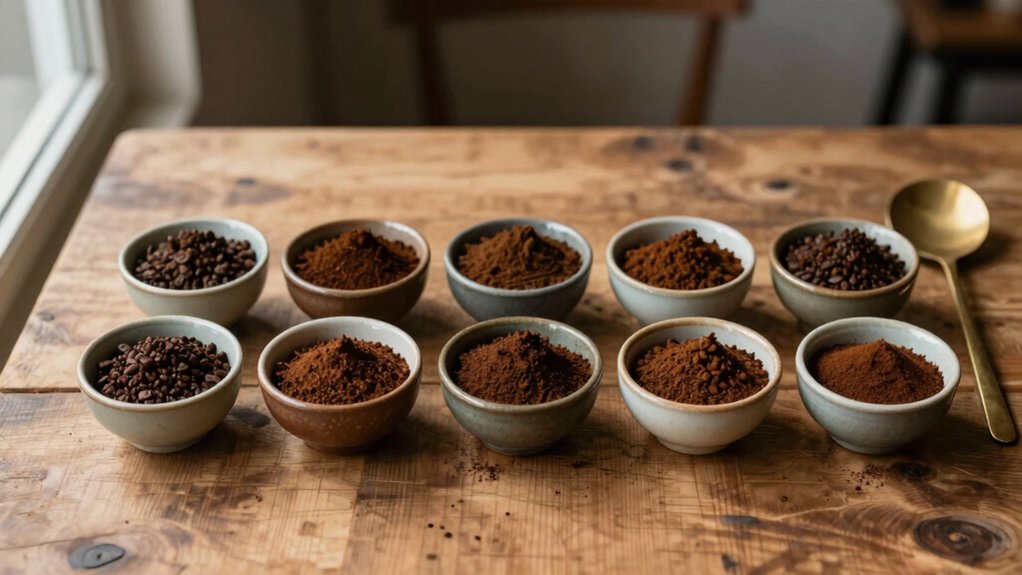
You’ll want a particle-size map to predict extraction: extra-fine 0–200 µm for Turkish, fine 200–400 µm for espresso and fine drip, medium 600–800 µm for pour-over and most drip methods.
Weigh doses to ±0.1 g, keep water volume constant, and adjust grind to fix extraction while using dose for strength.
Reduce static, clean burrs, and tap out retention to improve consistency. Keep this framework and you’ll find practical steps to optimize grind, dose, and maintenance.
Quick Overview
- Extra-fine (0–200 µm) suits Turkish and some espresso styles, producing very fast extraction and high surface area.
- Fine (200–400 µm) is typical for espresso and fine drip; it balances extraction speed and crema/clarity.
- Medium (600–800 µm) fits most pour-over and drip brews; it allows for even extraction and clean flavors.
- Coarser grinds slow extraction and suit French press or cold brew. Aim for uniform particles to avoid sour or bitter notes.
- Use consistent dosing on a scale. Adjust grind before dose for balance, and log results to reproduce preferred extraction.
Particle Size (µm) Chart
Why does Grind Size matter so much? You rely on specific particle sizes to match brewing variables: contact time, pressure, filter type. The chart below maps common ranges so you can predict extraction and control grind distribution.
Better particle uniformity reduces over- and under-extracted flavors. Therefore, target narrow ranges for pressure brewing and wider ones for immersion. Use the table to compare categories quickly and pick a starting point for adjustments.
| Category | Particle Size (µm) | Typical Methods |
|---|---|---|
| Extra-Fine | 0–200 | Turkish, specialty |
| Fine | 200–400 | Espresso, fine drip |
| Medium | 600–800 | Pour-over, drip |
Dose Vs Extraction Checklist
How much coffee should you dose to hit your target extraction and desired strength? You’ll aim for dose consistency to control strength while adjusting grind to reach extraction balance. Use a scale and consistent dosing routine; small weight shifts change TDS and extraction percentage.
- Weigh dose precisely (±0.1 g), record brew ratio, and hold water volume constant to isolate grind effects.
- Measure extraction with refractometer or taste: if under-extracted, slightly increase dose or coarsen grind; if over-extracted, reduce dose or fine-tune grind finer.
- Track outcomes: log dose, grind setting, brew time, and tasting notes to correlate dose consistency with extraction balance across sessions.
This checklist gives reproducible, evidence-based guidance.
Grind Retention and Clumping
You’ll notice retention and clumping affect dose accuracy and extraction consistency. This is often caused by burr alignment, static charge, and fines trapped in grinder chambers. Static-driven clumps and retained particles skew your dose and create under- or over-extracted pockets. Therefore, address distribution, knockout, and brief sifting when needed.
Regular grinder cleaning, occasional reburring or recalibration, and dosing protocols (weigh, distribute, purge) will reduce retention and improve brew repeatability.
Causes Of Retention
Ever wondered why your grinder yields clumps, fines, and pockets of retained grounds instead of a consistent dose? You’ll find several mechanical and physical causes.
Static charge makes particles stick to each other and the chute, creating clumps and unequal dosing. Blade or dull burrs produce irregular particle distributions with excessive fines that compact and hide in crevices. Hopper shape and dosing funnel geometry trap grounds in dead zones.
Moisture—either from beans or humid air—promotes clumping and alters grind flavor by concentrating extraction-prone fines. Overfilled or underfilled dosers change airflow and retention volumes. Fine tolerances and poor burr alignment increase retention unpredictably.
Addressing these causes improves dose consistency and preserves aroma balance by reducing trapped, stale particles that skew subsequent brews.
Impact On Extraction
Those retention and clumping mechanisms directly change extraction by altering particle distribution, flow paths, and contact time. When fine particles cling in pockets or static-induced clumps, you get uneven surface area and channels that speed or stall water; this produces under- or over-extracted zones. Your chosen grind size interacts with retention: finer grinds tend to pack and retain more, increasing localized extraction impact. Coarser grinds shed uneven fines that sink or float, changing contact time.
That variability shifts soluble yield and flavor balance — bitterness, sourness, or muted sweetness. To evaluate effects, measure TDS and taste for consistency across brews after adjusting grind size and dosing. Quantifying extraction impact lets you target an even particle distribution and more repeatable results.
Preventing Static Clumping
How can you reduce static clumping and grind retention so your dose and extraction stay consistent? You’ll improve grind consistency by addressing static at the point of grinding: cooler, low-humidity environments and rested beans reduce charge buildup.
Use metal or anti-static catchments rather than plastic to lower sticking; a short tap on the grinder and a gentle shake help dislodge retained grounds. For single doses, grind directly into the filter or portafilter to minimize transfer loss.
Consider a small ionizing spray (very light moisture) or dedicated anti-static tools when static is severe; however, apply sparingly to avoid altering roast extraction. Track dose variance for several shots to quantify improvement: consistent dosing correlates with more repeatable extractions.
Focus on static management, not dramatic workflow changes.
Grinder Maintenance Tips
A few targeted maintenance steps will cut grind retention and clumping; they will also keep your dosing consistent. You should empty and brush the hopper and chute daily to remove stale fines that promote clumps and inconsistent dosage distribution.
Once a week, disassemble and clean burrs with a soft brush or recommended cleaner. Residues change particle profiles and increase retention. Check and tighten burr alignment monthly; misalignment creates oversized chips that trap between burrs.
Use compressed air sparingly and only to clear the chute. Overuse can drive fines deeper. Replace worn burrs per manufacturer intervals since dull surfaces increase static and clumping.
Log maintenance actions and dosing variance for two weeks after service to confirm improvements in grind homogeneity and dosing consistency.
Dosage And Distribution
Clumping and retention in your grinder directly skew dose consistency and brew balance, so you should address them before worrying about extraction. You’ll first weigh and record doses to spot retention: measure beans in, ground out, and trapped fines. Regularly purge a small dose or use a brush to clear the chute; that reduces ghost doses and improves dosage consistency.
Second, target distribution uniformity in the puck or filter by tapping, funneling, or using a distribution tool to break clumps and spread particles evenly. For coarser methods (French press), check for large aggregates. For finer methods (espresso), watch for micro-clumps that cause channeling. Track changes after adjustments; data will confirm improved consistency and better-balanced cups.
Frequently Asked Questions
How Does Water Temperature Affect Grind Size Recommendations?
Higher water temperatures speed extraction, so you’ll grind coarser to avoid over-extraction. Lower temperatures slow extraction, so you’ll grind finer to compensate. This explains how water temperature influences grind size: hotter water needs larger particles; cooler water needs smaller ones.
Use temperature driven grind adjustments in small steps. Test taste and extraction time; adjust grind size 1–2 notches while keeping brew variables consistent for evidence-based results.
Can I Mix Grind Sizes for a Single Brew?
Yes, you can mix grind sizes, but you’ll need technique to preserve brew consistency. Using coarse plus fine particles speeds extraction: fines extract quickly and can over-extract; coarse slow and under-extract.
To control this, dose and stir minimally, filter appropriately, or use staged pouring. For immersion methods, avoid excess fines to limit sediment.
For pourover, aim for a calibrated blend and test adjustments incrementally for repeatable results.
How Long Can I Store Ground Coffee Without Quality Loss?
You can store ground coffee for about 1–2 weeks at peak quality. Expect noticeable aroma preservation drops after that. Usable flavor can last up to a month if sealed. For best results, keep grounds in an airtight, opaque container at cool room temperature.
Avoid the fridge or freezer for daily use, and buy whole beans if you need longer storage. Proper sealing and minimal air exposure preserve aroma and slow staling.
Does Altitude Change Ideal Grind Settings?
Yes, altitude impacts extraction; so you should adjust grind calibration. At higher altitudes, lower boiling temperatures slow extraction. Therefore, you’ll grind slightly finer or extend contact time to compensate.
At lower altitudes, higher boiling points extract faster; thus, coarser grinds can prevent over-extraction. Test systematically: change one variable, taste, and record results. Use consistent dosing and brewing parameters to isolate altitude impact on flavor and grind calibration.
Which Grinder Types Best Minimize Heat Buildup?
Burr grinders, especially conical or flat burr types, best minimize heat buildup. You’ll get consistent grind size with less friction than blade grinders, preserving water temperature-related extraction control and avoiding unwanted volatile loss.
Choose slower RPM burrs or hand grinders to further reduce heat buildup. That stabilizes your water temperature impact and lets you adjust grind size effects precisely. Avoid high-speed blades that generate heat and inconsistent particles.
Conclusion
You’ve learned how grind size, dose, and distribution shape extraction. You have also learned how retention, clumping, and static undermine consistency. Apply the particle-size chart to match your brew method, weigh doses, and adjust grind to hit target TDS and yield.
Prevent retention with good dosing technique and periodic maintenance. Minimize static by grinding into cool, humid conditions or using anti-static tools. Stay precise, measure results, and iterate until extraction is repeatable.