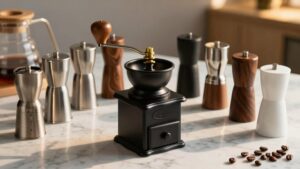
Coffee Grinder Retention Explained
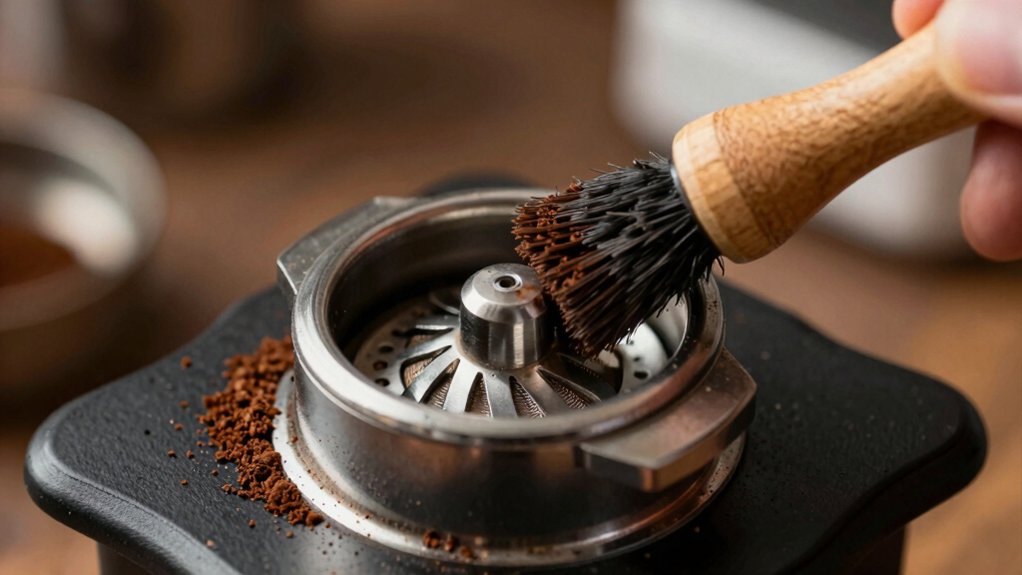
Grinder retention is the dry grounds that stick inside your machine and change dose weight and flavor carryover.
Compact straight-through designs often hold under 2 g.
In contrast, larger doser-style grinders can trap 6–12+ g.
Burr type and hopper size matter: flat burrs and roomy hoppers trap more, while conicals and small hoppers clear faster.
Doser grinders pocket stale grounds; doserless units minimize carryover.
Clean and purge routinely to protect consistency.
Keep going to learn practical tests and maintenance tips.
Quick Overview
- Retention is the amount of ground coffee left inside a grinder after a dose; it affects freshness and dose accuracy.
- Grinder design (compact vs roomy) and burr architecture (conical vs flat) largely determine how much coffee is retained.
- Doser grinders trap grounds in chambers, which increases stale carryover. Doserless machines minimize retention for single-dose workflows.
- Larger hoppers and flat burrs typically increase retention by creating more headspace and trapping between burr faces.
- Measure retention by weighing beans in versus grounds out. You can reduce it using purge doses, brushes, or low-retention models.
Grind Retention by Model
Curious how much old coffee your grinder actually holds? You’ll see retention varies by grind architecture and hopper capacity: compact, straight-through designs keep retention under 2 grams. Larger burr gaps and roomy hoppers push retention higher. Compare models below to gauge purge needs and single-dosing suitability.
| Model | Retention (g) | Notes |
|---|---|---|
| Baratza Sette 270 | Minimal chamber space; low retention | |
| Eureka Mignon Specialita | 1.3 | Compact burr chamber; single-dose friendly |
| Lucca Atom | ~2 | Forked screen; designed for full hopper use |
| Eureka Zenith | 6.5 | Larger gap; needs purging |
| Eureka KRE | 12 | Large conical burrs; high retention |
Use scale tests to quantify real-world retention for your beans and settings.
Burr Type & Hopper Size
Now that you’ve seen how different models hold varying amounts of old grounds, burr type and hopper size become important factors that determine where and how much coffee collects. You’ll notice that burr type (flat vs. conical) affects retention patterns: flat burrs often trap more between faces; conicals tend to funnel toward the chute.
Hopper size influences headspace and residence time. Larger hoppers let stale particles settle and cling to walls.
- Compare burr type: flat for consistency but higher internal trapping; conical for gravity-aided clearing.
- Evaluate hopper size: big hoppers increase temporary retention; small hoppers reduce stagnation.
- Combine choices: pick burr type and hopper size to minimize dead zones and ease cleaning.
Doser vs. Doserless Comparison
Now you’ll compare doser and doserless grinders by looking at how each design affects grind retention and dose consistency. We’ll cover how retention levels, cleaning and maintenance needs, and workflow speed influence real-world dosing accuracy.
Doser Versus Doserless
How do doser and doserless grinders change the way retained coffee affects your workflow and cup quality? You’ll notice doser compatibility matters: dosers trap and portion retained grounds in chambers, so stale particles can re-enter doses unless you purge or clean regularly.
With doserless ergonomics, you get a direct path from burrs to portafilter or container, reducing temporary retention and making single-dosing simpler. You’ll trade convenience for control; dosers suit high-volume shops that need quick, repeatable doses. Doserless units favor precision, lower carryover, and easier maintenance.
Mechanically, dosers create pockets where permanent retention accumulates; doserless straight-through designs minimize those pockets. Adapt your cleaning routine to the head type: purge, brush, or knock out residues to protect extraction consistency and flavor.
Grind Retention Levels
Curious how much coffee actually sticks around in different grinder types? You’ll find doser grinders often trap more grind retention in their dosing chambers and secondary pathways. Accumulated grounds sit between doses, increasing stale carryover.
Doserless designs typically have straighter grind paths and shorter discharge distances; thus, temporary retention drops and single-dose workflows become practical. Measure by weighing beans in versus grounds out to quantify total retention and distinguish temporary from permanent pockets.
Be aware of model incompatibilities when swapping parts or comparing specs. Some grinders claim low retention but only in specific configurations or burr sets. To minimize issues, you’ll prefer direct-dose or low-retention models, regular tapping and brushing, and matching your workflow to the grinder’s true measured retention.
Dose Consistency Factors
Why does a doser or doserless design change how repeatable your doses are? You’ll see dosers meter and store ground portions, giving mechanical repeatability; however, they add retention pockets that trap old particles. Doserless grinders deliver straight-through grounds to a portafilter or container, reducing temporary retention and improving single-dose repeatability.
You’ll weigh the trade-offs: dosers smooth workflow in high-volume settings but increase mixing of fresh and stale grinds. Doserless minimizes carryover and variance between small doses. Don’t confuse this with an incorrect topic; dose consistency relates directly to retention dynamics, not irrelevant to listed H2s.
Focus on shot-to-shot variance, path geometry, and whether internal dead space or metering mechanisms introduce unpredictable residuals affecting your extracted brew.
Cleaning And Maintenance
Want cleaner shots with less fuss? You’ll find doser and doserless grinders demand different grinder maintenance and debris management approaches.
With a doser, you’ll brush the hopper, doser chambers, and burrs frequently to prevent trapped grounds from oxidizing. You’ll also dismantle the doser to clear teeth and springs so old grinds don’t contaminate new doses.
Doserless machines simplify flow but shift focus to the chute and portafilter interface. You’ll tap and brush the chute, clean the catch tray, and periodically remove burrs for a deeper clean.
In both types, scheduled deep cleans, compressed-air-free debris removal, and careful reassembly preserve particle distribution and extraction. Proper routine reduces permanent retention, keeps flavor pure, and extends grinder life.
Workflow And Speed
How does grinder style change the rhythm of your workflow and the speed you can serve? Your choice between doser and doserless reshapes workflow speed and grinding cadence. A doser stores doses, letting you prep multiple portions quickly; it smooths handoffs during rushes but increases temporary retention as old grounds sit in dosing chambers.
A doserless machine grinds directly into a portafilter or container, reducing retained volume and preserving freshness. However, it demands tighter coordination: your grinding cadence must match tamping and extraction timing. For precision service, doserless gives lower retention and faster flavor consistency per shot. For high-volume shifts, a doser can raise throughput at the cost of potential stale carryover unless you clear chambers frequently.
Frequently Asked Questions
How Does Retention Affect Espresso Crema and Crema Stability?
Retention reduces crema formation and weakens crema stability. Stale, oxidized grounds release fewer volatiles and generate inconsistent fines; you’ll get less CO2 and uneven particle distribution. As a result, crema volume drops and collapses faster.
To preserve crema formation and crema stability, you should minimize retained grounds, grind fresh doses, brush chutes, and use low-retention settings or designs that keep particle distribution consistent for stable emulsification and longer-lasting crema.
Can Retained Oils Promote Mold Growth Inside Grinders?
Yes, retained oils can increase mold risk inside grinders. You’ll find that oily residues from old grounds create moist, nutrient-rich surfaces where mold spores can grow, especially in warm, humid environments.
If retained oils mix with stale grounds or aren’t routinely cleaned, you’ll accelerate microbial growth and odors. Regular brushing, wiping with food-safe cleaner, and avoiding long-term bean storage in the hopper will keep mold risk low.
Does Water Cleaning (Wiping With a Damp Cloth) Reduce Retention?
Yes, water cleaning helps, but it’s limited. Does water cleaning reduce retention? It dislodges oils and sticky fines on accessible surfaces, lowering temporary retention and improving grind consistency.
The impact of damp cloth cleaning is greatest on hoppers, chutes, and exterior burr housings. You’ll still need dry brushing and disassembly for trapped, permanent retention. Don’t soak burrs; wipe, dry thoroughly, and combine with periodic deep cleaning for best results.
Are There Special Brushes or Tools for Deep-Cleaning Burrs?
Yes, you can use specialized tools: a retention brush and burr extraction tools. You’ll use a retention brush to clear chute, hopper edges, and burr surfaces. It loosens trapped grounds and oils.
Burr extraction tools let you remove upper burrs safely for deep cleaning, inspecting permanent retention, and wiping components. You’ll also find brushes with anti-static bristles and dedicated scrapers; they make thorough maintenance faster and reduce stale-flavor risks.
Can Retention Change With Seasonal Humidity or Temperature?
Yes: seasonal humidity and temperature effects can change retention. You’ll notice higher humidity makes grounds stickier and increases static-related clumping; more particles cling to burrs and chutes. Cold, dry conditions boost static, also trapping fines.
Temperature shifts can alter oil viscosity, affecting buildup. You should monitor conditions, adjust cleaning frequency, and tweak grind settings or anti-static measures seasonally to keep retention low and extraction consistent.
Conclusion
You now understand how grinder retention, driven by burr type, hopper size, doser design, and grind chamber geometry, affects dose consistency and workflow. You’ll choose lower-retention models or adopt protocols: flush doses, timed purges, regular cleaning, to stabilize espresso and batch brewing.
Keep maintenance consistent and factor speed needs into your selection. Doserless grinders favor precision and quick changes; dosers suit high-throughput setups. Apply these choices to match your workflow and lift cup-to-cup consistency.