Coffee Pod Compatibility Glossary by Brand and Machine
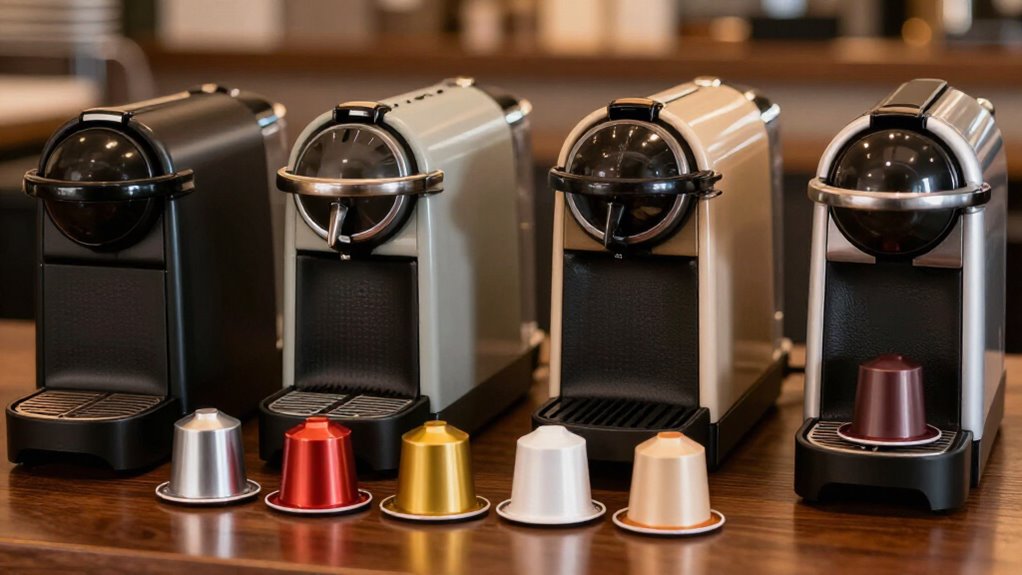
Match each pod to your machine’s brewing system before buying. Nespresso Original uses conical, non-barcoded capsules, puncture, and pressure extraction; Vertuo uses hemispherical, laser-barcoded capsules and centrifusion, so the formats cannot interchange.
Keurig K-Cups are pierced for drip-style brewing, while 44 mm ESE paper pods require an ESE-compatible brew group.
Check L’OR Classic versus XXL sizing, manufacturer charts, and model exceptions, including Lattissima Pro.
Unlisted brands require support confirmation; the glossary below clarifies key terms.
Check Original vs Vertuo
First, check whether your machine belongs to Nespresso’s Original or Vertuo line, because the capsule systems aren’t interchangeable. If the name says Vertuo Next, Vertuo Pop, or Vertuo Plus, choose Vertuo-compatible capsules. For Pixie, Essenza Mini, or Citiz, choose Original capsules.
Original capsules use a conical profile, flat aluminum base, and three-pin puncture pattern for pressure-based extraction. Vertuo capsules use a hemispherical profile, a laser-etched barcode, and barcode-locked centrifusion extraction. Their hardware and brewing processes differ fundamentally, so neither format can operate in the other line. Don’t force a capsule into the chamber: you risk failed brewing, leakage, or equipment damage.
Before ordering, read the machine label and confirm the capsule line on the product packaging. Brand names alone aren’t enough; the line designation determines fit and function.
Nespresso, Keurig, Vertuo Terms
Once you’ve identified whether your Nespresso machine uses OriginalLine or Vertuo capsules, distinguish those systems from Keurig’s K-Cup format. OriginalLine means a pressure-extracted espresso system using non-barcoded capsules and needle puncture. Vertuo uses barcode scanning and centrifusion to control extraction; Vertuo capsules won’t brew in OriginalLine machines. K-Cups use pierced cups for drip-style extraction, not Nespresso’s espresso process.
| Term | System | Compatibility cue |
|---|---|---|
| OriginalLine | Nespresso | Third-party capsules must state OriginalLine. |
| Vertuo | Nespresso | Barcode-dependent; use Vertuo-labeled capsules. |
| K-Cup | Keurig | Use pods explicitly marked K-Cup compatible. |
| Refillable insert | Select Keurig | Verify piercing and chamber compatibility first. |
Before buying, check your exact model, warranty terms, and authentication requirements. Third-party claims can vary, while incompatible capsules may leak, fail to puncture, or damage the brewer.
Review guidance before use.
Capsule Size & Shape Terms
You’ll compare capsule diameter and height standards first, since slim and wide formats fit different brew chambers. Next, you’ll distinguish dome, cone, and flat-base profiles across Nespresso Original, Vertuo, L’OR, and K-Cup designs.
You’ll also see why E.S.E.’s 44 mm, 10 mm-thick disc follows a separate sizing standard.
Capsule Diameter Terms
Capsule diameter terms describe a pod’s physical footprint and shape, not its flavor or strength, so the correct format must match your machine’s brewing chamber, seal, and piercing system. Systems use profiles, including Nespresso Original’s small conical capsule, flat aluminium base, and three-pin puncture layout. Vertuo capsules use a different hemispherical geometry, so they won’t fit Original machines.
Look for format cues such as “E.S.E. 44mm,” “Nespresso Original 3-pin conical,” “55mm,” or “38mm.” These labels identify a diameter-specific ecosystem, not a taste profile. L’OR Classic capsules suit Nespresso Original-compatible machines and L’OR BARISTA® systems, while larger L’OR XXL capsules work exclusively in L’OR BARISTA® brewers.
Before buying, match the diameter and shape to your exact model; a near match can prevent sealing, piercing, or extraction.
Capsule Height Standards
In pod systems, size standards define a capsule’s physical height, shape, and puncture architecture, not its flavor or strength, so the format must match the machine’s brewing chamber and sealing mechanism. For Nespresso Original machines, expect a small conical capsule with a flat aluminum base and three-pin puncture pattern that opens the seal at brew start. L’OR Classic capsules follow this smaller-format standard and work in L’OR BARISTA and Nespresso Original systems.
L’OR XXL capsules use a taller, larger format exclusively for L’OR BARISTA machines, matching larger cups and long drinks. Nespresso Vertuo capsules use a hemispherical, bowl-like form instead. Their barcode-locked centrifusion process replaces Original’s puncture-based flow, so you can’t interchange the formats. Check your model’s specified capsule standard before buying compatible products online.
Slim Versus Wide
Although “slim” and “wide” describe physical dimensions rather than flavor or strength, they determine whether a capsule will seat, seal, and puncture correctly. When you compare options, treat “slim” and “wide” as fit specifications, not serving-size promises.
In the Nespresso Original-compatible market, Classic-style capsules generally suit espresso-to-lungo brewing, while larger XXL formats target bigger cups and aren’t interchangeable across systems. Check the machine’s chamber, port, seal, and needle pattern before you buy; a capsule that’s too narrow may shift or miss the puncture points, while one that’s too wide may not close or seat fully.
“Compatible” on a third-party label doesn’t guarantee identical tolerances for every Original machine. Don’t assume a Vertuo capsule will substitute: Vertuo uses a separate form factor and barcode-based identification.
Dome And Cone
When you’re comparing capsule shapes, treat cone and dome as compatibility specifications rather than size or flavor labels.
Cone capsules typically follow the Nespresso OriginalLine format: their conical geometry fits a high-pressure system that punctures the capsule with three pins. This shape supports espresso-style extraction, but it isn’t compatible with Vertuo machines.
Check the machine’s model name and documentation, because “Nespresso-compatible” alone doesn’t identify the required line. Third-party products should state OriginalLine compatibility explicitly and match the chamber and piercing mechanism.
Dome capsules, often associated with Nespresso VertuoLine, use a hemispherical, bowl-like form factor. Vertuo brewers pair that geometry with barcode recognition and spinning centrifusion extraction, so a dome capsule won’t substitute for a cone capsule.
Before buying, verify the system, not the brand.
Flat Base Designs
Flat-base design usually refers to Nespresso Original capsules, which combine a flat aluminium base with a conical body and a three-pin puncture pattern. When you choose an Original-compatible capsule, match that geometry to the machine’s extraction chamber: the pins must contact the base correctly for reliable brewing.
OriginalLine capsules target high-pressure espresso systems, and third-party listings should state OriginalLine explicitly.
Don’t confuse this format with Vertuo capsules, which use a hemispherical, bowl-like body, centrifusion, and a laser-etched barcode. K-Cup pods use a plastic bucket form with an internal paper filter, so they aren’t flat-base capsules. E.S.E. products are hard, symmetrical 44-millimetre discs, not capsule-style bases.
Check machine and pod specifications; brand labels don’t establish compatibility, and geometry can cause piercing, leaks, or extraction.
Rim And Lip Profiles
Capsule compatibility depends on more than the flat base: the rim and lip profiles must also match the machine’s seating, sealing, and puncture points. Treat rim profile as the capsule’s outer edge shape. A conical shoulder, rolled rim, or bowl-like contour changes how the shell centers and seals in the brew chamber.
Your machine’s specifications may list capsule formats such as L’OR BARISTA XXL; these terms can describe geometry and volume, not simply serving size.
Hard-shell capsules use precision-engineered walls and hermetic seals. If the lip sits too high or low, the brewer may miss its puncture area, causing leaks, weak flow, or under-extraction. Check your machine’s model list and compare rim diameter and shoulder profile before purchase or reuse to confirm fit precisely.
Original Versus Vertuo
Although both systems use Nespresso branding, Original and Vertuo capsules differ fundamentally in size, shape, and extraction design. Original capsules are small, conical forms with a flat aluminium base. Your Original machine punctures these capsules at points and uses 19-bar, high-pressure extraction.
Vertuo capsules have a hemispherical, bowl-like profile and carry a laser-etched barcode. Your Vertuo machine reads that code, then spins the capsule using centrifusion rather than relying on the Original piercing arrangement.
Don’t treat the labels as interchangeable: an Original capsule won’t operate correctly in a Vertuo brewer, and a Vertuo capsule won’t fit or brew in an Original system. When you shop, match the capsule’s system label and physical form to your machine. The conical-versus-hemispherical distinction signals the compatible brewing architecture.
XXL Capsule Dimensions
When you see “XXL” on a capsule, treat it as a larger, long-drink format designed for the L’OR BARISTA® system, not for Nespresso® Original machines. The label signals greater capsule volume than Classic, which generally occupies the small-to-medium category. XXL consequently targets larger cups and longer coffees, rather than compact espresso shots.
Although it follows the hard-capsule framework used by L’OR capsules, its shape and dimensions optimize extraction inside BARISTA® brewers.
Don’t assume a visual resemblance guarantees fit: XXL geometry remains system-dependent. If you’re shopping for an XXL-style drink, choose an XXL capsule only when your machine is L’OR BARISTA®. A Nespresso® Original brewer requires OriginalLine capsules, not this larger format. Check the machine model and packaging compatibility statement before brewing to avoid leaks.
ESE Pods vs Capsules
You’ll find E.S.E. pods as 44 mm paper-filter discs, while Nespresso, Keurig, and Dolce Gusto use rigid plastic or aluminium capsules. Match the format to your machine’s holder, piercing system, or barcode-controlled brewer, because incompatible hardware can prevent brewing and compromise extraction.
You’ll also compare dose consistency, storage protection, and end-of-life options, since paper E.S.E. pods may offer simpler composting than many capsules.
Structure And Materials
E.S.E. pods are hard, approximately 44 mm paper discs with a small removal tab, whereas Nespresso Original capsules are hermetically sealed aluminium or high-density plastic containers engineered for high-pressure extraction.
That structure keeps the coffee in a breathable filter-paper matrix, rather than a rigid chamber. With a hard capsule, you’ll rely on an intact lid and sealed body until the brewer punctures the seal; water can then enter under pressure of up to approximately 19 bars, emulsifying coffee oils and supporting crema.
Brewing System Compatibility
Because E.S.E. pods are 44 mm paper discs designed for dedicated E.S.E.-compatible brew groups, they won’t work reliably in capsule systems such as Nespresso Original, Nespresso Vertuo, or Keurig K-Cup machines. E.S.E. pods use paper discs with a removal tab and sit in a compatible portafilter or holder; they don’t enter a capsule chamber or engage capsule puncturing hardware.
Nespresso OriginalLine capsules fit only OriginalLine machines, while barcode-reading Vertuo capsules fit only Vertuo brewers. K-Cup pods match Keurig chambers, although third-party dimensions, seals, and piercing performance can vary.
Before buying, check your exact model and its stated ecosystem: E.S.E., Nespresso OriginalLine, Nespresso Vertuo, Keurig K-Cup, or Dolce Gusto. A brand name alone isn’t enough; match format to chamber and mechanism.
Flavor And Extraction
For flavor, 44 mm E.S.E. pods use a hard, symmetrical paper disc that an E.S.E.-compatible machine brews through with a gentler, flow-based extraction. You’ll typically taste cleaner, drip- or pour-over-like notes, because the format depends on controlled water flow rather than capsule piercing and intense pressure.
E.S.E. pods suit a single espresso-style serving, but they won’t deliver the thick, oil-emulsified crema associated with hard capsules.
Storage And Sustainability
Once you’ve considered extraction, storage becomes the next distinction between formats. E.S.E. pods use a hard, approximately 10 mm, 44 mm paper disc with a small removal tab, rather than a sealed capsule shell. Because paper offers less oxygen protection than hermetically sealed aluminium or high-density plastic, store E.S.E. pods cool, dry, and away from light, and follow the package date.
Capsules, including many Nespresso Original-style products, can preserve freshness for up to about 12 months when oxygen-sealed.
Sustainability depends on recycling. Paper E.S.E. and soft pods can use compostable filter paper, while plastic or aluminium capsules need take-back routes. Compostable capsules may require industrial facilities.
Don’t assume compatibility: an E.S.E. pod won’t fit Nespresso Original or Vertuo machines. Verify compatibility first before purchase.
LOR BARISTA Capsule Examples
When you choose capsules for a L’OR BARISTA® machine, you’ll need to distinguish between the two L’OR formats: Classic capsules support smaller espresso, ristretto, and lungo-style drinks and work with both L’OR BARISTA® and Nespresso® Original machines, while XXL capsules fit only the BARISTA® system and target larger coffees and long drinks.
Choose Classic when you want a conventional single-cup espresso profile, ristretto intensity, or a longer lungo from either compatible platform. Choose XXL when your BARISTA® machine must deliver a larger coffee or extended long drink.
The formats aren’t interchangeable in purpose: Classic emphasizes compact servings and broader machine flexibility, whereas XXL expands volume within the BARISTA® system. Before brewing, identify the capsule label and match the intended beverage size to its format.
Check Manufacturer Compatibility Charts
Start with the manufacturer’s compatibility chart and match your exact machine name to the listed capsule format. Don’t rely on brand-only wording: charts separate Nespresso Original systems from Vertuo systems and identify compatible or excluded models.
Review the L’OR chart: L’OR Classic supports L’OR BARISTA® and Nespresso® Original systems, whereas L’OR XXL is exclusive to L’OR BARISTA®.
For Nespresso-related charts, confirm whether the listed machine accepts Original capsules or Vertuo capsules; these formats aren’t interchangeable. Use the chart’s exact compatibility table, not a similar product name, because some third-party capsules won’t work in Lattissima Pro or Vertuo lines.
If your model isn’t listed, check the manufacturer’s FAQ or contact support before purchasing. Ask about capsule fit, extraction requirements, warranty limits, and any authentication restrictions.
Decode Machine Model Numbers
To decode a machine model number, match it to the pod system assigned to that exact brand line, not merely to the manufacturer. Read the model family, suffixes, and capsule designation together; a familiar brand name doesn’t guarantee a shared format. Use these checks:
- Nespresso: “Original” identifies the conical capsule, flat aluminium base, and three-pin puncture format; “Vertuo” requires barcode-scanned Vertuo capsules.
- L’OR BARISTA® accepts L’OR XXL only; Classic capsules serve Classic-compatible systems, including Nespresso® Original machines.
- Match a listed model exactly; an absent number means unknown compatibility, not assumed cross-fit.
- Treat Vertuo machines and their centrifusion system as incompatible with non-Vertuo capsules.
- Check exceptions: third-party capsules may exclude models such as Nespresso Lattissima Pro.
If unlisted, verify compatibility with brand support before you purchase.
Conclusion
Before you buy coffee pods, confirm your machine’s platform, not just its brand. Nespresso Original and Vertuo capsules aren’t interchangeable, while Keurig K-Cup pods, ESE paper pods, and LOR BARISTA capsules follow different specifications.
Match the pod’s size, shape, barcode, or rim design to your model number, then verify the manufacturer’s compatibility chart. If details conflict, don’t guess: choose the machine-approved format to protect extraction quality and fit, maintain warranty coverage, and preserve longevity overall.