
Cold Brew Concentrate Dilution Guide
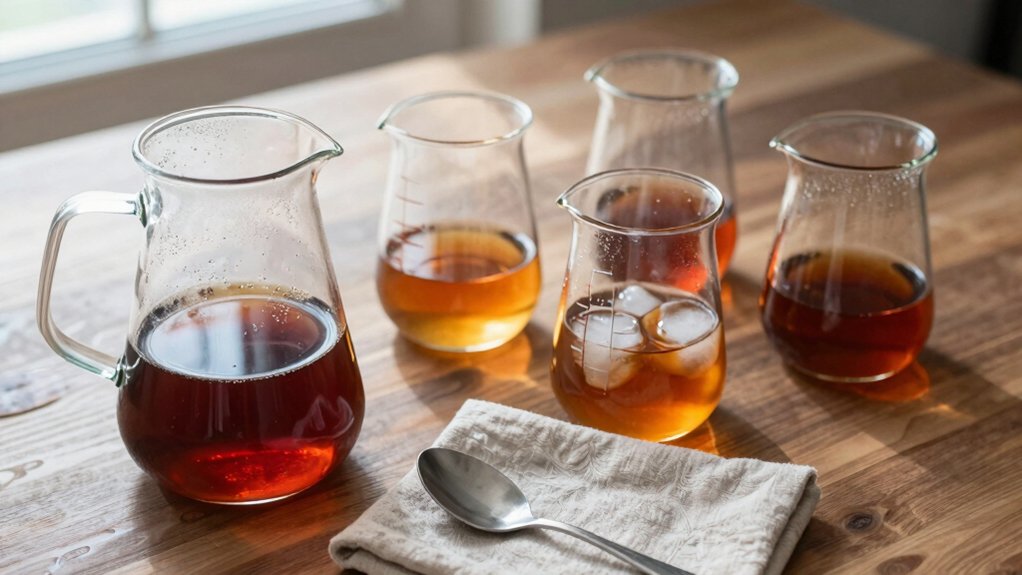
Use weight-based dilutions to control strength and mouthfeel: 1:4 for heavy dilution (cocktails, milk), 1:8 as a versatile standard, 1:12 for near ready-to-drink, and 1:16 for straight serve. Account for 20–30% ice melt in iced pours.
Equilibrate concentrate to 20–22°C for 30–45 minutes. Weigh components and log batch ID, temps and sensory notes. Adjust milk ratios by type and document sweetener additions. Continue for precise milk and stability guidance.
Quick Overview
- Use 1:8 concentrate-to-water as a versatile starting point; adjust to 1:4–1:16 for stronger or weaker preferences.
- For iced drinks, account for 20–30% ice melt by reducing initial dilution or water volume accordingly.
- Equilibrate concentrate to 20–22°C for 30–45 minutes and weigh ingredients to reproduce consistent dilution.
- Adjust dairy: Whole milk starts 1:1 (or 1:2 for lighter); non-dairy often needs a stronger concentrate (10–25% increase).
- Log batch ratio, milk type, ice melt, temperatures, and sensory notes. Run two blind trials to finalize recipes.
Concentrate-To-Water Ratios Chart
How concentrated do you want your cold brew concentrate to be? You’ll choose a brew ratio by weight (coffee:water) to target strength: 1:4 for very concentrated, 1:5 to 1:6 for strong, 1:7 to 1:8 for moderate, and 1:11 or more for ready-to-drink. Use a scale; parts can be ounces or grams.
Account for ice melt (approximately 20 to 30 percent) when planning dilution. Ignore any irrelevant topic or unrelated concept that doesn’t affect weight, grind, or dilution.
| Ratio (coffee:water) | Use case |
|---|---|
| 1:4 | Heavy dilution: cocktails, milk |
| 1:8 | Standard concentrate: versatile |
| 1:12 | Ready-to-drink: minimal dilution |
| 1:16 | Smooth straight serve |
Room-Temperature Serving Checklist
Want your cold brew served at room temperature with consistent taste? You’ll use an empirical serving checklist to standardize concentration and dilution. Verify concentrate temperature, ambient room temperature, and equilibration time before mixing. Measure concentrate and water by weight or volume; record values. Check pH and total dissolved solids if available to confirm consistency.
- Confirm room temperature target (20–22°C). Equilibrate concentrate to that range for 30–45 minutes.
- Weigh concentrate and water to the planned dilution ratio. Document mass and batch ID.
- Sensory spot-check after 5 minutes; adjust small water increments (±5%) and log changes.
Follow this serving checklist to reproduce flavor accurately across servings and shifts.
Adjust for Milk Type
When you choose a milk, adjust dilution to account for fat, sweetness, and viscosity. Whole milk mutes acidity and can handle higher dilution; try 1:2 concentrate-to-milk. Almond milk’s thin body often requires less dilution or added sweetener to preserve mouthfeel.
Oat milk’s natural sweetness and thickness lets you increase dilution: 1:3–1:4 without losing body. Soy milk’s protein stabilizes crema and accepts similar ratios to whole milk with minor sweetening. For non-dairy sweetening, quantify added sugars or syrups and reduce concentrate slightly (≈10–15%) to maintain target strength.
Whole Milk Ratios
Several common whole-milk dilutions work well with cold brew concentrate: start with a 1:1 concentrate-to-whole-milk mix for a balanced, creamy cup. Use 1:2 for a lighter, milk-forward latte; or 2:1 for a bolder, milk-rich drink. You should target cold milk balance by measuring temperature and fat percentage: whole milk at 36–40°F preserves emulsion and perceived sweetness.
Use 1:1 for standard strength, 1:2 when prioritizing mouthfeel over caffeine, and 2:1 when you need intensity without extra concentrate. Stir gently to avoid aeration that creates chunky milk texture. Adjust for ice melt by reducing initial milk volume ~10–15% for iced servings. Record ratios and sensory notes to reproduce preferred outcomes.
Almond Milk Adjustments
Moving from whole milk, you’ll need to adjust for almond milk‘s lower fat, different protein structure, and colder serving temperature to preserve stability and mouthfeel. You should increase the concentrate-to-milk ratio slightly; shift toward 1:1 or 2:1 from typical whole-milk 1:2 to compensate for a thinner body. Measure by weight when possible and record results.
Add 5–10% more concentrate if almond milk tastes diluted. Consider small emulsifiers (lecithin 0.1–0.3%) or a brief high-shear mix to improve suspension. Test shelf stability for 24–48 hours.
For sweetness control, quantify almond milk sweetness and reduce added syrups accordingly. A 10–15% decrease in sweetener often matches perceived balance. Log adjustments for reproducibility.
Oat Milk Considerations
Why choose a different concentrate ratio with oat milk? You should because oat milk texture increases perceived body and can mute acidity. Therefore, you need less concentrate to achieve a balanced mouthfeel.
Empirically, start at a 1:1 concentrate-to-oat-milk baseline for a standard cafe-style beverage. Then, reduce concentrate by 10–25% if the oat milk is high-viscosity.
Measure sweetness objectively: oat milk sweetness varies by brand and will amplify perceived sweetness of the concentrate. If sweetness exceeds target, lower concentrate strength (move toward 1:2) or choose unsweetened oat milk.
Account for ice melt: thicker oat milk delays dilution. Therefore, sample after 3–5 minutes. Record grams or ounces for each trial to reproduce preferred ratios consistently.
Soy Milk Balancing
How should you adjust your concentrate when using soy milk? Measure soy milk’s higher protein and moderate fat relative to other non-dairy milks. Then reduce concentrate-to-milk ratio incrementally.
Start at a 1:1 dilution and test a 1:2 (one part concentrate to two parts soy milk) to observe mouthfeel and perceived bitterness. Record sensory data: sweetness, body, crema loss, and acidity. Soy milk’s protein enhances perceived non-dairy sweetness and can mute acidity. You may need a slightly stronger concentrate; increase concentrate by 10–20% to restore flavor balance.
Adjust for ice melt by reducing added liquid. Standardize your preferred ratio after two blind trials. Then document exact parts for reproducible results across batches.
Non-Dairy Sweetening
After adjusting concentrate for soy milk’s protein and fat profile, you’ll next calibrate sweetening to match each non-dairy’s sweetening impact and mouthfeel. Measure perceived sweetness of almond, oat, coconut, and pea milks against a water baseline using a refractometer or standardized tasting panel.
Quantify added sweetener (g sucrose or equivalent) per 100 ml of final beverage to achieve target non-dairy sweetness. Adjust for oat’s higher body by reducing sweetener 10–15%. For coconut’s aromatics, increase 5–10% to maintain flavor balance. For pea and almond, start at baseline and tweak ±5% based on bitterness suppression.
Document concentrate dilution ratio, milk type, ice melt, and grams sweetener to reproduce consistent sensory outcomes across batches.
Frequently Asked Questions
How Long Does Concentrate Stay Fresh in the Fridge?
You can expect concentrate to stay fresh in the fridge for about 7–14 days. Freshness lifespan typically peaks in the first week. Store it in an airtight container at 4°C (39°F) or lower. Label with brew date, and avoid cross-contamination.
Sensory checks (smell, taste, appearance) will detect spoilage sooner than guidelines. If you see off-odors, turbidity, or sourness, discard immediately to avoid health risks.
Can I Freeze Cold Brew Concentrate?
Yes, you can freeze cold brew concentrate. For freezing safety, cool it fully, transfer to airtight, freezer-safe containers, leaving headspace for expansion, and label with date.
Freeze in portions for easier thawing. Thawed concentrate stores refrigerated for approximately 3–5 days; do not refreeze.
For concentrate storage, expect minor flavor loss and slight texture changes. Empirical tests show best quality within one month frozen; however, it remains microbiologically safe longer.
Does Concentrate Work in Hot Coffee Recipes?
Yes, you can use concentrate in hot recipes, but mind concentration vs flavor and caffeine potency. Heat dilutes perceived acidity and increases extraction of soluble oils. Therefore, dilute the concentrate more than for iced drinks to avoid overpowering bitterness and caffeine.
Experiment with 1:2–1:4 concentrate-to-hot-water ratios. Measure caffeine potency empirically, and adjust brew strength and serving volume to achieve target flavor, body, and stimulant level consistently.
How Do I Calculate Concentrate for Cocktails?
Use calibration ratios and dilution math: Decide cocktail strength, then calculate concentrate volume = desired total beverage × (concentrate fraction).
For a 1:4 brewing concentrate used at 1:10 dilution, concentrate fraction = 1/(1+9)=0.10. So for a 6 oz cocktail you’d add 0.6 oz concentrate and 5.4 oz mixers/ice (adjust for ice melt).
Record calibration ratios and repeat measurements for consistency.
Are There Any Safety Concerns With Reheating Concentrate?
Yes, you can reheat concentrate, but follow safety reheating and storage reheating safety protocols. Reheat only once, to under 75°C (167°F) for immediate use. Avoid prolonged high heat that degrades flavor and increases microbial risk.
Cool rapidly and store at ≤4°C within two hours. Discard after 48–72 hours. Use clean containers, avoid repeated reheating cycles, and label batches with date/time to maintain empirical control and traceability.
Conclusion
Use the concentrate-to-water ratios as your baseline; then validate by measuring total dissolved solids (TDS) if you want repeatable extraction strength.
For room-temperature service, factor in dilution and mouthfeel before chilling. When adding milk, account for fat and suspended solids: whole milk requires less concentrate. Almond and oat need slightly higher ratios to maintain perceived strength; soy sits intermediate.
Adjust sweeteners empirically: dissolve and taste until the beverage meets your target sensory and TDS specifications.