Coffee Equipment Maintenance Schedule Template
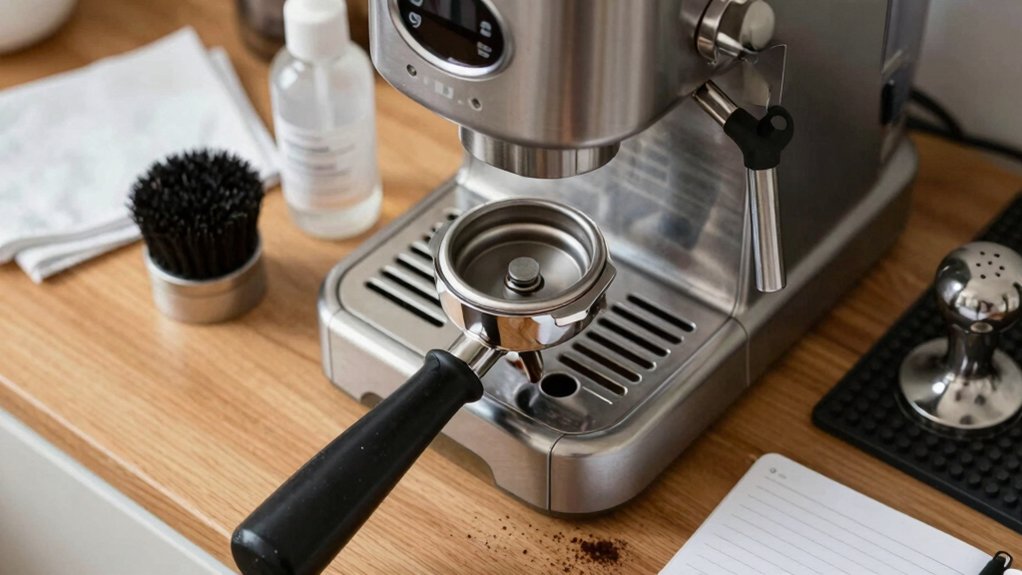
You’ll use a concise maintenance schedule template that sets daily cleaning tasks (backflush, steam-wand purge, portafilter and basket wash). It includes shift-by-shift group-head pressure checks with logged gauge readings. Additionally, it incorporates descaling intervals tied to measured water hardness. Document technician initials, corrective actions, and deviations.
Match descaling frequency to hardness (soft/moderate/hard) and choose descaler by boiler alloy. Follow a stepwise isolate, circulate, flush procedure and post-service inspection. You’ll find detailed procedures and checklists next.
Quick Overview
- Include daily tasks (backflush group heads, purge/wipe steam wand, clean portafilters and baskets) with operator initials and times.
- Log shift-by-shift group head pressure checks with calibrated gauge; record static/extraction pressures and corrective actions.
- Schedule boiler descaling using a hardness-based matrix (soft/moderate/hard) and adjust for high-volume machines.
- Record water hardness readings, filtration/treatment type, and trigger earlier descaling when hot-side indicators appear.
- Specify descaler chemistry, dilution, stepwise isolation/circulation/drain/flush procedure, and post-service verification steps.
Daily Machine Cleaning Chart
A concise daily cleaning chart keeps machines reliable and sanitary: follow the listed tasks each shift, record completion, and address exceptions immediately. You’ll implement a maintenance philosophy that prioritizes routine backflushes, steam-wand purges, portafilter rinses, and drip-tray emptying. Use cleanliness metrics (completion time, residue level) to verify effectiveness and note deviations.
| Task | Frequency |
|---|---|
| Backflush group heads | Daily (water; detergent end-of-day) |
| Purge/wipe steam wand | After each use + daily soak |
| Clean portafilters & baskets | Daily |
Log technician initials, time, and any exceptions (hard-water buildup, clogged wand). Inspect dispersion screens daily and schedule extra cleaning when metrics exceed thresholds. Keep records concise for audits and trend analysis.
Group Head Pressure Limits
Having a clear daily cleaning routine helps preserve extraction consistency. Monitoring group head pressure is the next step to ensure shot quality and equipment health. You should verify group head pressure against manufacturer pressure limits each shift, using a calibrated gauge. Record static and extraction pressures, note deviations, and correlate with shot yields.
If pressures drift high or low, inspect the boiler feed, pump regulation, and possible scale buildup; these issues can precede required descaling. Adjust PID or pressurestat settings only after confirming mechanical causes. Use a checklist to document corrective actions and personnel responsible.
- Measure static pressure at idle and extraction pressure under load.
- Compare readings to manufacturer pressure limits; log anomalies.
- Inspect boiler feed, fittings, and initiate descaling protocol if scale suspected.
Boiler Descaling Interval
You should schedule boiler descaling based on recommended frequency adjusted for measured water hardness, and document each service. Choose an appropriate descaling solution, follow a strict step-by-step procedure for safe chemical circulation and rinsing, and then perform a post-descale inspection of heating elements, seals, and sensors.
Record the solution used, concentrations, contact time, and inspection findings to inform future intervals.
Recommended Descaling Frequency
Because mineral buildup reduces heat transfer and impairs pump performance, you should follow a scheduled descaling interval based on water hardness, machine usage, and manufacturer guidance. Establish a descale frequency matrix: soft water (120 ppm) = monthly.
For high-volume commercial machines, increase frequency by 25–50% relative to domestic schedules. Log each descaling event, product used, concentration, contact time, and technician.
Verify post-descale conductivity and inspect heating elements and seals for scale remnants. If pressure, temperature, or flow anomalies recur within one cycle, shorten the interval and investigate filtration.
Always conform to manufacturer limits for descaling agents and procedures to avoid warranty voidance and component damage.
Water Hardness Assessment
How hard is your water, and how will that determine boiler descaling intervals? You should measure water hardness in grains per gallon (gpg) or ppm using test strips or a titration kit. Establish baseline hardness at intake and after any filtration.
Correlate hardness to descaling frequency: gpg (soft) — inspect quarterly; 3–7 gpg (moderate) — schedule descaling monthly; >7 gpg (hard) — descaling every 2–4 weeks. Record hardness values, treatment type, and dates in your maintenance log.
Monitor hot-side sampling for early signs of mineral buildup: reduced flow, longer heat-up, or scale flakes. If indicators appear earlier than scheduled, advance descaling. Adjust intervals when you change filters, water sources, or notice trending increases in water hardness.
Descaling Solution Selection
Which descaling chemistry fits your boiler system and water profile depends on material compatibility, scale composition, and concentration control. You’ll select a descaling solution based on boiler alloy (stainless steel, copper, brass), phosphate or carbonate scale prevalence, and measured water hardness.
Use acidic formulations (citric, lactic, sulfamic) for calcium carbonate. Choose inhibited acid blends for mixed-metal systems to limit corrosion. Verify manufacturer compatibility and required dilution to maintain safe ppm and contact time.
For high water hardness, increase frequency and use stronger chelants per spec. For softened or low-hardness supply, use milder agents. Always monitor pH, temperature, and flow during treatment. Document batch concentrations and total dissolved solids before returning the machine to service.
Step-By-Step Procedure
Now that you’ve selected a descaling chemistry compatible with your boiler materials and water profile, follow a strict, step-by-step procedure to perform the descaling safely and effectively.
Isolate power and water, drain the boiler, and consult the machine schematic. Mix descaler at manufacturer concentration, fill the boiler to the service level, and run controlled heat cycles per spec.
Circulate the solution through steam and hot-water circuits for the prescribed dwell time; monitor temperature and pressure. Drain and flush repeatedly until neutral pH is confirmed.
Refill with treated water, purge air, and return the machine to service. Record every action, measurements, and parts used in Maintenance logs. Update Spare parts inventory for any seals, gaskets, or sensors replaced.
Post-Descale Inspection
What should you inspect immediately after a descaling cycle to confirm boiler integrity and readiness for service? You verify pressure stability, visual condition, and control responses in a strict sequence.
First, confirm no leaks at fittings, welds, or sight glasses; any seepage indicates maintenance misalignment or seal failure. Second, monitor pressure rise and drop against manufacturer setpoints for five consecutive cycles to validate safety valves and pressure sensors.
Third, test heating element resistance and thermostat calibration with a multimeter and calibrated thermometer. Fourth, flush and sample output water for residual descaler; chemical traces require repeat rinse.
Fifth, inspect internal surfaces via sight port for pitting or corrosion. Document findings; label units “Subtopic irrelevant” only if unrelated records are encountered.
Frequently Asked Questions
How Do I Document Service History and Parts Replaced?
You document service history and parts replaced by keeping a centralized log where you record dates, technician, serial numbers, work performed, and parts swapped, using consistent codes and timestamps.
Use digital forms or CMMS to enable tracking parts, quantities, costs, and warranty details. Attach invoices and photos.
Back up records, generate regular reports, and audit entries monthly to ensure accuracy and compliance with maintenance protocols and manufacturer requirements.
Can I Use Third-Party Water Filters Safely?
Yes, you can use third-party filters if you follow safety considerations precisely. You’ll verify compatibility with your machine, confirm micron ratings and flow rates, and check materials for NSF/ANSI certifications. You’ll replace cartridges on schedule and monitor water chemistry.
You’ll log filter changes and inspect for leaks, pressure drops, and microbial growth. If performance deviates, you’ll revert to manufacturer-approved filters and document corrective actions.
What Qualifications Should a Service Technician Have?
You need a qualified technician with formal service certification, hands-on espresso equipment experience, and plumbing or electrical competence. They should hold manufacturer-specific service certification, HVAC or refrigeration credentials for condensers and boilers, and documented training in safety procedures.
Verify they will use calibrated tools, follow diagnostic protocols, keep maintenance logs, and carry liability insurance. Prefer technicians with 3 to 5 years of field service, OEM parts access, and clear references for commercial machine work.
How Do I Track Maintenance Costs and ROI?
Track maintenance costs by logging labor, parts replacement records, filter purchases, and third party filter safety checks. Additionally, include warranty implications in a centralized ledger. Use service history documentation and technician qualifications to validate entries.
Calculate ROI by comparing reduced downtime, repair avoidance, and extended equipment life to total spend over time. Include DIY repair considerations separately to assess risk-adjusted savings. Update projections regularly for accuracy.
Are There Warranty Implications for DIY Repairs?
Yes, DIY repairs can void warranty eligibility. You’ll assume DIY risk when you open sealed components, replace parts, or alter factory settings without manufacturer authorization.
Follow service manuals, use authorized parts, and get pre-approval for owner-performed maintenance to preserve coverage. Document procedures, serial numbers, and receipts. If unsure, contact the manufacturer or certified technician. That methodical approach minimizes disputes and protects remaining warranty rights.
Conclusion
You’ve got a clear, actionable maintenance plan that protects extraction quality and equipment lifespan. Follow daily cleaning, monitor group head pressure limits, and schedule boiler descaling based on water hardness.
Choose an appropriate descaler and stick to the step-by-step procedure. Then perform a post-descale inspection to confirm seals, heating efficiency, and pressure stability. Maintain documented intervals and water treatment records, and you’ll prevent scale buildup, reduce downtime, and ensure consistent espresso performance.